

More news on this day
Violent spring storms building over Central Texas on Friday brought fresh turbulence to the U.S. air travel system, with Austin-Bergstrom International Airport emerging as one of several hard-hit hubs where major airlines struggled to keep fast-moving weather and already fragile schedules from collapsing into widespread delays and cancellations.
Get the latest news straight to your inbox!
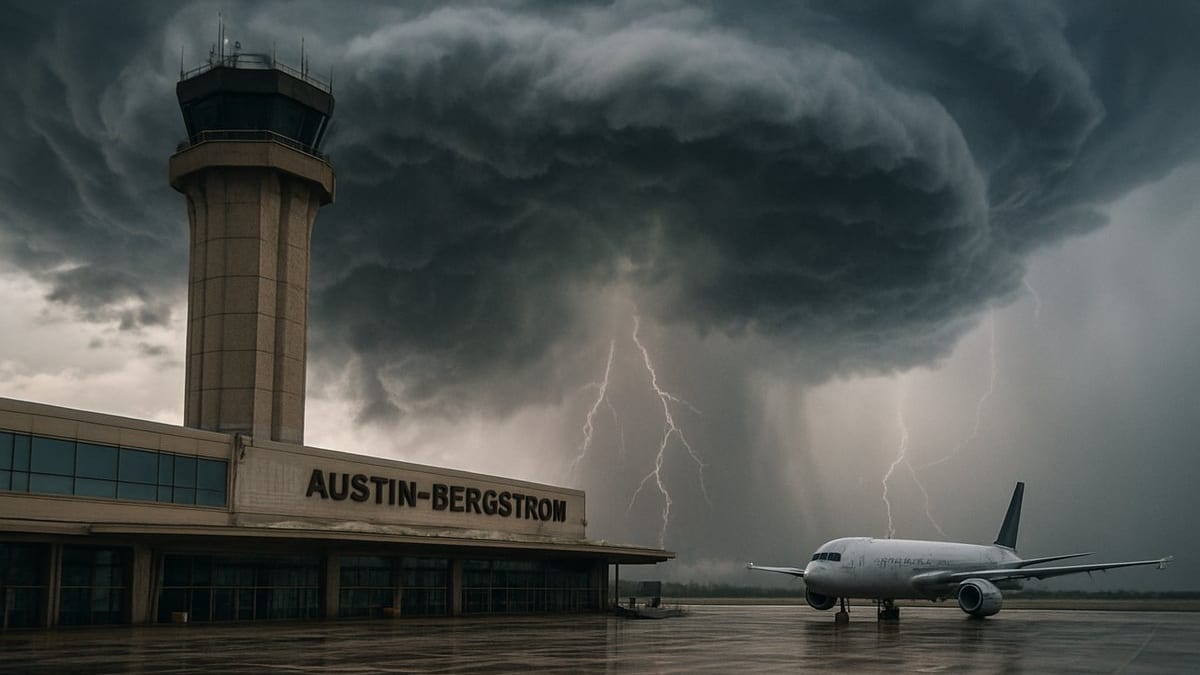
Supercharged Storms Converge on a Crowded Central Texas Hub
Publicly available radar and forecast discussions pointed to a corridor of strong to severe thunderstorms across West and Central Texas on April 3, with forecasters highlighting the risk of large hail, damaging wind gusts and rapidly deteriorating visibility along key flight paths into Austin. As cells intensified and moved east, they intersected some of the state’s busiest air corridors, constraining arrivals and departures at Austin-Bergstrom and neighboring hubs.
Flight-tracking dashboards for Friday showed a sharp uptick in delays and cancellations nationwide, with Austin listed among a cluster of airports experiencing mounting disruption. Data compiled by aviation analysts indicated that several hundred flights across the country were canceled by midday and thousands more delayed, with weather along a broad swath of the central United States cited as a primary driver.
Austin-Bergstrom entered the latest round of storms at a sensitive moment. The airport had just completed shifting Allegiant and Frontier operations from the now-closed South Terminal into the main Barbara Jordan Terminal at the start of April, consolidating all commercial traffic under one roof during a period of sustained passenger growth and ongoing construction.
Historic performance data for Austin already showed a pattern of mounting pressure, with previous years seeing more than one in five departures delayed during some spring travel periods. The combination of rapid demand growth, construction-related constraints and convective weather has repeatedly turned the airport into a bottleneck when storms roll through Central Texas.
Ground Stops, Reroutes and a Network on the Brink
As storms intensified over Central Texas, publicly accessible Federal Aviation Administration status boards indicated intermittent traffic-management programs for Austin-Bergstrom, including reduced arrival rates and holding patterns that forced inbound flights to circle or divert. At times, departures to Austin from other regions launched under average delays approaching or exceeding half an hour, with the potential for longer waits as thunderstorms pulsed over approach corridors.
Major network carriers and large domestic operators appeared prominently in the disruption tallies. American Airlines, Delta Air Lines, United Airlines and Southwest Airlines each reported clusters of delayed or canceled services touching Austin, with schedule data showing particular strain on intra-Texas and short-haul routes that depend on quick turns and tight crew rotations.
The timing of the Central Texas storms magnified their impact. Carriers are still working through the broader operational aftershocks of a difficult winter and early spring, when multiple large-scale weather events across North America forced aircraft and crews out of position. Industry-focused analyses in recent weeks have described airlines in a prolonged state of “recovery mode,” with thin staffing and high load factors leaving limited slack when another round of severe weather hits key nodes.
In that context, a localized super-storm complex over Austin and surrounding airspace behaved more like a systemwide shock. Delayed aircraft arriving from other hubs knocked subsequent departures off schedule, while crews bumped up against duty-time limits. Flights that did operate often left with every seat occupied, reducing options for travelers trying to rebook around the worst of the weather.
Passengers Face Long Lines, Tight Space and Limited Options
Inside Austin-Bergstrom, the combined effect of compressed operations and intense storms translated into crowded gate areas, extended customer-service queues and a scramble for scarce seats on later departures. Reports from recent disruption waves show that fully booked flights have become the norm on many domestic routes in early 2026, meaning a single cancellation can strand dozens of passengers for hours or longer.
Travel publications tracking the April 3 disruption wave urged passengers to lean heavily on airline mobile apps and third-party alert tools, which often reflect gate changes and rolling delays faster than overhead boards. For travelers making tight connections through Austin into other major hubs, those tools can be critical in deciding whether to push for a standby seat, reroute through a different city or abandon an itinerary before it fully unravels.
With construction reshaping parts of the terminal complex and consolidation moves still bedding in, the airport’s concessions and landside services also face additional stress when weather chokes flight operations. Industry observers have noted that hotel capacity near Austin’s airport can tighten quickly on storm-affected evenings, while rideshare pricing and rental-car availability fluctuate sharply as stranded travelers seek last-minute alternatives.
Consumer advocates continue to remind passengers that most weather-related disruptions fall outside standard U.S. airline compensation rules, limiting eligibility for vouchers or hotel coverage. Instead, the practical advice centers on flexibility and documentation: accepting earlier or later flights when offered, keeping receipts for out-of-pocket expenses and monitoring any special travel waivers carriers may post when severe weather targets a specific region.
Central Texas Weather Risks Collide With Ambitious Growth
The latest storm-driven turmoil at Austin-Bergstrom underscores a broader tension between Central Texas’s booming travel demand and the region’s exposure to volatile weather. Historical records for the Austin area document high-impact events from winter storms to tornado outbreaks and flash floods, each capable of turning a busy regional hub into a chokepoint for hours or days at a time.
Airport planning documents and recent city reports describe a long-term expansion strategy intended to more than double passenger capacity through a new concourse, expanded gate areas and a larger arrivals and departures hall. These projects are designed in part to relieve chronic congestion and provide more space and redundancy when irregular operations strike.
Yet the pace of passenger growth has outstripped infrastructure upgrades at many points over the last decade, leaving airlines, ground handlers and air-traffic personnel managing a high-throughput operation in facilities that were originally scaled for a smaller market. On days when supercharged storm systems sweep across Central Texas, that mismatch becomes readily apparent in the form of gate shortages, lengthy taxi queues and aircraft waiting on the ramp for safe departure windows.
Analysts following U.S. aviation performance caution that Austin’s experience on April 3 fits a familiar pattern. As climate variability produces more frequent and intense bouts of extreme weather, airports in fast-growing regions are likely to see more days when local storms trigger national ripple effects. Without surplus capacity in aircraft, crews and terminal infrastructure, even a few hours of violent weather over a single airport can leave a trail of missed connections stretching from coast to coast.
What Travelers Can Expect in the Coming Days
With forecasters flagging the possibility of additional thunderstorm development across parts of Texas into Friday night, operations at Austin-Bergstrom may take time to fully normalize. Past events suggest that residual delays can linger well after the last cells clear the radar screen, as airlines work through backlogs of displaced aircraft and passengers.
Travel experts advise anyone booked through Austin or other Central Texas airports over the weekend to treat schedules as provisional, building extra time into connections and considering earlier departures when available. Same-day rebooking options are often most plentiful for those who act quickly once the first round of delays appears on airline apps or flight-status boards.
For Austin-Bergstrom, the latest storm episode serves as another stress test of an airport in transition. As expansion projects advance and airlines continue to refine their schedules, the challenge will be to keep a fast-growing gateway resilient enough to ride out the next line of supercells that inevitably blossoms over Central Texas skies.