

More news on this day
Severe weather-linked disruption at New York’s John F. Kennedy International Airport on March 16 has cascaded across airline networks, leaving hundreds of travelers stranded or rerouted in major hubs including Boston, Los Angeles, Fort Lauderdale, Orlando, Toronto and other cities in the United States and Canada, after 328 flights were reported delayed and 267 canceled at JFK alone.
Get the latest news straight to your inbox!
Storm System Turns JFK into an Epicenter of Disruption
Publicly available tracking data on March 16 indicates that a powerful storm system moving along the U.S. East Coast forced airlines to dramatically scale back operations at John F. Kennedy International Airport, one of the nation’s busiest international gateways. The combination of high winds, low visibility and thunderstorms triggered widespread air-traffic management programs designed to slow arrivals and departures for safety reasons.
Operational data show that by late afternoon, 328 flights connected to JFK had been delayed and 267 canceled, a level of disruption that rivals some of the worst single-day weather events of recent years. The figures reflect not only flights to and from New York, but also the complex web of routes that pass through the airport, amplifying knock-on delays across North America.
Because JFK functions as a critical transatlantic and transcontinental hub, any large-scale interruption there quickly reverberates through airline schedules. Aircraft and crews scheduled to continue on to other destinations were left out of position, pushing delays into the evening and prompting some carriers to scrub later departures preemptively rather than risk extended tarmac holds and overnight strandings.
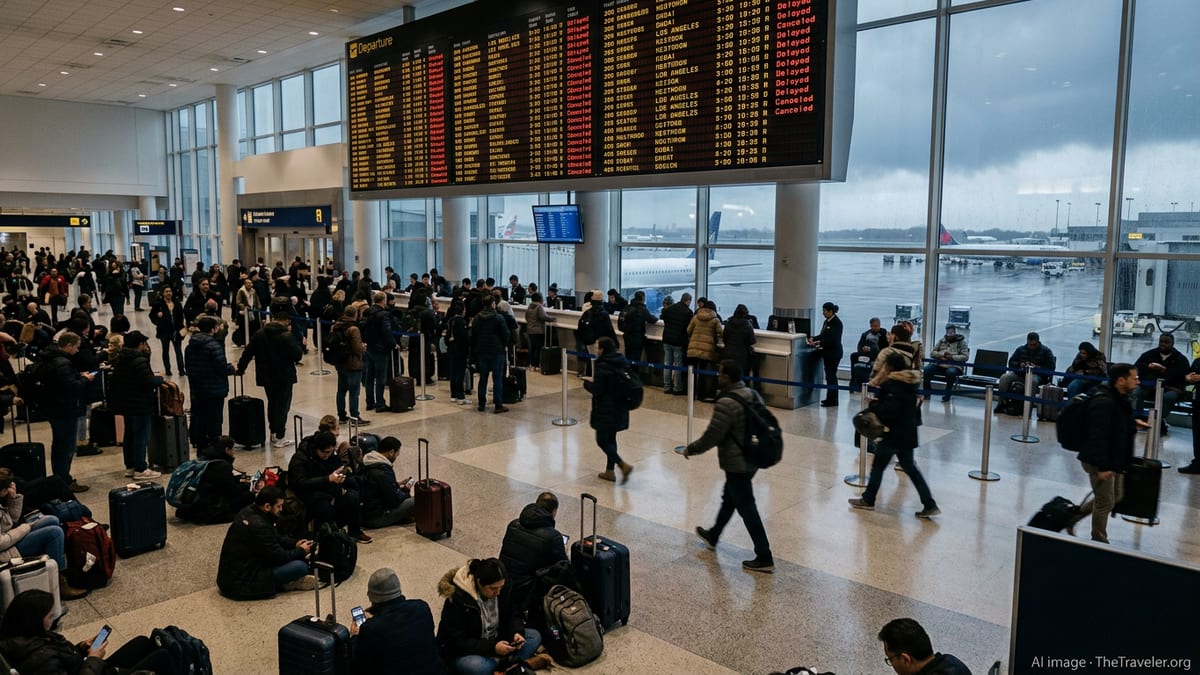
Airport operations updates and aviation tracking platforms depicted crowded terminals, backed-up departure boards and long lines at service desks as travelers sought alternative routings, hotel vouchers or new departure dates. For many passengers, the immediate impact was missed connections and abandoned itineraries; for airlines, it was another costly weather-driven shock during an already challenging winter.
Ripple Effects Hit Major U.S. and Canadian Hubs
The disruption at JFK did not remain local. Because many of the delayed and canceled services were part of multi-leg journeys, the shock quickly spread to other key airports across the United States and Canada. Flights linking New York with Boston, Los Angeles, Fort Lauderdale, Orlando and Toronto were heavily affected, creating pockets of congestion and operational strain far from the original storm track.
Published coverage and live tracking data showed clusters of delayed arrivals into Boston and Orlando, particularly on routes that depended on aircraft originating from or passing through the New York area. In Toronto, where winter weather had already stretched airport and airline resources in recent weeks, the fresh wave of schedule changes further complicated efforts to keep operations stable.
Western gateways, including Los Angeles, also felt the impact, even in relatively calm local weather. Long-haul services to and from New York are often timed to feed international departures or red-eye rotations; once those aircraft and crews were held or canceled at JFK, gaps opened up in schedules hours later and thousands of kilometers away. Some transcontinental flights departed significantly late, while others disappeared from departure boards altogether.
Smaller U.S. and Canadian cities that rely on JFK for international connectivity faced an additional challenge. Regional flights meant to feed early evening transatlantic departures were among those delayed or canceled, leaving travelers in secondary markets with reduced options and, in some cases, unexpected overnight stays before they could be rebooked onto new itineraries.
Weather, Airspace Constraints and Airline Networks Combine
The day’s chaos at JFK illustrates how weather, airspace management and tightly wound airline networks can interact to magnify disruption. Reports on aviation performance consistently highlight that a majority of U.S. flight cancellations are linked to weather, and today’s storms fit that pattern. High winds and convective activity over the Northeast forced traffic managers to slow the rate at which aircraft could safely land and take off.
When arrival and departure rates are reduced, airlines must compress or reshuffle schedules, often triggering rolling delays throughout the day. Once a threshold is crossed, cancellations become a primary tool to prevent even more severe gridlock. That appears to have been the case at JFK, where the cancellation count rose steadily through the morning and early afternoon as forecasts confirmed that conditions would remain volatile.
Compounding the immediate weather effects are the structural realities of hub-and-spoke networks. Carriers depend on aircraft cycling through several cities each day, meaning a delay on an early-morning service into JFK can propagate across multiple routes. Operational analyses frequently show that once disruptions exceed a certain scale at a major hub, it can take a full day or more for schedules to normalize, even after skies clear.
While some airports have added infrastructure and technology to better handle bad-weather operations, the clustering of major hubs in a storm-prone corridor along the U.S. East Coast continues to present challenges. With New York, Boston, Washington and other major centers often affected by the same systems, there is limited capacity elsewhere to absorb diverted flights or reroute large numbers of passengers at short notice.
Travelers Confront Long Waits, Rebookings and Limited Options
For travelers, the large number of delays and cancellations translated into long hours in terminals and a scramble for alternatives. Airport display boards at JFK showed dense blocks of red and amber next to flights, indicating late departures, gate changes, or cancellations. Similar scenes were reported in connecting cities, where passengers on inbound flights from unaffected regions arrived to find their onward journeys disrupted by events in New York.
Publicly available guidance from airlines and regulators typically emphasizes that, during weather-related disruptions, customer options depend on the cause of the delay and the carrier’s policies. In many cases, travelers can be rebooked without change fees on later flights or different routings, but same-day alternatives may be scarce when a large share of the schedule is affected simultaneously, as occurred in this event.
Travel forums and social media posts from earlier winter storms suggest that passengers facing similar disruptions often resort to creative rerouting, including flying through less congested hubs, switching to rail for shorter segments, or booking separate tickets on other carriers when possible. However, such workarounds can be expensive and are not always feasible for families or those traveling on tightly constrained budgets.
Travel advisers generally recommend that, on days with widespread disruptions, passengers monitor flight status closely, keep airline apps updated, and respond quickly to rebooking offers. Yet even proactive planning has limits when hundreds of flights are simultaneously removed from the system. For many caught up in the JFK-related turmoil, the day became an exercise in patience rather than precision planning.
Broader Questions About Resilience in a Volatile Travel Season
The severe disruption centered on JFK arrives in the context of an already turbulent winter for air travel in North America. Recent storms have produced some of the highest single-day cancellation totals since the early stages of the pandemic, reigniting discussion about the resilience of airline operations and airport infrastructure in an era of increasingly volatile weather.
Aviation analysts note that while safety protocols have successfully reduced weather-related accidents, those same safeguards mean that airlines must be prepared to halt or sharply curtail flying when conditions deteriorate. At capacity-constrained hubs such as JFK, where airspace is crowded and runway configurations offer limited flexibility in strong crosswinds, there is little margin to maintain normal schedules in the face of rapid weather changes.
The events of March 16 highlight how even well-established contingency plans can be stretched when storms, peak travel demand and interconnected routes collide. As delays and cancellations spread across Boston, Los Angeles, Fort Lauderdale, Orlando, Toronto and other airports, the reliance on a few major hubs for both domestic and international connectivity became clear once again.
With the busy spring and summer travel seasons approaching, the latest disruption is likely to spur renewed attention on strategies to manage such shocks, from diversifying routings and adding slack to schedules to investing in systems that better anticipate how localized weather events at airports like JFK can cascade across continents.