

More news on this day
Severe winter weather across Western Europe has triggered significant flight disruption in the United Kingdom, France and the Netherlands, with reports indicating at least 37 operations cancelled and 16 flights deferred by Air France, British Airways and KLM, leaving thousands of passengers facing overnight delays and missed connections at major hubs in Paris, London and Amsterdam.
Get the latest news straight to your inbox!
Storm System Slams Key European Hubs
The latest storm system sweeping across northwest Europe has brought high winds, freezing rain and low visibility to some of the region’s busiest airports, including Paris Charles de Gaulle, London Heathrow and Amsterdam Schiphol. Publicly available airport and airline operations data show waves of schedule adjustments through the day, concentrated in short- and medium-haul routes linking the three hubs to the rest of Europe.
Operational summaries indicate that at least 37 flight operations involving Air France, British Airways and KLM have been cancelled, with an additional 16 flights deferred to later time slots or subsequent days as airlines work around crew duty limits and ground-handling constraints. The pattern mirrors previous winter disruption episodes in northwestern Europe, where strong crosswinds and icing risk frequently force runway capacity reductions and tighter spacing between arrivals and departures.
Travel industry monitoring suggests that the heaviest disruption is currently focused on intra-European services, particularly shuttle flights between Paris, London and Amsterdam and feeder services from regional airports in the UK, France and the Benelux countries. Long-haul operations have so far seen fewer outright cancellations but are experiencing knock-on delays as aircraft and crews are displaced by the earlier schedule changes.
Weather services and aviation tracking platforms indicate that wind gusts above safe crosswind limits, combined with intermittent snow and sleet, have periodically closed individual runways or reduced usable capacity at all three hubs. In these conditions, airlines typically consolidate traffic onto fewer flights, leading to clusters of cancellations in the middle of the day and late evening.
Impact on Air France, British Airways and KLM Networks
According to published disruption summaries and timetable changes, Air France has concentrated cancellations on regional European routes from Paris Charles de Gaulle and Orly, including services to UK regional airports and nearby continental cities. Short-haul rotations have been particularly vulnerable where a single missed early-morning sector can cascade into multiple cancellations later in the day.
British Airways has focused its response at London Heathrow and London City, where strong winds and low cloud have reduced arrival rates. Publicly visible schedule data show a cluster of short-haul cancellations to and from European capitals, alongside delays on selected transatlantic services whose departure slots have been retimed to fit into a constrained flow of traffic.
KLM, operating from Amsterdam Schiphol, has trimmed parts of its European network, especially frequent shuttle routes to neighboring countries. Operations tracking indicates a mix of outright cancellations and deferrals, with some flights shifted to larger aircraft to consolidate passengers from multiple scrapped departures.
Across all three networks, the 16 deferred flights reflect a strategy of postponing departures into less congested time windows once winds ease or runway conditions improve. While this can preserve some capacity, it frequently leads to missed connections for passengers relying on hub-and-spoke transfers, particularly those heading for long-haul evening banks from Paris, London and Amsterdam.
Scenes on the Ground in Paris, London and Amsterdam
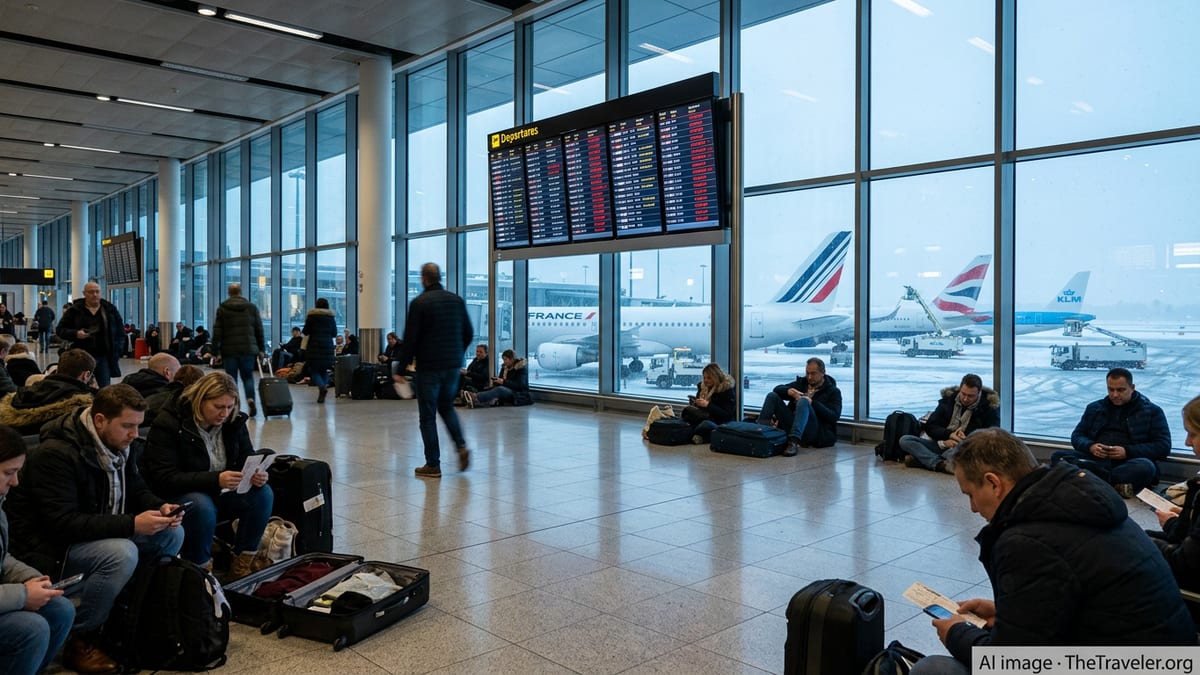
Travelers transiting Paris Charles de Gaulle, London Heathrow and Amsterdam Schiphol have faced long queues at check-in counters, transfer desks and customer service points as airlines work through rebooking backlogs. Images and descriptions circulating on social platforms show crowded departure halls, with passengers clustering around departure boards as rolling updates on cancellations and revised departure times are posted.
Reports from airport operators and media outlets describe additional pressure on accommodation and ground transport. With some evening flights removed from the schedule, passengers stranded overnight have been competing for limited hotel availability near the airports, while local train and bus services have also been affected by the same severe weather system.
At the hubs themselves, ground-handling operations have been slowed by safety restrictions on ramp staff working in high winds and icy conditions. De-icing procedures, which are mandatory in freezing precipitation, add to turnaround times and shrink the number of flights that can be processed in each hour, contributing to the decision to cancel or defer marginal services.
The cumulative effect has been a ripple of disruption that spreads beyond Paris, London and Amsterdam to secondary airports around Europe and on to long-haul destinations, as aircraft and crew are displaced from their planned rotations. Passengers booked on onward sectors in North America, Africa and Asia have reported extended layovers and involuntary overnight stays.
Altered Schedules and What Passengers Can Expect
Publicly available schedule information and airline travel advisories indicate that timetable changes are likely to continue into the next operating day, even if weather conditions improve. Once rotations are disrupted, it can take several cycles for airlines to reposition aircraft and crews and restore the planned pattern of flights, especially on dense shuttle routes and evening long-haul departures.
For the current disruption, Air France, British Airways and KLM have adjusted schedules primarily by thinning out frequencies on routes where multiple daily services operate. This allows carriers to maintain at least a skeleton service on key city pairs, while freeing up aircraft and crew capacity to protect long-haul operations and flights with high numbers of connecting passengers.
Passengers may see changes such as merged flights, equipment swaps to larger aircraft, or altered departure times that shift services into off-peak slots when air traffic control can accommodate more movements. In some cases, evening flights have been retimed to early morning the following day, which can significantly affect onward connections and hotel arrangements.
Published advisories also indicate that some inbound flights have been cancelled with aircraft left at outstations, a step that reduces congestion at the main hubs but may delay recovery on those routes. Travelers booked on these services are typically rerouted through alternative hubs or rebooked for travel one or more days later, depending on seat availability.
Passenger Options Under UK and EU Rules
Under UK and EU air passenger regulations, travelers affected by cancellations and long delays have specific entitlements, although compensation rules differ when the cause is severe weather. Public guidance on UK261 and EU261 frameworks explains that airlines must offer a choice between rerouting at the earliest opportunity, rerouting at a later convenient date, or a refund of the unused ticket in the event of a cancelled flight.
In circumstances where passengers are left waiting at the airport, carriers are expected to provide care and assistance, including meals and refreshments appropriate to the delay, and hotel accommodation and transport between the airport and hotel when an overnight stay becomes necessary. Weather-related disruption is generally considered an extraordinary circumstance, which limits cash compensation, but does not remove the obligation to provide practical support and rerouting or refunds.
Consumer information resources advise passengers to monitor their booking directly through airline apps or websites, where rebooking options are often displayed automatically when a flight is cancelled. Many airlines also permit self-service changes onto alternative departures where seats are available, which can be faster than waiting in airport queues for staff-assisted rebooking.
Travel experts recommend that passengers keep records of boarding passes, booking confirmations and receipts for necessary expenses during the disruption, as these documents may be required when submitting claims for reimbursement of meals, accommodation or transport. Those with onward connections on separate tickets are urged to contact all affected carriers as early as possible, as protections for missed connections can be more limited when itineraries are not on a single booking.