

More news on this day
Travelers flying between Japan, the United States and key domestic hubs are facing fresh disruption this week, as severe winter weather and knock-on operational issues force the cancellation of more than 30 flights, hitting routes to Newark, Boston, Osaka, Fukuoka and other major destinations and affecting airlines including AirAsia Japan, United Airlines, Japan Airlines and several regional carriers.
Storm Systems Link Japan Flight Woes to U.S. Northeast Disruption
The latest wave of cancellations comes in the wake of a powerful winter storm that has battered the U.S. Northeast since February 23, 2026, prompting thousands of flight cancellations and delays at major hubs including Boston and Newark. With transpacific schedules tightly interlinked, disruption on one side of the Pacific has quickly translated into equipment and crew imbalances on the other, putting additional strain on already busy Japan–U.S. corridors.
Airlines operating long-haul routes to and from Japan have been forced to trim frequencies and preemptively cancel select services to stabilize their networks. United Airlines, which operates a number of daily flights between Newark and Japanese gateways, is among carriers adjusting schedules as it recovers from days of severe weather disruption at its East Coast hubs.
Industry analysts say that while the majority of cancellations are still concentrated in North America, ripple effects are now clearly visible in Japan, where aircraft rotations, crew duty limits and missed connections are forcing airlines to consolidate flights, particularly on routes connecting Tokyo and Osaka with Newark and Boston.
Major Japanese Hubs See Cluster of Cancellations and Delays
Within Japan, operations at Tokyo, Osaka and Fukuoka remain under pressure following several days of weather-related delays and a cluster of cancellations across key domestic and regional airports. Data compiled over the latest 24-hour period show that more than 500 flights were delayed countrywide and over a dozen were outright canceled at hubs including Tokyo, Osaka, New Chitose, Kumamoto and Takamatsu, with additional cancellations now pushing the total above 30 when international services are included.
Japan Airlines and other full-service carriers have been working to rebook affected customers onto later departures from Tokyo’s Haneda and Narita airports, while low-cost operators such as AirAsia Japan and Peach Aviation have warned of tighter seat availability on popular routes into Osaka and Fukuoka as they consolidate services. The impact is especially acute on late-February business and leisure traffic, a period traditionally marked by strong demand on domestic trunk lines.
At Kansai and Itami airports serving Osaka, departures to Fukuoka, Sapporo and Okinawa have experienced rolling delays as airlines reposition aircraft and crews. While most flights are ultimately departing, schedule irregularity is leading to missed onward connections, particularly for travelers attempting to link domestic Japanese sectors with long-haul flights to North America.
AirAsia Japan, United and JAL Adjust Schedules on Key Routes
AirAsia Japan, which connects Japanese regional cities with East and Southeast Asia, has warned that a small number of services touching Japan may be canceled or retimed as severe weather systems and congestion across parts of Asia ripple into its network. Flights involving Fukuoka and Osaka are among those under close review, with the carrier advising passengers to monitor booking tools and airport departure boards for same-day changes.
United Airlines has continued to issue weather-related travel waivers on routes linked to Newark and Boston, including selected services that connect via Japanese hubs. While the airline has focused its largest cuts on North American sectors, some Japan-bound travelers are being re-accommodated via alternative gateways or on later operating days, effectively reducing available capacity on affected dates.
Japan Airlines, meanwhile, has signaled that it may implement further minor schedule adjustments as it balances aircraft utilization and recovery flying in the wake of recent domestic congestion. Customers have reported repeated time changes on some international itineraries, and the carrier is encouraging travelers to reconfirm departure times in the days leading up to travel, especially where connections through Tokyo or Osaka are involved.
Passengers Confront Long Queues, Rolling Rebookings and Limited Options
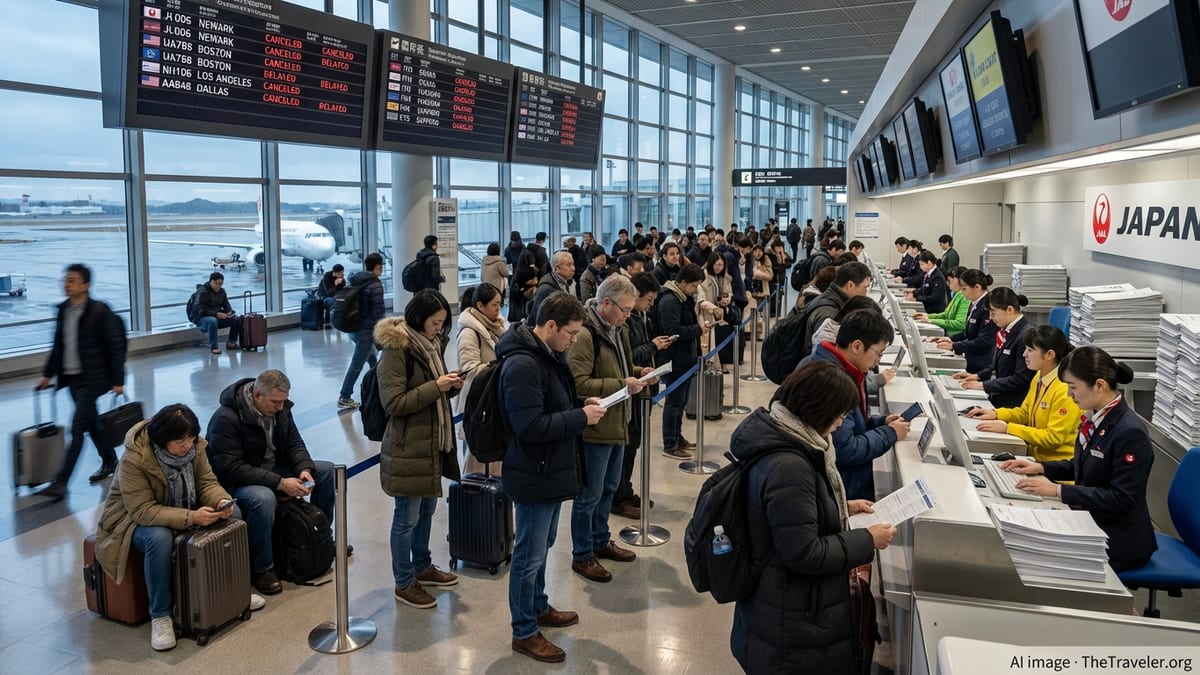
For passengers on the ground, the combined effect of storms in the United States and knock-on disruption in Japan has been crowded terminals, long queues at service counters and a noticeable squeeze on alternative flight options. At major Japanese hubs, travelers whose flights to or from Newark and Boston have been canceled are frequently being rerouted via West Coast gateways or rebooked onto services departing one or two days later.
Domestic travelers attempting to connect through Osaka or Fukuoka have encountered similar challenges, with some reporting multiple same-day schedule changes and tight connection windows as airlines shuffle aircraft. In some cases, passengers have been encouraged to voluntarily shift to later services or travel on less congested days to ease pressure on peak operations.
Travel advisors say the situation highlights the vulnerability of complex multi-leg itineraries that rely on punctual domestic segments feeding into long-haul departures. They are urging customers to build in longer connection times, especially when traveling through winter-weather-prone hubs like Boston, Newark and northern Japan, and to keep a close eye on real-time notifications from both airlines and airports.
New Updates and Advice for Upcoming Travelers
As of February 28, 2026, airlines are cautiously optimistic that the worst of the U.S. Northeast storm has passed, but warn that residual disruption will likely persist for several days as aircraft and crews are repositioned. That means further short-notice cancellations and retimings remain possible on routes linking Japan with Newark, Boston and other East Coast cities, as well as on domestic Japanese sectors that feed those flights.
AirAsia Japan, United Airlines, Japan Airlines and other affected carriers are continuing to offer flexible rebooking options for passengers holding tickets over the impacted travel window, allowing many to move their journeys without additional change fees. However, fare differences may still apply on some routes, and seat availability on alternative dates is tightening as more travelers opt to delay their trips.
Officials at major Japanese airports are advising passengers to arrive earlier than usual, particularly for international departures, to allow extra time for check-in, security and potential rebooking. Travelers are also being encouraged to carry essential items such as medications, chargers and a change of clothes in their hand luggage in case of unexpected overnight delays, and to monitor airline apps and airport displays closely for the latest status updates.