

More news on this day
Thousands of passengers have been left stranded across Australia and beyond after intense storms and operational snarls triggered delays to more than 600 flights and forced dozens of cancellations at Sydney, Melbourne and Brisbane airports, disrupting services by Qantas, Air Canada, Emirates, United, Qatar Airways and other major carriers.
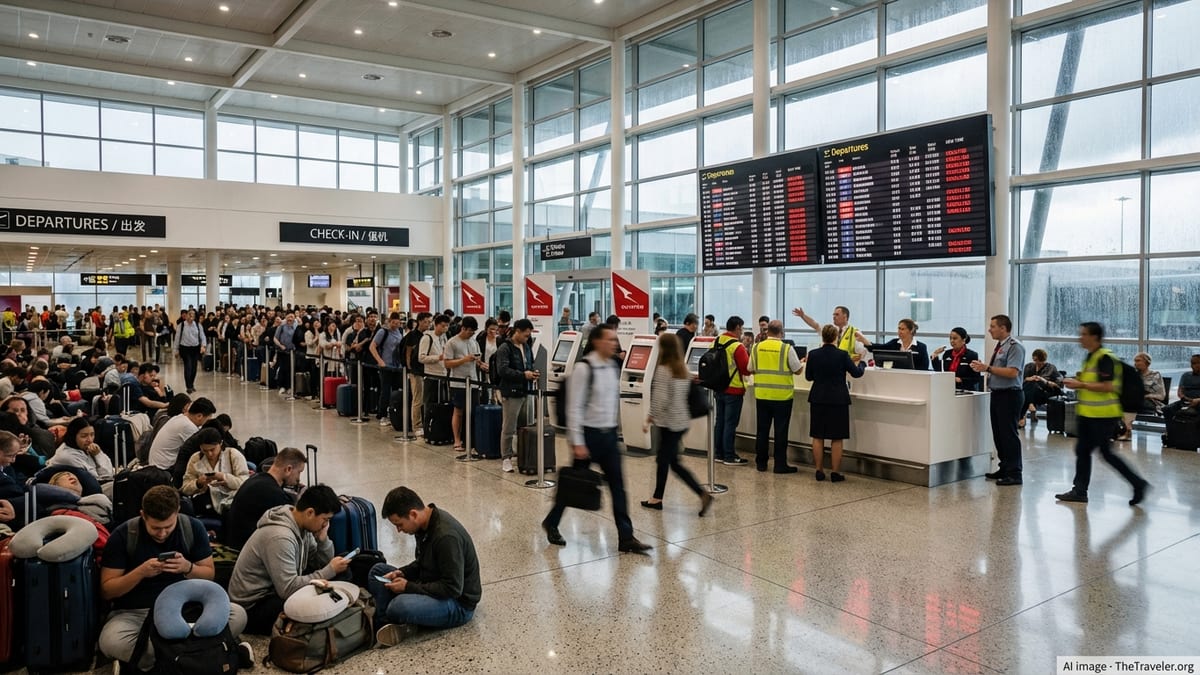
Major Hubs Buckle as Weather and Congestion Collide
Australia’s three busiest gateways struggled to keep aircraft moving on Friday as bands of heavy rain and thunderstorms swept across key flight paths. Aviation data reviewed by TheTraveler.org indicates that 601 flights were delayed and 65 cancelled at Sydney, Melbourne and Brisbane alone, creating a rolling backlog that is expected to linger into the weekend.
The disruption, concentrated on February 27, followed a week of unsettled weather and growing congestion on core domestic routes such as Sydney to Melbourne and Sydney to Brisbane. A series of late‑running services on Thursday evening left aircraft and crews out of position for the Friday morning peak, compounding the impact of fresh storm cells over the southeast.
Ground holds, slower runway operations and tighter separation requirements in poor visibility meant aircraft waited longer for takeoff and landing slots. Queues quickly built at security and check‑in as airlines attempted to rebook passengers or consolidate lightly loaded services.
By mid‑afternoon, departure boards across the three airports showed long columns of delayed flights interspersed with cancellations, with some routes facing multiple disrupted rotations in a single day.
Qantas and International Partners Hit on Key Long‑Haul Routes
Qantas bore the brunt of the turmoil on core domestic links, with multiple services between Melbourne, Sydney and Brisbane running significantly late or being scrubbed altogether. Real‑time trackers showed consecutive Qantas flights experiencing delays of 40 to 60 minutes on Thursday evening, while at least one high‑frequency Melbourne to Brisbane rotation, QF612, was cancelled on Friday morning as the carrier attempted to reset its schedule.
The knock‑on effects were felt throughout Qantas’s international network and that of its partners. Codeshare flights operated on behalf of Emirates, Air Canada, Hawaiian Airlines and IndiGo were among those delayed out of Sydney and Brisbane, as late‑arriving Qantas metal forced revised departure times and, in some cases, missed onward connections.
Qatar Airways, which relies heavily on domestic feeder traffic into its Australian gateways, reported schedule pressure on its Sydney and Melbourne services as connecting passengers and baggage were held up by late incoming flights. United Airlines and Air Canada similarly faced tighter connection windows for North America‑bound travelers, prompting rebookings onto later departures where seats were available.
While long‑haul flights typically receive priority to minimise global disruption, several intercontinental departures pushed back well behind schedule after crews timed out or ground staff struggled to clear backlogs of checked luggage and late‑arriving passengers.
Ripple Effects Across Abu Dhabi, Auckland, Manila and Dubai
With Australia serving as a vital spoke in global air networks, the delays quickly spread to key international hubs. Airlines and airport operators reported flow‑on disruptions to services linking Sydney, Melbourne and Brisbane with Abu Dhabi, Auckland, Manila, Dubai and other major destinations.
In Dubai, passengers on Emirates flights arriving from Australia reported extended waits at transfer security and rebooking counters as misconnected travelers from Qantas‑operated feeder routes were reassigned to later services across Europe and Africa. At Abu Dhabi, Etihad and partner carriers prepared additional customer service teams to handle travelers whose itineraries were thrown off by late Australian departures.
Auckland and Manila, both heavily reliant on precise timing for long‑haul and regional connections, saw schedule reshuffles as aircraft originating in Australia arrived late and turned around on compressed ground times. Some carriers reduced turnaround buffers, while others opted to accept further downstream delays in order to allow crew to remain within legal duty limits.
Airlines warned that even once weather improves over eastern Australia, residual disruption could extend for 24 to 48 hours on multi‑segment itineraries that combine domestic and international legs, particularly for those transiting the Gulf and Southeast Asia.
Passengers Face Long Queues, Missed Holidays and Hotel Scrambles
For travelers on the ground, the statistics translated into frayed tempers and fraying plans. At Sydney and Melbourne, lines for airline customer service desks and call centers stretched for hundreds of metres at peak times, as passengers tried to salvage connecting flights, cruises and holiday departures.
Families en route to school holidays in New Zealand, Southeast Asia and the Middle East were among the worst affected, with many finding that alternative same‑day connections were fully booked. Some reported being offered itineraries that would route them through multiple transit points or push their arrival back by a full day or more.
Airport hotels near Sydney, Melbourne and Brisbane filled quickly as the afternoon wore on, forcing airlines in some cases to transport stranded passengers to suburban properties or to offer meal and transport vouchers instead of formal accommodation guarantees. Travellers already checked into airside areas at international terminals often had to remain in the transit zone while waiting for reassigned flights.
Consumer advocates urged passengers to keep any documentation of delays, cancellations and expenses, noting that compensation policies vary widely between domestic and international tickets and between airlines, but that some travelers may be entitled to refunds, credits or reimbursements for out‑of‑pocket costs.
Airlines and Airports Move to Stabilise Operations
By late Friday, airlines and airport authorities were working to stabilise operations ahead of the busy weekend travel period. Sydney, Melbourne and Brisbane airports coordinated closely with air traffic control to sequence takeoffs and landings in line with changing weather conditions, aiming to clear as many backlogged flights as possible before the evening curfew at Sydney and operational limits at other fields.
Carriers introduced short‑term measures such as upgauging certain flights to larger aircraft where possible, consolidating lightly booked services and waiving change fees for affected customers. Qantas, Emirates, Qatar Airways and United all encouraged passengers to check their flight status frequently and, where feasible, to allow additional time at the airport.
Operational planners cautioned that, given the scale of the disruption, a return to normality would likely be gradual. With aircraft and crews displaced around the network and many long‑haul rotations already committed for the coming days, the system has limited slack to absorb further shocks if storms persist over southeastern Australia.
For now, travellers heading through Sydney, Melbourne or Brisbane are being advised to build generous buffers into their itineraries, remain flexible about routing options and stay in close contact with their airlines as the region’s aviation sector works to get passengers back in the air.