

More news on this day
Hundreds of air passengers have been left stranded in Italy after a fresh wave of disruption triggered 195 flight delays and 20 cancellations at major airports serving Milan, Rome, Catania and Florence, affecting services operated by Ryanair, easyJet, Air France and several other carriers.
Get the latest news straight to your inbox!
Severe Weather and Operational Strains Hit Key Italian Hubs
Recent storm systems sweeping across parts of Europe have added fresh pressure to an already stretched aviation network in Italy, with publicly available data indicating widespread disruption at some of the country’s busiest gateways. Flight tracking dashboards and Italian media coverage point to a sharp spike in delays and cancellations on routes linking Milan, Rome, Catania and Florence to other European cities.
Airlines including Ryanair, easyJet and Air France feature prominently in the lists of affected services, reflecting their large presence in the Italian market and dense schedules on domestic and intra-European routes. In several cases, delays of more than three hours have been reported, forcing passengers into long queues at check-in, security and airline service desks.
Reports indicate that disruption has been heaviest at Milan’s major airports and at Rome Fiumicino, with knock-on effects at Catania Fontanarossa in Sicily and Florence’s Amerigo Vespucci Airport. The pattern mirrors broader European trends in which high-frequency short-haul carriers are particularly exposed when bad weather or air traffic control restrictions reduce runway capacity and create bottlenecks.
Although weather has been a key driver of the latest problems, operational fragilities such as congested airspace, crew repositioning challenges and tight aircraft turnaround times have compounded the impact on travelers. Delays in one part of the network have in several instances cascaded through later rotations, extending disruption well beyond the original storm window.
Impact on Passengers Stranded in Milan, Rome, Catania and Florence
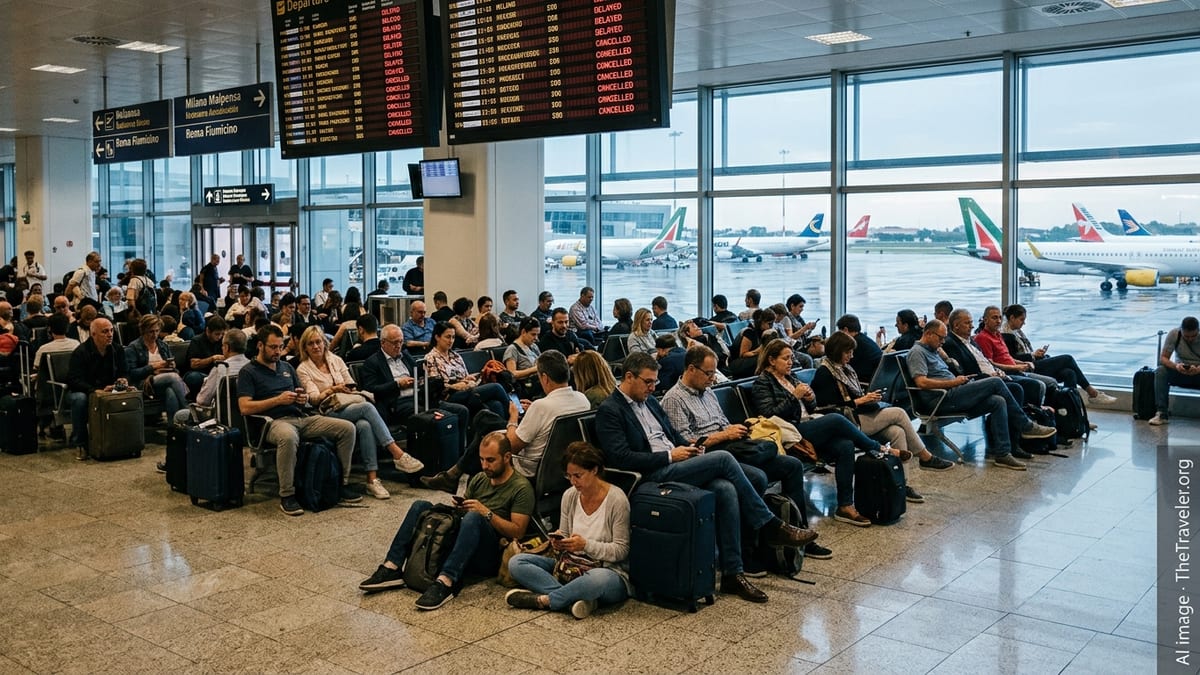
For travelers caught up in the latest wave of disruption, the effect has been immediate and highly visible. Images shared across social media platforms and descriptions in local coverage show crowded departure halls, long lines at airline customer service counters and many passengers resting on terminal floors and seats as they wait for new departure times.
In Milan, delays and cancellations have been reported across both Malpensa and Linate, affecting business and leisure travelers at the start and end of journeys. Rome Fiumicino, Italy’s primary long-haul gateway, has seen connecting passengers face missed onward flights as arrival delays from European carriers leave too little time for transfers, creating further rebooking challenges.
At Catania, a vital link between Sicily and mainland Italy, disrupted services have particularly affected those returning from holidays or visiting family, with fewer alternative flights available compared to larger hubs. In Florence, which handles a mix of business and tourism traffic, delays have spilled into peak departure banks, complicating onward rail and car travel plans across Tuscany.
Accounts from stranded passengers describe difficulties securing hotel rooms near airports during periods of concentrated disruption, as well as confusion about whether to remain airside in hope of a quick turnaround or to exit the terminal and seek overnight accommodation. For many, the primary concern has been clarity on when they can realistically expect to travel.
Ryanair, easyJet, Air France and Other Carriers Scramble to Recover Schedules
Low-cost and network airlines with substantial Italian operations have been working to stabilize their schedules while facing limited spare capacity. Public flight information boards show Ryanair and easyJet operating many of the delayed departures, while Air France and other European carriers have adjusted timetables and consolidated some flights in response to slot and crew constraints.
According to published aviation trend reports, carriers such as Ryanair, easyJet and Air France have in recent seasons been among those most exposed to disruption caused by air traffic control issues and industrial or weather-related shocks across Europe. Their dense operations in key hubs mean that even modest periods of restricted runway availability can translate quickly into a large number of delayed rotations.
In the current disruption, several airlines have re-accommodated passengers on later flights from the same airport, while others have offered rerouting via alternative European hubs where seats are available. However, with winter and early spring schedules typically operating with tight margins, many travelers have reported limited same-day options and the need to wait until the following day for a confirmed seat.
Operational recovery efforts also depend on the ability to reposition crew and aircraft when flights are diverted or significantly delayed. Once aircraft and staff are out of place, airlines often need multiple rotations to fully realign their networks, which can prolong irregular operations and leave residual delays even after weather conditions improve.
What Travelers Can Expect Under EU Passenger Rights Rules
Travelers affected by lengthy delays or cancellations in Italy fall under the scope of European air passenger protection rules, which set out minimum standards of care and, in some cases, financial compensation. Under these rules, airlines are generally required to provide assistance such as meals, refreshments and communication when delays exceed certain thresholds relative to flight distance.
When an overnight stay becomes necessary because the new departure time is on the following day, passengers are typically entitled to hotel accommodation and transport between the airport and the place of lodging. These rights apply regardless of the cause of disruption, although the precise level of service and how it is delivered can vary by carrier and airport.
Eligibility for financial compensation, distinct from basic care and assistance, depends on factors such as the length of delay on arrival, the route and whether the disruption was due to extraordinary circumstances such as severe weather or air traffic control restrictions. In instances where storms or safety-related constraints are central to the disruption, many cases may fall outside automatic compensation rules, though passengers remain entitled to re-routing or refunds when flights are cancelled.
Consumer advocates routinely encourage affected passengers to keep detailed records of boarding passes, delay notifications and any expenses incurred for hotels or meals, in order to support later claims directly with airlines or, where necessary, through national enforcement bodies or dispute resolution schemes. Clear documentation is often key to accelerating the assessment of requests.
Travel Advice as Italy Braces for Further Operational Volatility
With Italian and wider European aviation systems entering a period marked by unsettled weather and continued airspace congestion, industry observers expect further episodes of disruption in the coming weeks. Travelers planning flights through Milan, Rome, Catania or Florence are being urged by public advisories and travel industry commentary to build extra time into itineraries, particularly when making self-planned connections.
Checking flight status frequently in the 24 hours before departure and monitoring airline apps and airport information screens remain essential steps. Travel experts also highlight the value of maintaining updated contact details with airlines so that schedule changes can be communicated promptly, as automated alerts are often the first indication that departure times have shifted.
For those yet to travel, selecting earlier flights in the day, where possible, can reduce the risk of knock-on delays from earlier disruptions and create more room for same-day rebooking if services are cancelled. Where itineraries involve crucial onward connections, some passengers may prefer to route through larger hubs with multiple daily frequencies, which typically offer more recovery options during irregular operations.
As airlines work to clear backlogs and restore normal operations following the latest wave of delays and cancellations, passengers across Italy’s main airports are likely to experience continued crowding and occasional last-minute gate changes. Travel industry commentary suggests that flexibility, careful planning and familiarity with passenger rights will all be valuable tools for those navigating the country’s skies in the near term.