

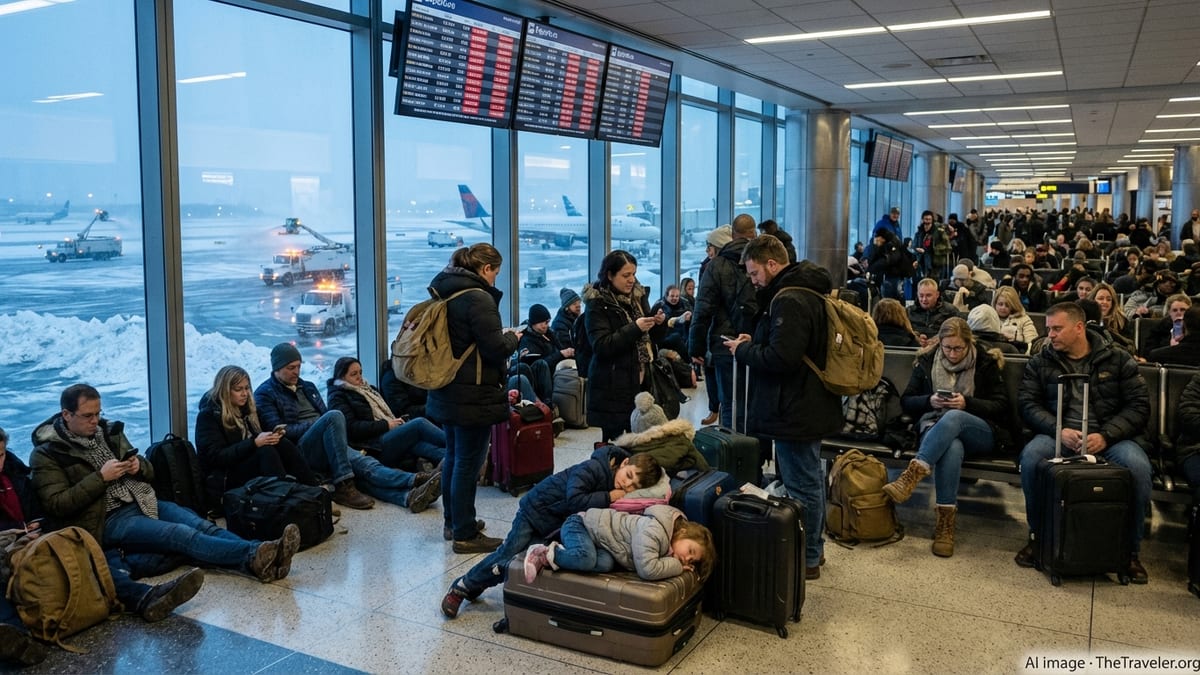
Thousands of passengers were left in limbo on Saturday as 82 flights were delayed and 16 canceled at Boston Logan International Airport, the latest flashpoint in a sprawling wave of U.S. air travel disruptions also hammering major hubs in Orlando, Chicago, Washington D.C. and Tampa.
Storm Systems and Strained Operations Converge on Key U.S. Gateways
The latest round of travel chaos comes as a series of winter weather systems and lingering operational strains collide across the U.S. aviation network. While conditions at Boston Logan were officially listed as light snow and mist with near-freezing temperatures early Saturday, a fragile system already stretched by recent storms and high winter demand meant even modest weather degraded on-time performance and pushed schedules off balance.
Data from flight-tracking and airport operations platforms show Logan running well above normal for delays through the day, with nearly half of departures and more than a third of arrivals experiencing schedule slippage, and a small but disruptive share of flights canceled outright. Those percentages translate into thousands of affected passengers, many of them attempting to connect through other major hubs that were themselves struggling with weather and staffing issues.
The problems at Boston did not occur in isolation. In recent weeks, the national airspace system has been repeatedly jarred by Winter Storm Fern, a far-reaching and historic system that disrupted traffic from Texas and the Midwest to the Northeast, followed by additional snow events and a powerful East Coast bomb cyclone. Airlines and airports are still working through the operational hangover from those storms, with crew availability, aircraft rotations and maintenance windows all under pressure.
Industry analysts note that even when a particular storm moves on, the cumulative impact can linger for days or weeks. Tight schedules, high aircraft utilization and complex crew rules mean that a single day of cascading delays at several large hubs can leave carriers short of slack, making subsequent disruptions harder to absorb. Saturday’s troubles at Logan and other airports illustrate how quickly local weather can trigger a broader national ripple effect.
Boston Logan Passengers Face Long Lines, Tight Connections and Limited Options
At Boston Logan International Airport, travelers arriving before dawn encountered growing crowds at check-in counters and security lanes as overnight and early-morning disruptions began to show. Families returning from school breaks and business travelers headed to weekend conferences were among those caught in snaking queues, many staring anxiously at departure boards that flickered from “On Time” to “Delayed” as updated estimates came in.
Some passengers reported being held on aircraft at the gate or on taxiways during deicing operations, a familiar winter ritual in New England that nevertheless adds significant time to each departure cycle. Others arrived from international services only to discover that their onward domestic connections had already departed or been canceled, sending them into rebooking lines that stretched across terminal concourses.
Airport staff worked to manage the surge, directing travelers toward airline counters, self-service kiosks and mobile rebooking tools. Public announcements reminded passengers to remain patient and to stay in close contact with their airlines through apps and text alerts, which often provide the most up-to-date gate and timing information. Yet for those facing missed weddings, cruises and once-in-a-lifetime vacations, the advice could offer only limited comfort.
Boston’s role as both a major origin airport and a connecting hub for transatlantic and domestic routes added complexity to Saturday’s disruptions. Delays on arriving flights from Europe and the Caribbean hurt the punctuality of outbound services that rely on the same aircraft, while cancellations forced airlines to make difficult decisions about which routes to protect and which to trim from the schedule.
Orlando, Chicago O’Hare, Washington D.C. and Tampa Become Secondary Hotspots
Beyond New England, a constellation of other major airports reported elevated delays and cancellations as the same weather pattern and operational constraints rippled across the country. Orlando International, one of the nation’s busiest leisure gateways, saw departure and arrival schedules compressed by storms moving through the Southeast, complicating travel plans for vacationers bound for theme parks and cruise ports.
In Chicago, O’Hare International once again served as a barometer for the broader system. Snow, low ceilings and crosswinds pushed airlines to adjust runway configurations and reduce departure rates, triggering holding patterns and slot restrictions that cascaded into the afternoon and evening. For passengers connecting between the East and West Coasts, even a modest delay in Chicago could spell a missed final flight of the day.
Washington-area airports, including Reagan National and Dulles International, also contended with winter precipitation and mixed rain-snow bands that forced deicing operations and intermittent visibility reductions. Tampa, typically more insulated from winter volatility, was not spared either, as thunderstorms and gusty winds in the broader Florida region led to ground stops and reroutes up and down the peninsula.
Combined, these regional stress points amplified the difficulty of restoring normal operations. Aircraft and crews displaced by disruptions in one city often failed to arrive in time to operate flights in another, resulting in rolling delays. Where weather remained within safe operating limits, constrained runway capacity and longer taxi times created additional bottlenecks.
Legacy of Winter Storm Fern and a Season of Extreme Weather
This weekend’s disruptions cannot be fully understood without considering the cumulative toll of this winter’s extreme weather. Winter Storm Fern, which swept from the Southern Plains through the Midwest and into the Northeast in late January, prompted thousands of cancellations and delays across the United States. Some carriers endured record levels of disruption, particularly at fortress hubs where most flights are tightly banked into morning and evening peaks.
In the weeks since Fern, further cold waves and a powerful bomb cyclone off the East Coast have added layers of complexity for airlines already rebuilding schedules. Even as major roads reopened and power was restored in many communities, airports and carriers have faced continuing challenges in repositioning aircraft, clearing maintenance backlogs and stabilizing crew rosters disrupted by earlier storms.
For passengers, this has meant a winter of heightened uncertainty. While airlines publish regular schedules months in advance, the reality on the day of travel has often depended on the latest radar images and wind forecasts. Travelers with flexible plans have increasingly opted to build in extra time at connections or to avoid tightly timed itineraries that can unravel quickly when storms flare.
Meteorologists and aviation planners note that climate variability is making traditional patterns less predictable. Periods of unseasonably mild weather can be followed by sudden, severe cold snaps and high-impact storms, challenging both long-range planning and day-of operations. For Boston Logan and other coastal airports, the combination of snow, freezing rain, strong winds and low visibility remains a perennial threat throughout late winter.
Airlines Juggle Schedules, Waivers and Customer Care
Facing another day of elevated disruption, airlines serving Boston and the affected hubs moved to implement a mix of schedule adjustments and customer care measures. Many carriers preemptively trimmed the number of flights during the most weather-sensitive windows, seeking to consolidate passengers onto fewer services that could be more reliably operated, rather than risking widespread last-minute cancellations.
Travel alerts and flexible rebooking policies were reissued or extended, allowing customers booked on impacted routes to change travel dates without standard penalties or fare differences in specific cases. For some flights, airlines encouraged travelers who did not absolutely need to fly on Saturday to move their itineraries to early next week, when more stable conditions are forecast.
On the ground, gate agents and call center staff again found themselves on the front line of managing passenger frustration. Long wait times for phone support drove many customers toward digital tools, but high demand also strained apps and websites, leading to intermittent slowdowns. Airport lounges and food outlets filled with travelers resigned to extended waits, while hotels near Logan and other hubs experienced a spike in last-minute bookings from those forced to overnight unexpectedly.
Carrier executives emphasize that safety remains the overriding priority, particularly when winter weather affects runway conditions and visibility. While that message is broadly accepted, travelers confronting multi-hour delays and missed connections increasingly expect clearer communication about the causes of disruption and realistic recovery timelines.
Air Traffic Management and FAA Constraints Under the Microscope
The Federal Aviation Administration’s air traffic management decisions also played a pivotal role in shaping Saturday’s experience. When snow, low clouds or storms reduce visibility or runway capacity at key hubs, the agency can impose ground delay programs or ground stops that meter the flow of flights into congested airspace. These tools are essential to maintaining safety, but they inevitably lead to knock-on delays across the network.
In Boston, light snow and mist combined with winter operating procedures to reduce the pace at which aircraft could safely depart and arrive. At the same time, bottlenecks in other air traffic control sectors and en route corridors affected how quickly flights could move along popular east-west and north-south routes. The result was a patchwork of delays that affected some flights far more severely than others.
The disruptions come at a time when the FAA is under pressure to accelerate deployment of its Next Generation Air Transportation System technologies, particularly advanced weather-processing and decision-support tools designed to increase efficiency during storms. While new systems have begun rolling out nationally, the events of this winter underline how weather remains the single largest driver of prolonged air travel delays.
Aviation experts suggest that continued investment in both technology and staffing will be necessary to improve resilience. Enhanced forecasting, better real-time data sharing between airlines and the FAA, and more flexible routing options could help airports like Boston Logan, Orlando and Chicago O’Hare reduce the duration and severity of future disruption events.
What Stranded and Delayed Travelers Can Do Now
For those currently stuck at airports from Boston to Tampa, the most pressing question is often what can be done in the moment. Travel advocates advise passengers to monitor both airline apps and airport departure boards closely, since estimated departure times can change rapidly as weather evolves and slots open up. Enrolling in text and push notifications can provide early warning of gate changes or additional delays.
Where flights have been canceled, passengers are urged to rebook digitally where possible, rather than relying solely on in-person customer service queues. Searching alternative routings, including connections through secondary hubs that may be less affected by weather, can increase the chances of getting moving sooner. At the same time, travelers should be realistic about the limits of the system on heavy disruption days, when available seats are scarce across many carriers.
Experts also recommend that passengers keep receipts for meals, ground transportation and hotel stays incurred as a direct result of significant delays or cancellations, particularly for international itineraries, where consumer-protection rules may offer avenues for reimbursement or compensation. Even within the United States, some airlines provide meal vouchers, hotel assistance or frequent-flyer miles on a case-by-case basis when disruption is severe.
Ultimately, the combination of winter storms, operational constraints and high seasonal demand has made this a difficult stretch for U.S. air travel. The events at Boston Logan, Orlando, Chicago O’Hare, Washington D.C. and Tampa highlight how intertwined the national network has become, and how a localized outbreak of bad weather can quickly cascade into a nationwide challenge for airlines and travelers alike.