

More news on this day
Thousands of air travelers across the United States faced cascading disruptions over the weekend as severe late winter weather triggered ground stops at Chicago’s O’Hare International Airport and Midway International Airport, forcing airlines to cancel and delay hundreds of flights and stranding passengers far beyond the Midwest.
Get the latest news straight to your inbox!
Ground Stops Ripple Across the National Air Network
The latest North American storm system, unfolding between March 13 and March 16, brought heavy snow, high winds and low visibility to large swaths of the country, with Chicago emerging as one of the hardest hit aviation hubs. Publicly available flight tracking data on Sunday and Monday showed O’Hare and Midway among the nation’s leaders for cancellations and delays as the storm intensified over the Great Lakes region.
Reports indicate that ground stops were implemented at both airports at several points as conditions deteriorated, temporarily halting departures and significantly slowing arrivals. When ground stops are in effect, flights destined for the affected airport can be held on the ground at their origin, while aircraft already in the air may be diverted or placed into holding patterns until traffic managers judge it safe to resume operations.
Because O’Hare is one of the world’s busiest connecting hubs and Midway is a major point to point base for domestic carriers, interruptions in Chicago quickly spread across the broader air network. Travelers departing from or connecting through cities as far apart as the East Coast, Texas and the Mountain West reported missed connections, overnight diversions and extended tarmac waits as airlines attempted to work through the backlog.
Airlines that operate large connecting banks at O’Hare adjusted schedules throughout the day, trimming frequencies on key routes and consolidating flights where possible. At Midway, carriers with dense short haul schedules into surrounding states were forced to cancel waves of flights as bands of heavy snow and periods of freezing precipitation moved over the field.
Thousands of Passengers Stranded and Rebooking Windows Tighten
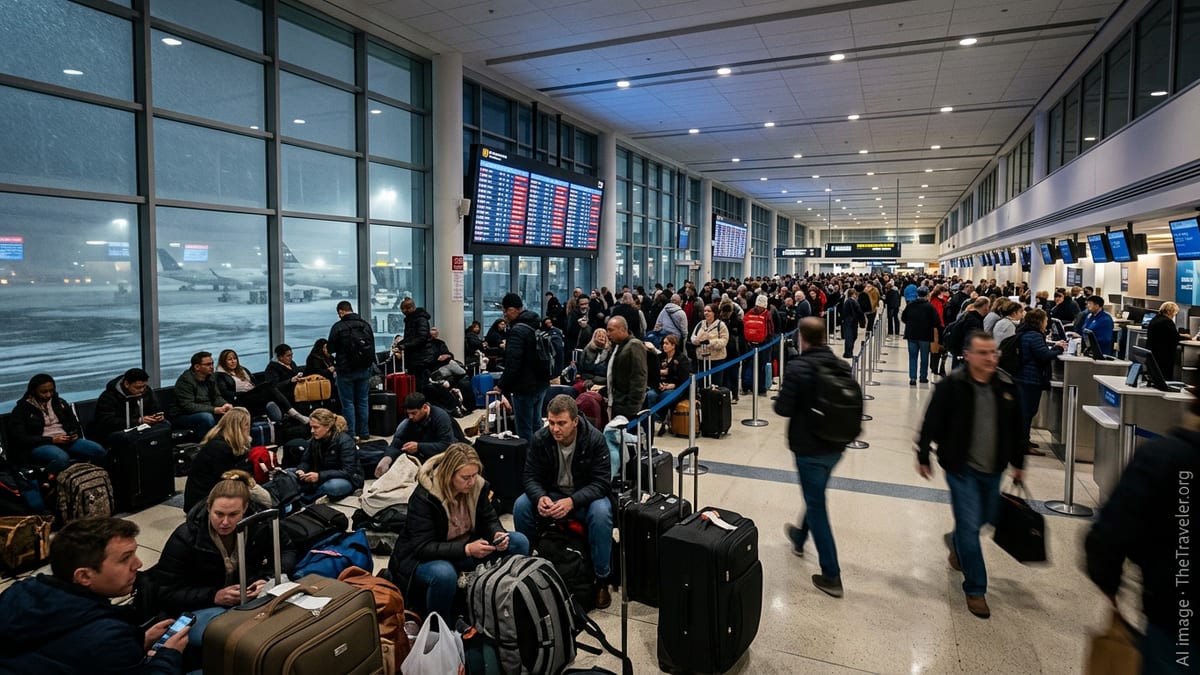
By Sunday night, images shared on social media from both terminals showed long lines at customer service desks, crowded gate areas and travelers camping out on the floor with bags and blankets. Accounts from stranded passengers described waits of several hours to speak with airline agents, as rebooking options narrowed for those hoping to reach their destinations before the workweek.
According to published coverage and airline advisory pages, carriers instituted weather waivers for Chicago and other affected Midwest airports, allowing many travelers to change tickets without additional fees. However, limited seat availability on remaining flights and ongoing weather uncertainty meant that some passengers were rebooked days later than originally planned.
Hotels near O’Hare and Midway saw a sharp spike in demand, with many properties around the terminals reporting few remaining rooms by late evening. Travelers unable to secure hotel accommodations turned concourses into makeshift rest areas, using charging stations and food courts as temporary bases while they monitored flight status boards for signs of improvement.
The disruption also affected crews, with pilots and flight attendants timing out under federal duty rules after long delays. That led to additional cancellations unrelated to real time weather, as airlines struggled to reposition staff and aircraft to resume normal operations once conditions improved.
Severe Weather Compounds a Historically Busy Air System
The twin shocks of heavy snow and severe thunderstorms came at a time when Chicago’s airports are already operating at very high volumes. Chicago Department of Aviation data show that O’Hare and Midway together handle more than 2,500 daily passenger flights and over 100 million travelers in a typical year, making the system particularly vulnerable to weather related bottlenecks.
Late winter storms can be especially disruptive in the Midwest, where shifting temperature gradients often bring a volatile mix of rain, wet snow and strong winds. Forecasters tracking the March 13 to March 16 storm complex highlighted sharp pressure drops and fast moving fronts sweeping across the Plains and Great Lakes, conditions that translate into low cloud ceilings, wind shear and rapidly changing visibility at airports.
While modern air traffic management tools and upgraded deicing facilities have improved reliability compared with previous decades, Chicago’s role as a primary connecting node means that a slowdown at O’Hare or Midway still reverberates widely. When dozens of arrivals are delayed or canceled, onward flights that depend on those aircraft and passengers can also be disrupted, sometimes in cities far from any active weather.
Historical analyses of flight performance have repeatedly identified O’Hare as one of the leading contributors to systemwide delay minutes during major winter storms. Recent federal reports on aviation congestion note that when intense weather coincides with peak travel periods, the combination can rapidly overwhelm buffers built into airline schedules.
Travelers Navigate Cancellations, Waivers and Limited Options
For individual passengers caught in the latest round of disruptions, practical concerns centered on how to get home or reach time sensitive appointments. Airline travel waiver pages indicated that customers originating, connecting or terminating in Chicago during the storm window could often change itineraries without a change fee, provided they traveled within a specified date range and kept the same cabin type.
Travel forums and social feeds filled with advice from frequent flyers urging others to monitor their airline’s mobile app, proactively search for alternative routings and consider nearby airports within driving distance if same day options out of Chicago disappeared. Several travelers described success in rerouting via secondary hubs or accepting longer connections in exchange for confirmed seats.
Others faced more difficult choices, particularly those on international itineraries or traveling with children. With many long haul flights already near capacity during the spring break period, securing space on replacement services proved challenging. Some passengers reported opting to abandon trips entirely and request refunds under airline policies for significant schedule changes or extended delays.
Publicly available information from airline operations pages stressed that weather related cancellations are prioritized for safety and that crews cannot depart if conditions fall below required visibility or crosswind thresholds. The combination of runway contamination from snow, gusty winds and rapidly shifting visibility around the Chicago lakeshore made it necessary at times to pause operations until conditions stabilized.
What Comes Next for Chicago Operations
As the storm system gradually shifts east and north, forecasts call for improving conditions over Chicago early in the new week, with lower winds and more stable visibility expected. Even so, recovery from such a wide scale disruption typically takes at least a day beyond the end of the worst weather, as airlines reposition aircraft, reopen temporarily closed routes and rebuild crew rotations.
Industry analysts note that as climate patterns bring more frequent episodes of intense winter storms and fast changing severe weather, major hubs like O’Hare and Midway may face recurrent operational stress. Recent planning documents from Chicago’s aviation authorities highlight ongoing investments in new terminals, runway improvements and deicing capacity, all aimed at improving resilience during challenging weather events.
For travelers, the latest episode serves as another reminder of how closely flight reliability is tied to regional weather in key hub cities. Those scheduled to fly to, from or through Chicago in the coming days are being advised, through airline and airport information channels, to check flight status frequently, remain flexible about routing and allow extra time at the airport while carriers work through the backlog.
With storms continuing to affect portions of the Midwest and East Coast, additional knock on delays remain possible, even as Chicago’s airports work to restore a more typical flow of departures and arrivals. The full scale of the disruption, in terms of total cancellations, missed connections and stranded passengers, is expected to become clearer as airlines publish updated performance figures for the storm period.