

More news on this day
Travelers at Hartsfield-Jackson Atlanta International Airport are facing another day of significant disruption as a fresh wave of weather-related issues and staffing knock-on effects triggers scores of flight cancellations and delays on key U.S. routes.
Get the latest news straight to your inbox!
Fresh Turbulence at the Nation’s Busiest Hub
Publicly available tracking data and traveler reports on Sunday, March 22, indicate that around 40 flights have been canceled at Hartsfield-Jackson Atlanta International Airport, affecting a broad mix of domestic services. The latest figures follow a bruising week for U.S. air travel, in which storms and a stretched aviation system have repeatedly constrained operations at major hubs.
Major U.S. carriers, including Southwest, Delta Air Lines, American Airlines, United Airlines and JetBlue, are among those showing cancellations or severe delays on their Atlanta schedules. While the number of grounded flights at Atlanta is well below the peak levels seen during the mid-March winter storm, the impact is magnified by the airport’s role as a central connection point for travel across the country.
Published coverage over recent days has described the broader U.S. network as being in recovery mode after a powerful storm system swept through the Midwest and East Coast between March 13 and March 17, causing thousands of cancellations nationwide. Atlanta, New York and Chicago were among the hardest-hit hubs, and operational ripples are still being felt as airlines work to reposition aircraft and crews.
Travelers transiting Atlanta on Sunday face a combination of outright cancellations, lengthy delays and gate changes, even where local weather has improved. For many, the disruption is now being driven less by active storms and more by the residual effects of earlier system stress, including aircraft out of position and flight crews reaching duty time limits.
Key Routes to New York, Chicago, Los Angeles and Florida Affected
Based on live departure and arrival boards, flights between Atlanta and major markets such as New York, Chicago, Los Angeles, Miami and Orlando are among the most affected. These are some of the busiest domestic corridors in the United States, linking major business centers and popular leisure destinations, which means even a relatively small number of cancellations can displace thousands of passengers.
Services to New York area airports, including LaGuardia and John F. Kennedy, have been especially sensitive over the past week as the storm system pushed high winds and poor visibility into the Northeast. When conditions deteriorated earlier in the week, New York rapidly accumulated delays and cancellations, and those disruptions fed back into Atlanta-bound and Atlanta-originating flights that rely on aircraft cycling through the region.
Chicago, another core connecting hub in the Midwest, has also played a major role in the current disruption picture. Heavy snow and blizzard conditions around the Great Lakes region earlier in the week led to widespread schedule cuts at Chicago’s primary airports. Those lost rotations removed flexibility from airline networks, making it harder to recover quickly and leaving subsequent Atlanta services vulnerable to cancellation when new weather or staffing complications emerged.
On Southern and transcontinental routes, flights linking Atlanta with Los Angeles, Miami and Orlando remain under pressure. These city pairs are critical for both domestic tourism and international connections, funneling travelers to Caribbean, Latin American and Pacific long-haul departures. Any interruption in Atlanta’s ability to feed those flights can cause a cascade of missed connections and unscheduled overnight stays for passengers.
Storm Legacy and Strained Airline Operations
The latest problems at Hartsfield-Jackson cannot be viewed in isolation. Meteorological and transportation reports on the March 13 to March 17 storm complex describe a large, powerful system that generated heavy snow, high winds and severe weather across much of the central and eastern United States. That event produced thousands of flight cancellations nationwide and forced carriers to trim schedules across multiple days.
In Atlanta, the storm intersected with already busy spring travel demand, leaving little slack in the system. Once flights began to cancel in significant numbers, aircraft and cabin crews were left out of position relative to their next scheduled departures. In addition, federal duty-time limits restrict how long pilots and flight attendants can work without rest, meaning that crews delayed by earlier storms sometimes timed out before operating subsequent flights, triggering further cancellations even after skies cleared.
Travelers sharing their experiences on public forums over the past two weeks have described repeated rebookings, late-night or early-morning departures, and episodes where flights were boarded and then deplaned before ultimately being canceled. Such accounts highlight the compounding effect of weather and operational constraints, where one day’s storm leads to several days of rolling disruption.
Hartsfield-Jackson’s scale also amplifies every irregularity. As one of the busiest airports in the world by passenger numbers, Atlanta handles enormous volumes of connecting traffic for Delta and its partners, as well as significant operations from Southwest, American, United, JetBlue and other carriers. When a single hub of that size experiences disruption, it quickly reverberates across the wider U.S. network.
Passenger Impact: Long Lines, Missed Connections and Crowded Rebooking Desks
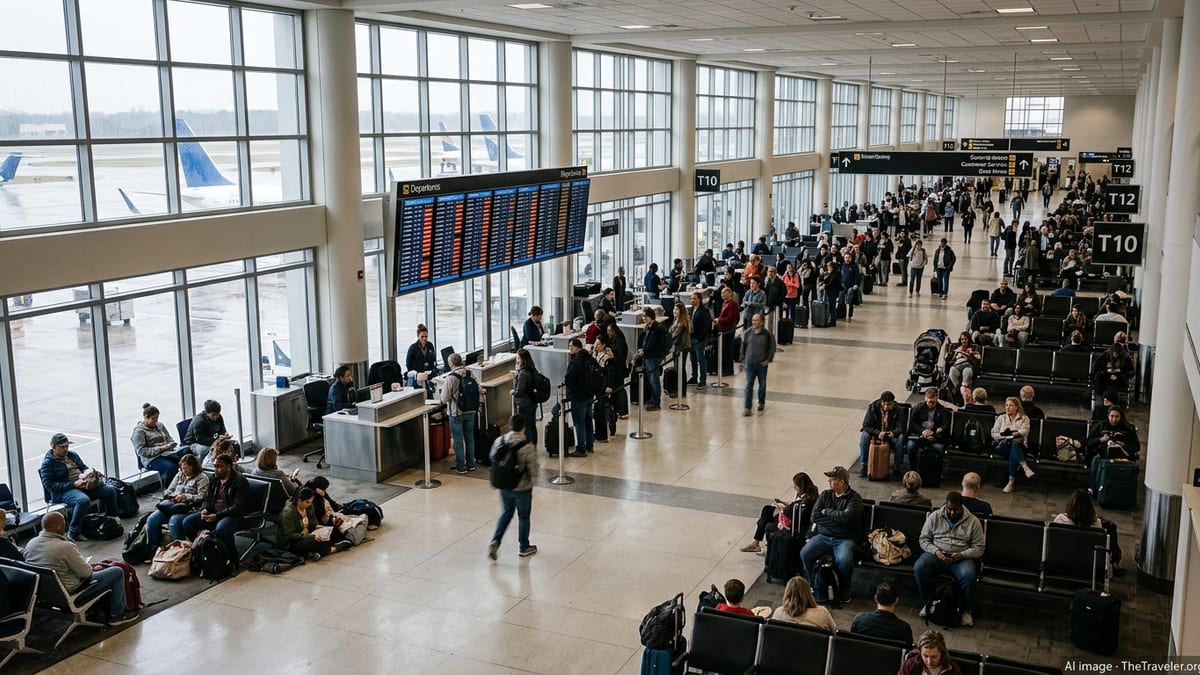
The operational difficulties at Atlanta have translated into long waits on the ground for many travelers. Recent publicly shared accounts from inside the terminal describe extensive security lines, crowded concourses and boarding areas packed with passengers waiting for updated information on delayed or re-timed flights.
Missed connections have become a recurring issue as disrupted inbound flights arrive too late for travelers to make their original onward services. In many cases, passengers bound for destinations such as New York, Chicago, Los Angeles, Miami and Orlando are being rerouted through alternative hubs or rebooked onto flights departing many hours later, or even the following day, as airlines attempt to work through backlogs.
Hotel availability around the airport has also tightened at various points in the past week. When substantial numbers of flights cancel late in the evening, many travelers find themselves searching for last-minute accommodation while also competing for open seats on the first departures the next morning. Some passengers have turned to early-morning or overnight flights to secure any available routing out of Atlanta, contributing to unusually busy off-peak travel periods.
Families on spring break trips and travelers heading to or from major events have been particularly exposed to the disruption, as peak-season loads leave fewer empty seats with which airlines can absorb displaced customers. For those with fixed check-in dates for cruises, vacation rentals or tournaments, even a single canceled leg through Atlanta can throw broader plans into doubt.
What Travelers Can Do If Their Flight Is Affected
Consumer advisories drawing on U.S. Department of Transportation guidance emphasize that passengers whose flights are canceled are generally entitled to a refund if they choose not to travel, even when the cancellation is due to weather. However, many travelers instead opt to be rebooked on the next available service, which can involve long waits on customer-service phone lines, in-app queues or at airport help desks during major disruption events.
Airline travel alerts issued over the past several days for the storm-affected regions typically allow customers to change their travel dates without change fees, and in some cases without fare differences, provided they keep the same origin and destination and travel within a specified window. Publicly available information shows that some carriers have extended these flexible policies through the weekend as they continue working to stabilize schedules.
Travel analysts often recommend that passengers flying into or out of Atlanta during periods of irregular operations monitor their flight status frequently, enable airline app notifications and consider traveling with only carry-on luggage where possible to make rebooking and rerouting easier. Arriving early at the airport can also provide a buffer for longer security wait times that sometimes accompany large waves of delays and cancellations.
With the broader U.S. system still unwinding the consequences of recent severe weather, additional localized disruptions remain possible in the coming days, particularly if new storm systems develop. For now, the situation at Hartsfield-Jackson Atlanta International Airport serves as a reminder of how quickly conditions at a single key hub can ripple across the national air travel network, affecting journeys between some of the country’s largest and most heavily traveled cities.