

More news on this day
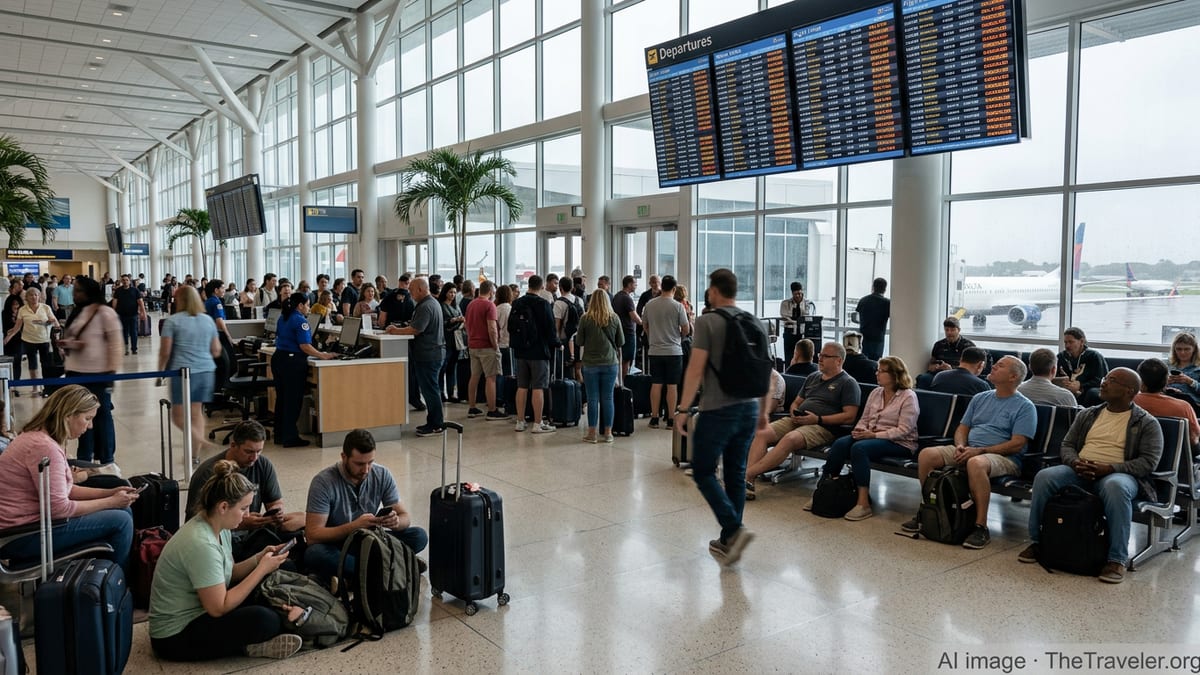
Southwest Florida International Airport is grappling with another wave of disruption today, as publicly available data show at least 164 new flight delays and 112 cancellations rippling across its network and frustrating travelers headed to and from Orlando, Pittsburgh, Philadelphia, Nashville, St. Louis, Cleveland and other key domestic destinations.
Get the latest news straight to your inbox!
Storm System and Network Strain Converge Over Florida
The latest operational turmoil at Southwest Florida International Airport, serving the greater Fort Myers and Cape Coral region, comes as a powerful mid-March storm system churns across large swaths of the United States. National aviation dashboards and weather reports indicate that the same system has already contributed to thousands of flight disruptions nationwide since the weekend, with Florida routes among the hardest hit.
Air traffic management advisories point to extensive flow-control measures into the state, including average multi-hour delays on routes into Florida’s major tourist gateways. That pressure is especially acute for airports that depend heavily on domestic leisure demand, where tight schedules and full flights leave little margin to recover when one leg goes wrong.
At Southwest Florida International, the surge of 164 additional delays and 112 newly canceled flights is the latest manifestation of this system-wide stress. The airport’s role as a fast-growing gateway for winter and spring visitors means disruptions there can quickly ripple outward, affecting connecting traffic and return journeys across the Midwest, Mid-Atlantic and Northeast.
The timing is particularly painful for travelers who planned to reach Florida in time for cruises, spring-break vacations or family gatherings, only to discover that the broader storm pattern has tightened constraints on crews, aircraft positioning and airspace capacity well beyond the state’s borders.
Key Domestic Routes Hit: Orlando, Pittsburgh, Philadelphia and More
Published route maps and air service updates for Southwest Florida International show nonstop links to a roster of mid-sized and major cities that have featured prominently in recent delay and cancellation tallies. These include Orlando, Pittsburgh, Philadelphia, Nashville, St. Louis and Cleveland, among others that anchor the airport’s domestic network.
Travelers bound for Orlando face particular complications when Florida airspace programs reduce arrival rates, often cascading back to originating airports such as Fort Myers. When those flow restrictions intersect with full peak-season schedules, even minor upstream delays can turn into last-minute cancellations, missed connections and extended overnight stays for passengers.
On northern and Midwestern routes, connections to Pittsburgh, Philadelphia, Nashville, St. Louis and Cleveland are vulnerable both to local weather at those hubs and to the broader storm that has swept across the central and eastern United States. Publicly available flight-tracking data show rolling delays in these markets that can strand aircraft away from their next scheduled departure point.
For passengers, the experience can feel inexplicable. Many leave clear skies in southwest Florida only to be told that their departure cannot operate because an incoming aircraft has been grounded by storms hundreds of miles away, or because air traffic managers have temporarily throttled traffic into congested corridors further north.
Why the Numbers Keep Climbing for Delays and Cancellations
The tally of 164 delayed and 112 canceled flights at Southwest Florida International reflects more than just bad luck with the weather. Aviation operations analysts point to a combination of factors that can cause disruption counts to escalate rapidly once a day begins badly.
First, crew duty limits remain a hard constraint. When earlier flights are held on the ground or diverted, pilots and flight attendants can time out before they reach their next scheduled leg. Even if the weather improves or airspace restrictions are eased, there may no longer be a legal crew available to operate a waiting aircraft, leading to last-minute cancellations that are especially frustrating for passengers who can see their plane at the gate.
Second, Florida’s concentrated leisure schedules create a narrow window to recover from early disruption. Many flights into and out of Fort Myers operate in banked peaks designed around check-in, cruise departures and hotel turnover times. If those peak periods are heavily delayed, airlines have fewer later departures available to re-accommodate stranded travelers on the same day.
Third, when a large storm affects multiple regions at once, spare aircraft and extra crews are often consumed by recovery efforts at major hubs. That can leave secondary airports like Southwest Florida International with limited backup options, even as they handle significant passenger volumes of their own.
Travelers Face Confusion, Long Lines and Difficult Choices
The human impact of today’s operational problems is highly visible across the terminal. Passengers report long queues at customer service counters, crowded gate areas and a scramble for scarce hotel rooms and rental cars as delays stretch into cancellations.
Some travelers are attempting to reroute through alternate Florida airports such as Orlando, Tampa or Miami, only to find that those gateways are under similar strain, with limited seats and their own weather or airspace constraints. Others are turning to long-distance drives as a last resort, weighing the cost and fatigue of a road trip against the uncertainty of waiting for the next available seat.
Social media posts and traveler forums highlight a recurring sense of bewilderment among passengers who see gates staffed, aircraft parked and local weather conditions appearing favorable, yet still encounter abrupt cancellations. For many, the complexity of modern airline networks and the dependence on aircraft and crews arriving from far-flung locations is only fully revealed when a major storm exposes the system’s fragility.
Families with rigid travel timelines, such as cruise departures or special events, are particularly vulnerable. Even a modest delay from Fort Myers to a connecting city can cause a missed embarkation time or a cascade of rebookings that require new hotels, revised ground transport and unexpected expenses.
What Disrupted Passengers Can Do Right Now
Consumer-advocacy guidance emphasizes a few immediate steps for those caught in the latest wave of disruptions at Southwest Florida International. Travelers are encouraged to monitor their flight status frequently through airline apps and departure boards, since schedules can change quickly as air traffic programs are updated and crews reach duty limits.
Rebooking options tend to be most promising early in the disruption cycle, before flights on alternative routes and airlines fill with displaced passengers. Those who are flexible about departure times, nearby airports or connecting itineraries may find more options than travelers who must adhere to fixed schedules or specific city pairs.
Publicly available policy summaries indicate that many airlines will offer fee-free changes in the face of significant weather or airspace disruptions, particularly when formal travel advisories are in place for affected cities. However, seat availability, fare differences and third-party bookings can limit these options, and travelers may need to weigh the benefits of waiting for a protected rebooking against the certainty of making their own alternative arrangements.
For now, with storm-related constraints still affecting large portions of the national airspace system, passengers heading into or out of Southwest Florida International are likely to face continued uncertainty. The combination of 164 new delays and 112 cancellations serves as a stark reminder of how quickly a single weather system and a saturated network can turn a planned getaway into a prolonged and exhausting ordeal.