

More news on this day
More than 1,600 flights have been delayed or cancelled at major European hubs over recent days, as Storm Dave, staffing pressures, and already-stretched schedules combine to create fresh disruption for spring travelers across the continent.
Get the latest news straight to your inbox!
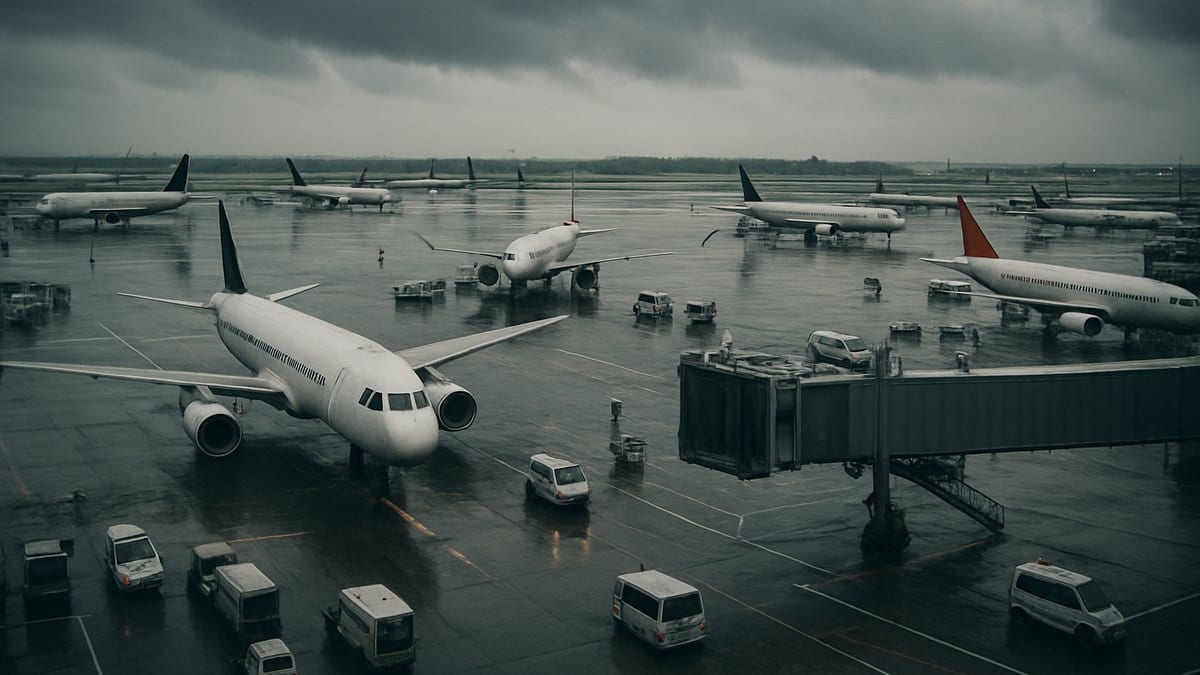
Wave of Disruptions Hits Key European Hubs
Publicly available operational data and recent industry analyses point to a sustained spell of disruption across Europe’s air network, with a combined tally of well over 1,600 delayed flights and scores of cancellations concentrated in the first week of April. The impact has centered on large connecting hubs such as Amsterdam Schiphol, Paris Charles de Gaulle, London-area airports, Frankfurt, Dublin, and Copenhagen, with Athens and major Spanish airports also affected.
Reports indicate that one of the most intense single-day events came on 7 April, as Storm Dave swept across northern and western Europe. Data compiled by passenger-rights platforms shows at least 1,469 delays and 238 cancellations tied to the weather system, affecting airports including Keflavik in Iceland, Stockholm Arlanda, Dublin, and several London and German hubs.
The latest turmoil follows earlier disruption days in late March and early April, when carriers such as Air France, KLM, British Airways, SAS, and major low-cost operators collectively logged thousands of off-schedule departures. A recent breakdown of one event highlighted nearly 1,900 delayed services in a single day on the Air France-KLM network alone, underscoring how quickly issues at one or two hubs can ripple across Europe.
Separate tallies from travel trade publications describe additional peaks, including a recent day when 1,695 delays and 102 cancellations were recorded across England, France, Germany, Greece, Spain, and the Netherlands, with Schiphol, Heathrow, Frankfurt, Munich, Athens, Barcelona, and Madrid among the hardest hit. On another day, 1,445 delays and 20 cancellations were logged across a different mix of European countries, reinforcing the picture of recurring instability rather than an isolated weather event.
Storm Dave and a Stretched Spring Schedule
Meteorological briefings on the 2025–26 European windstorm season described Storm Dave as a rapidly deepening North Atlantic system approaching the United Kingdom and nearby countries in early April. Aviation-focused summaries now indicate that the storm’s arrival on 7 April translated directly into large clusters of delays and cancellations at northern and western European airports, particularly those exposed to strong crosswinds and heavy rain.
At Keflavik International Airport in Iceland, disruptions to transatlantic and European connections were significant, with Iceland’s main hub carrier adjusting schedules as conditions deteriorated. Dublin, London, and Frankfurt also experienced widespread knock-on effects as aircraft and crews struggled to remain in position, resulting in late departures, missed connections, and reaccommodation challenges for passengers.
Travel industry coverage suggests that seasonal factors are amplifying the problem. Airlines entered the spring shoulder period with schedules already ramping up to meet rising leisure demand, leaving less slack in fleets and crew rosters. When storms like Dave pass through at this time of year, the margin to recover quickly shrinks, making widespread knock-on delays more likely.
In the days immediately before and after Storm Dave, additional localized issues compounded the strain. Italy’s Milan Malpensa and Rome Fiumicino reported nearly 300 combined disruptions in one recent event, while Copenhagen Airport logged close to 200 affected flights over a busy weekend, spreading secondary delays into Norway, Finland, and other Scandinavian and central European markets.
Major Airlines and Network Effects
The latest disruption wave has once again underscored the central role of Europe’s network carriers and their hubs. Recent analyses show Air France and KLM jointly accounting for nearly 1,900 delayed flights on 3 April, concentrated around Paris Charles de Gaulle and Amsterdam Schiphol, but with consequences for secondary airports in France, the Netherlands, and neighboring countries.
Other published reports highlight days when Lufthansa Group, British Airways, easyJet, Ryanair, Vueling, TAP Air Portugal, ITA Airways, Finnair, SAS, and Pegasus all featured prominently in disruption statistics. On one day with more than 1,600 combined delays and cancellations across multiple nations, Amsterdam, Athens, Barcelona, Madrid, Paris Charles de Gaulle, Frankfurt, Munich, Heathrow, and Manchester all reported elevated numbers of late or cancelled operations.
Because many of these carriers operate hub-and-spoke networks, an aircraft or crew arriving late into a hub can affect several subsequent departures. Flight-data summaries emphasize that this dynamic has been clearly visible in recent days, with secondary airports in Scandinavia, southern Europe, and smaller regional markets experiencing late-running services that originated at the main hubs hit hardest by weather and congestion.
Sector observers note that low-cost airlines have not been immune. While point-to-point models can sometimes isolate disruption more effectively than traditional networks, busy bases in cities such as Barcelona, Milan, and London have still faced significant challenges when slot restrictions, ground-handling bottlenecks, or staff shortages have coincided with adverse weather.
Impact on Passengers and Travel Plans
The disruption has affected both short-haul and long-haul travelers, with recent reports from transatlantic gateways illustrating how European delays feed into global networks. Washington Dulles International Airport, a major connection point for flights between North America and Europe, experienced 146 affected services on 6 April alone, with knock-on issues reported across the Atlantic on subsequent days.
For travelers already en route, the most immediate consequences have been missed connections, extended layovers, and, in some cases, overnight stays near hub airports. Consumer-rights organizations report increased interest in guidance on rebooking, care obligations at the airport, and potential financial compensation, particularly under European passenger-protection rules.
Publicly available guidance generally advises passengers to monitor flight status closely in the 24 hours prior to departure, use airline apps or airport information feeds where possible, and build extra buffer time into itineraries involving tight connections through major hubs. Some travel advisers are also recommending that passengers consider earlier departures or more robust connection windows when itineraries route through airports that have recently appeared at the top of disruption statistics.
The timing of the latest wave, coinciding with early spring getaways and business travel ramp-up, has heightened the sense of frustration for many passengers. Industry commentary suggests that, while airlines and airports are working to restore normal operations after each disruption spike, persistent weather volatility and resource constraints could lead to further pockets of instability as the peak summer season approaches.
What Comes Next for Europe’s Air Network
Forecasts for the days ahead indicate that Storm Dave’s most severe impacts are beginning to ease, with operational updates from several hubs pointing to a gradual normalization of schedules. However, analysts note that backlogs created by earlier disruptions can take time to unwind fully, particularly where aircraft and crews remain out of position.
Capacity planning for the rest of April and into the core summer months is likely to come under renewed scrutiny. Airlines are expected to weigh the commercial benefits of flying dense schedules against the operational risk of running with minimal reserve capacity, especially on routes that rely heavily on weather-sensitive hubs.
Airport operators, meanwhile, are facing questions about resilience measures, including staffing levels in air traffic management and ground handling, as well as the flexibility of infrastructure during peak hours. Commentary from aviation specialists suggests that incremental improvements in these areas could help contain future disruption spikes even when storms or other external shocks occur.
For passengers planning trips in the coming weeks, the recent tally of 1,600-plus delayed and cancelled flights across Europe serves as a reminder to remain flexible. Travel experts point to simple mitigation steps such as choosing earlier flights, allowing longer connection times, and keeping digital copies of itineraries and travel insurance details, as Europe’s air network continues to navigate a volatile start to the spring travel season.