

More news on this day
Europe’s aviation network is facing another turbulent week as Storm Dave and earlier spring weather systems combine to delay or cancel more than 1,600 flights across major hubs, disrupting travel plans for hundreds of thousands of passengers.
Get the latest news straight to your inbox!
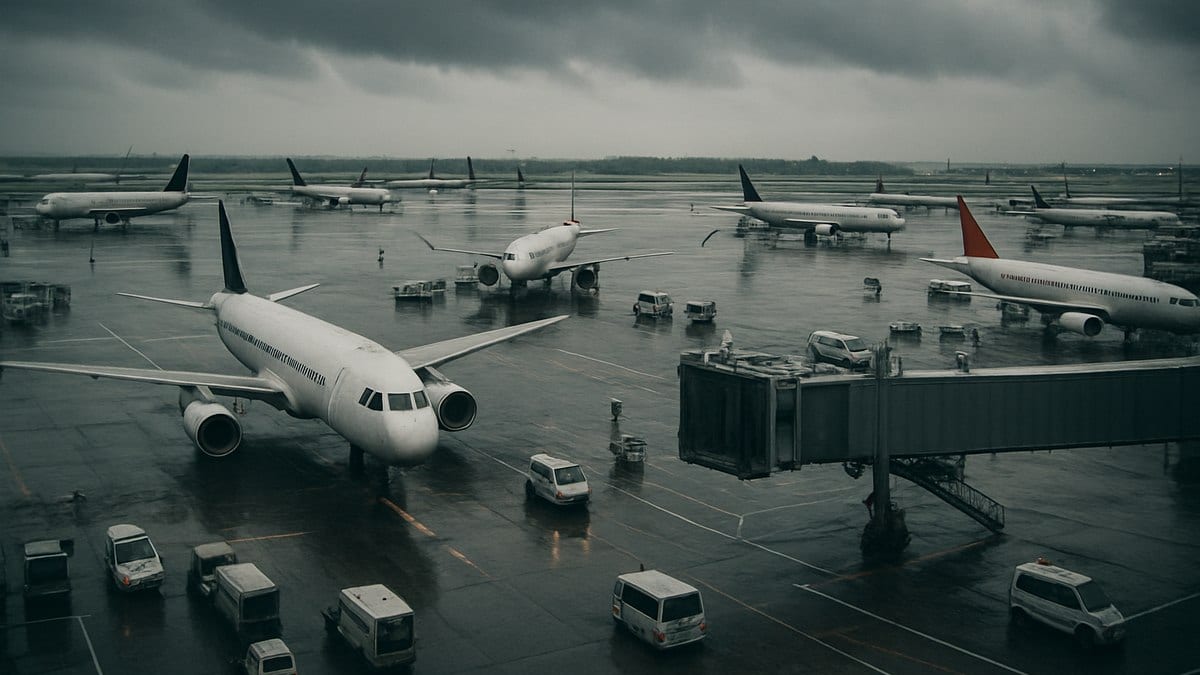
Storm Dave Slams Northern and Western Europe
Fresh disruption peaked on 7 April 2026 as Storm Dave swept across northern and western Europe, pushing wind and rain into some of the continent’s busiest air corridors. Publicly available data compiled by passenger-rights specialists indicates that at least 238 flights were cancelled and around 1,469 were delayed in a single day across key airports including Keflavik in Iceland, Stockholm Arlanda, Dublin, Frankfurt and several London-area hubs.
Airlines with strong networks in these regions, including Icelandair and Scandinavian carriers, were particularly exposed as they attempted to maintain both European and transatlantic schedules. Because many of these operations are built around tightly timed banked connections, a short hold on arrivals quickly translated into longer ground waits and missed onward flights for passengers.
Reports indicate that much of the disruption stemmed from a combination of high winds, reduced runway capacity and air traffic flow restrictions introduced to maintain safety in crowded airspace. Once departure waves started running late, aircraft and crews slid out of position, limiting airlines’ ability to restore punctuality later in the day even as weather conditions began to improve.
The scale of delays triggered by Storm Dave added to an already fragile situation in Europe’s skies, turning what might have been a localised weather event into a region-wide operational challenge.
Earlier Wave: Network Strain at Paris and Amsterdam
The impact of Storm Dave follows closely on the heels of a severe bout of delays centered on the Air France-KLM network on 3 April 2026. According to published figures, 1,899 flights operated by the group ran late that day, with disruption focused on Paris Charles de Gaulle and Amsterdam Schiphol, two of Europe’s most important connecting hubs.
While mass cancellations were largely avoided, the sheer number of late departures and arrivals created a rolling backlog across France, the Netherlands and neighboring countries. Each delayed inbound aircraft increased the pressure on turnaround times for its next sector, amplifying the knock-on effect into the evening and, in some cases, into the following day.
Secondary airports around the network also felt the strain, as delayed aircraft rippled into regional destinations that depend on feed from Paris and Amsterdam. For travelers, this translated into missed connections, unexpected overnight stops and last-minute rebookings, even on routes far from the original weather or technical triggers.
Industry observers point out that such large-scale delay events, even without extensive cancellations, can be among the most disruptive for passengers because they undermine the reliability of carefully choreographed hub schedules.
Impact Across Major European Hubs
The recent wave of disruption has not been confined to one or two airports. Data collected over the past week highlights repeated pressure at major hubs such as London Heathrow, Frankfurt, Copenhagen and Athens, alongside Spain’s key gateways in Barcelona and Madrid.
One widely cited operational snapshot from late March and early April showed at least 1,695 delays and more than 100 cancellations across a single day in countries including England, France, Germany, Greece, Spain and the Netherlands. Airports such as Amsterdam Schiphol, Athens International, Barcelona El Prat, Madrid Barajas, Paris Charles de Gaulle, Frankfurt and Munich all recorded triple-digit delay counts, underscoring how closely their fortunes are linked.
In Scandinavia, Copenhagen Airport registered 157 delays and 29 cancellations on 5 April, affecting 186 flights and spreading disruption into Norway and Finland. Similarly, Italian hubs Milan Malpensa and Rome Fiumicino reported a combined 271 delays and 15 cancellations on the same weekend, illustrating how quickly localised strain can become a national or regional issue.
These figures, combined with the fresh disruption from Storm Dave, push the total number of delayed flights comfortably beyond 1,600 across just a handful of high-impact days, with cancellations running into the hundreds.
Knock-on Effects Beyond Europe
The difficulties in Europe’s skies are intersecting with separate disruption in other regions, further complicating long-haul itineraries. In the Asia-Pacific region, a multi-day wave of delays and cancellations since early April has affected several major hubs, producing thousands of late departures and more than 200 cancellations on routes linking to North America, Europe and Australia.
For Europe-bound travelers, late departures from Asian gateways have increased the risk of missed onward connections in hubs such as Frankfurt, Paris, London and Amsterdam. Airlines often prefer to hold flights rather than cancel outright where possible, but this strategy lengthens delays and can push crew duty limits to their regulatory thresholds, sometimes forcing last-minute cancellations later in the day.
Transatlantic flows have also been influenced by recent disruption at Washington Dulles International Airport, where more than 140 flights were affected on 6 April. Several European carriers operating to and from Dulles experienced delays, feeding additional variability into already stretched schedules on key North Atlantic routes.
The result is a complex web of operational challenges that do not stop at regional borders, with delays originating in one hemisphere increasingly likely to materialise as missed connections in another.
What Travelers Are Experiencing and Can Expect Next
For passengers, the statistics translate into crowded departure halls, long queues at customer service desks and unpredictability around departure and arrival times. Easter and early spring breaks have increased demand across European routes, raising the stakes for families and leisure travelers who have limited flexibility in their plans.
Public information from passenger-rights platforms notes that, while many disruptions are linked to weather and airspace restrictions, some delays may still fall within airline responsibility, opening the door to compensation claims under European regulations in certain circumstances. Travelers are being encouraged in public guidance to retain boarding passes, request written explanations of disruption causes and keep receipts for any essential expenses incurred during extended waits.
Operationally, airlines and airports are working through a backlog created by successive disruptive days. Once weather systems move on, recovery typically depends on available spare aircraft, rested crews and unused capacity in schedules, all of which can be limited during peak periods. Even after headline events such as Storm Dave pass, residual delays often linger for several days as networks gradually realign.
With spring weather patterns still unsettled and traffic volumes rising toward the summer peak, further bouts of disruption cannot be ruled out. Travelers planning European trips in the coming weeks are likely to benefit from building additional time into connections, monitoring flight status closely and preparing for the possibility that tightly timed itineraries may not run exactly as scheduled.