

More news on this day
Travellers across Canada are facing widespread disruption as a powerful late-winter weather system triggers at least 40 flight cancellations and more than 200 delays affecting Air Canada, Jazz, Porter Airlines, Icelandair, WestJet and other carriers at major hubs including Toronto, Montreal, Vancouver, Ottawa and Calgary.
Get the latest news straight to your inbox!
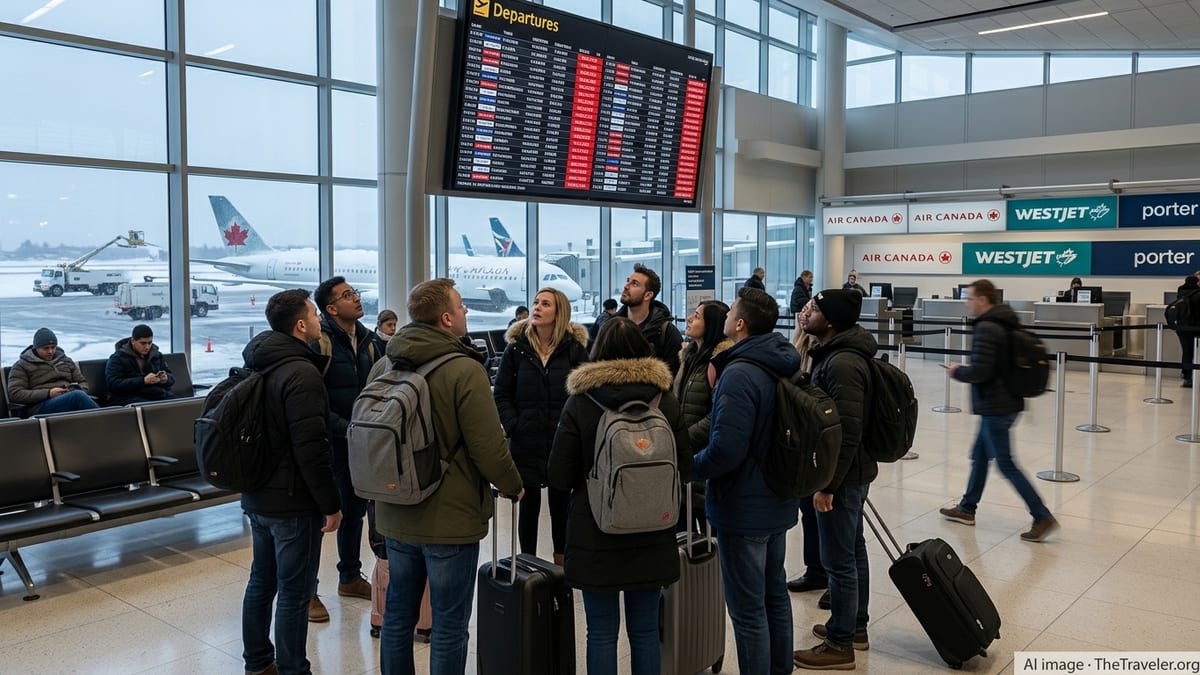
Weather System Triggers New Wave of Disruptions
Publicly available flight-tracking data and media coverage from the weekend indicate that a sprawling storm system sweeping parts of central and western Canada has sharply reduced visibility and complicated de-icing operations at several of the country’s largest airports. The ripple effects are being felt most acutely at Toronto Pearson, Montreal Trudeau, Vancouver International, Calgary International and Ottawa International, where a fresh round of ground stops and capacity reductions has been imposed.
Operational summaries show that more than 40 flights have been cancelled outright across multiple airlines, with over 200 additional services reporting significant delays. The latest wave of disruption follows an already difficult winter for Canadian aviation, coming on the heels of major storms in January and earlier in March that also forced mass cancellations and lengthy tarmac waits at Toronto and other hubs.
Industry data compiled in recent months point to a pattern in which relatively small schedule reductions or ground delays can quickly cascade across tightly timed networks. With aircraft and crews operating near capacity at many Canadian carriers, a few hours of low visibility, freezing precipitation or runway congestion can rapidly turn into widespread late departures, missed connections and stranded travellers.
Air Canada, Jazz and WestJet Bear the Brunt
Canada’s largest network carrier, Air Canada, along with its regional affiliate Jazz, appears to account for a substantial proportion of today’s cancellations and long delays, particularly on trunk routes linking Toronto, Montreal and Vancouver. Publicly accessible status boards show multiple round trips scrubbed or pushed back by several hours, including services between Toronto and western cities such as Calgary and Edmonton, as well as eastbound flights to Atlantic Canada.
WestJet is also experiencing notable disruption at its Calgary hub and on key domestic corridors. Recent regulatory filings and reporting on the airline’s operations show that WestJet has already been under pressure this year amid regulatory penalties and earlier weather-related event days, leaving little margin to absorb another bout of storms without schedule cuts or rolling delays. Travellers connecting through Calgary and Toronto on WestJet report tight onward connections and rebookings into the coming days as the airline works through a backlog of displaced passengers.
Regional routes operated under the Air Canada Express banner by Jazz are similarly affected, with smaller communities in Saskatchewan, Manitoba and the Atlantic provinces seeing flights cancelled or delayed as aircraft and crews are redeployed to stabilize core trunk routes. These secondary cancellations can magnify the impact on travellers, as options for rebooking from regional airports are often limited compared with Canada’s largest hubs.
Porter, Icelandair and Other Carriers Face Knock-On Effects
Disruptions are not confined to Canada’s two largest carriers. Porter Airlines, which has expanded rapidly out of Toronto Billy Bishop and Toronto Pearson with an all-jet fleet on routes such as Toronto to Vancouver, Montreal and Western Canada, is reporting weather and flow-control delays on several departures. Passenger accounts and schedule information from recent weeks suggest that Porter’s tight turnarounds at busy hubs can make it particularly vulnerable to de-icing backlogs and air traffic control spacing requirements.
Transatlantic and transborder operations are also being affected. Icelandair services linking Canadian gateways such as Toronto, Montreal or Vancouver with Reykjavik are seeing schedule changes as aircraft arriving late from storm-affected Canadian airports miss their planned departure windows back to Europe. Other foreign carriers with Canadian operations, including U.S. and European airlines, are experiencing similar knock-on delays when their inbound aircraft are held on the ground or diverted due to local weather constraints.
Domestic leisure routes to sun destinations are not immune either. Carriers that rely on aircraft cycling between Canadian hubs and southern vacation cities may be forced to cancel or significantly delay outbound flights when their inbound legs become trapped behind de-icing queues or runway plowing operations, further complicating travel plans for holidaymakers returning home at the end of school breaks.
Major Routes in Toronto, Montreal, Vancouver, Ottawa and Calgary Hit Hard
The brunt of the current disruption is concentrated on the country’s most heavily trafficked corridors. Between Toronto and Vancouver, one of Canada’s busiest domestic routes, multiple rotations across different airlines are showing departure times pushed back by several hours, with at least a handful of flights cancelled outright. Similar patterns are visible between Toronto and Calgary, as well as Toronto and Montreal, where tightly scheduled shuttle-style services can quickly fall out of sync when early-morning departures are slowed by de-icing and low ceilings.
In Montreal, which serves as a key hub for both Air Canada and Air Transat, weather-related limitations on runway capacity are leading to holding patterns and extended gate waits. This, in turn, is contributing to missed connections for travellers bound for Europe and the Caribbean, even on airlines that are not directly cancelling large numbers of flights. Reports from Vancouver point to a combination of rain, low cloud and lingering winter conditions at inland airports feeding into the network, a mix that tends to generate both arrival and departure delays.
Ottawa and Calgary are experiencing a particularly disruptive mix of local weather and wider network congestion. Ottawa’s role as a connecting point for government and business travellers means that relatively modest schedule changes can quickly affect same-day itineraries, while Calgary’s position as a western hub amplifies any storm-related slowdowns affecting traffic to and from the Prairies, British Columbia and transborder markets.
What Travellers Can Expect in the Coming Days
Published forecasts and airline travel advisories suggest that residual delays and scattered cancellations are likely to continue even after the worst of the storm has moved through. Aircraft and crews displaced by today’s irregular operations may need several days to return to their normal rotations, particularly on long-haul and transcontinental routes where duty-time rules and aircraft maintenance windows limit the ability to simply “catch up” overnight.
Passengers booked on upcoming flights in and out of Toronto, Montreal, Vancouver, Ottawa and Calgary are being advised via airline websites and social media feeds to monitor their flight status closely and to allow extra time at the airport, especially for early-morning departures when de-icing activity is typically heaviest. Many carriers have issued flexible travel policies during recent weather events, enabling travellers to move their trips by a day or two without change fees, although seat availability can be tight on peak routes.
Travel data from past Canadian winters indicate that once a major weather system has cleared, on-time performance gradually improves over several days, but isolated bottlenecks often persist at the busiest hubs. With this latest storm arriving late in the season, airlines and airports are again testing their ability to manage de-icing resources, runway clearing and passenger care obligations at a time when many travellers had hoped the worst of winter disruption was behind them.