

More news on this day
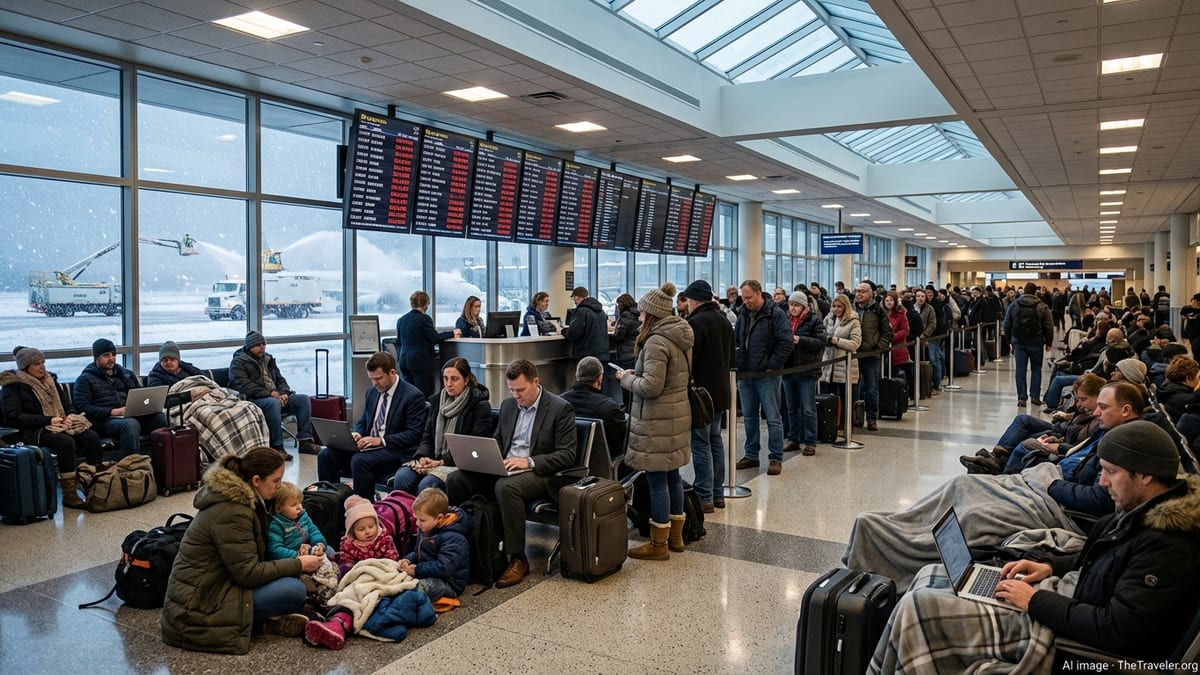
Hundreds of travelers were left stranded at Minneapolis–St. Paul International Airport on Monday as a fresh wave of delays and cancellations involving Delta Air Lines, Southwest Airlines and American Airlines rippled through Chicago, New York, Los Angeles and other major US cities.
Severe Weather and Network Strain Snarl Operations
The disruption at Minneapolis–St. Paul International Airport (MSP) comes amid a broader spell of unstable winter weather sweeping across parts of the Midwest and Northeast, straining airline schedules that were already operating near capacity. Flight-tracking data through Monday afternoon showed at least 124 delays and 24 cancellations tied to Delta, Southwest and American services in and out of MSP, with knock-on effects for flights across the country.
Minnesota’s largest airport is a critical Upper Midwest hub, particularly for Delta, which operates the majority of departures and connections through Minneapolis. When storms or air-traffic restrictions hit, delays quickly cascade across the airline’s network, affecting passengers not just starting or ending their journeys in the Twin Cities but also those using MSP as a connection point to Chicago, New York, Los Angeles and dozens of secondary markets.
Carriers were working to reposition aircraft and crews into Minneapolis as weather windows opened, but tight turn times and lingering ground restrictions at other hubs limited how quickly normal operations could resume. For many travelers, that meant an increasingly familiar scenario of rolling gate changes, creeping departure times and missed connections downline.
Long Lines, Thin Information for Stranded Passengers
Inside Terminal 1, the operational crunch translated into crowded concourses and snaking lines at customer service counters as passengers scrambled for scarce alternative options. With many later flights already heavily booked, some travelers reported being rebooked a full day or more after their original departure time, effectively marooning them in Minneapolis overnight.
Families traveling with small children searched for quieter corners of the terminal, while business travelers set up makeshift workstations on the floor near power outlets. Disposable blankets and neck pillows appeared in increasing numbers as the prospect of sleeping in the terminal became more likely for those unable to secure hotel rooms nearby.
Several passengers said the most frustrating element was the lack of clear, consistent information. Departure boards frequently lagged behind airline apps, and updates at the gate often conflicted with messages sent by text or email. Many travelers queued at service desks only to be redirected to digital channels, while others found that by the time they reached an agent, remaining seats on the most desirable rerouting options had already been taken.
Major US Routes to Chicago, New York and Los Angeles Hit Hard
The worst of the disruption centered on high-frequency domestic routes that link Minneapolis to other major hubs. Flights between MSP and Chicago O’Hare, New York’s LaGuardia and JFK airports, and Los Angeles International saw multiple instances of back-to-back delays as arriving aircraft and crews struggled to get into position. Even when flights did operate, they often departed significantly behind schedule, causing connecting passengers to miss tight onward links.
Secondary but still vital business markets such as Denver, Dallas, Atlanta and Washington also felt the impact. Delayed departures from Minneapolis translated into late-night arrivals at those airports, threatening crew duty limits and forcing schedule adjustments for subsequent rotations. As one delayed flight after another pushed deeper into the evening, options for same-day recovery shrank, heightening the risk that Tuesday’s operations would also begin on the back foot.
For travelers, the practical effect was similar regardless of destination: longer days in terminals, shortened trips at the other end and in some cases outright trip cancellations when alternative connections could not be found. Those with nonrefundable hotel or event bookings in Chicago, New York or Los Angeles faced the added stress of negotiating last-minute changes and potential losses.
Delta, Southwest and American Juggle Recovery Plans
Delta, which maintains its largest Midwestern hub in Minneapolis, bore the brunt of the local disruption, with a substantial share of the delays and cancellations concentrated on its regional and mainline services. The carrier deployed additional customer service staff to key banks of gates and encouraged travelers with flexible plans to voluntarily push their trips to later in the week to ease pressure on the operation.
Southwest, which connects MSP to its network of point-to-point routes across the central and western United States, also faced challenges as weather and airspace constraints affected not just Minneapolis but several cities in its broader grid. Even a single grounded aircraft can trigger a chain of schedule changes on the airline’s multi-stop itineraries, leaving passengers on flights far from Minnesota feeling the impact of a disruption that began at MSP.
American, while a smaller player in Minneapolis compared with Delta, nonetheless saw its carefully timed connections through hubs such as Chicago O’Hare, Dallas–Fort Worth and Charlotte thrown off balance. Delays on Minneapolis departures pushed some inbound flights into already congested arrival banks at those airports, forcing crews to wait for open gates and leading to further holdups for passengers already weary from earlier setbacks.
What Travelers Can Expect in the Coming Days
Airport officials and airline operations teams warned that even after the immediate weather system moves on, schedules may remain fragile for at least another day as carriers work through a backlog of displaced aircraft and crews. Early morning departures on Tuesday and Wednesday are typically used to reset the system, but any additional weather, mechanical issues or air-traffic constraints could prolong the period of instability.
Passengers with upcoming flights into or out of Minneapolis were urged to monitor their flight status frequently, arrive earlier than usual and take advantage of options such as same-day confirmed changes or travel waivers where available. Those with critical connections in Chicago, New York or Los Angeles were advised to build in additional buffer time or consider rerouting through less congested hubs if their carrier allowed it.
For travelers already caught in the disruption, the immediate priorities were more practical: finding hotel rooms within a reasonable distance of the airport, securing meal vouchers or partial refunds where policies allowed, and ensuring access to medications, chargers and essential items that might have been packed in checked luggage. As operations slowly stabilize, the experience at Minneapolis–St. Paul offered a reminder that in peak winter, even a handful of delayed or canceled flights can quickly snowball into a nationwide tangle for US air travel.