

More news on this day
Travellers at Montréal–Trudeau International Airport faced widespread disruption as 36 flights were cancelled and 95 delayed, affecting major routes to New York, Quebec City, Fort Lauderdale, Charlotte, Winnipeg and other domestic and transborder destinations.
Get the latest news straight to your inbox!
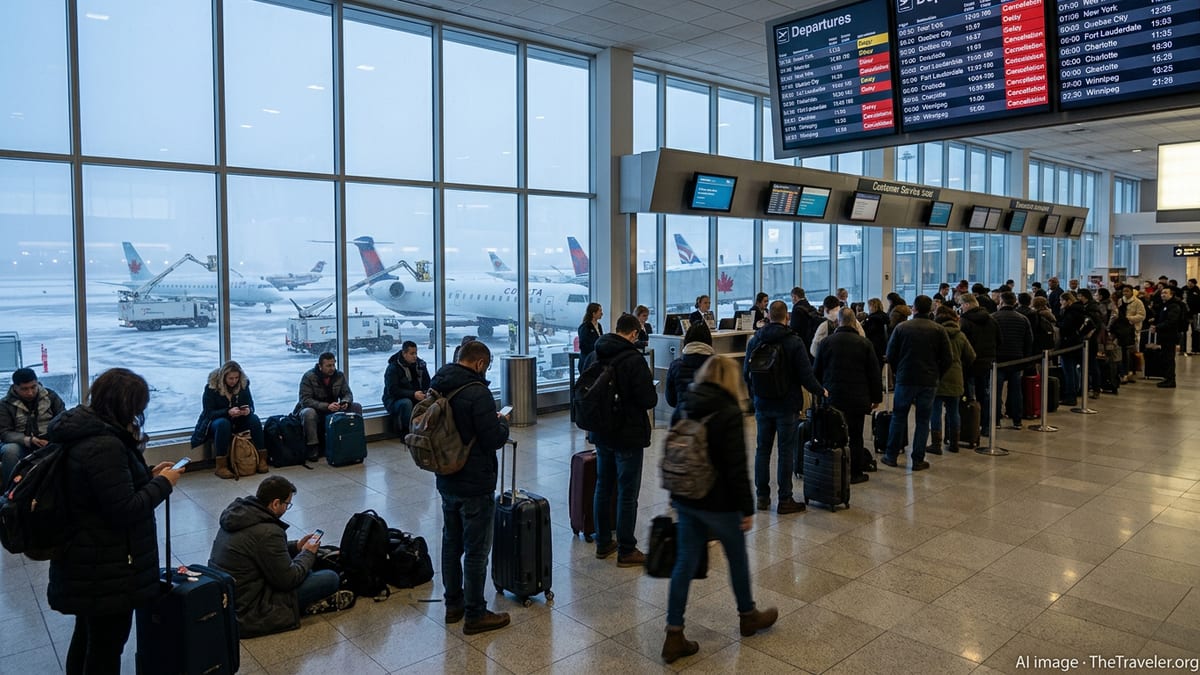
Weather and Operational Strains Converge at Montréal–Trudeau
Publicly available flight-tracking data for Monday, March 16, 2026, indicate that operations at Montréal–Trudeau International Airport were significantly disrupted, with dozens of departures and arrivals either cancelled outright or forced into extended delays. The pattern aligns with a broader spell of adverse late-winter weather in eastern Canada and the northeastern United States, where freezing rain and snow have periodically affected air traffic in recent days.
Reports on recent travel advisories for Montreal and New York show that airlines have been warning of possible schedule changes around an incoming system of freezing precipitation, prompting carriers to preemptively trim schedules on some routes. This type of reduction is often used to avoid long tarmac waits and to keep de-icing queues manageable when runway capacity is constrained and visibility is reduced.
The disruption at Montréal–Trudeau has landed at the tail end of a difficult winter for Canadian and North American carriers, during which on-time performance has been under pressure from repeated storms and tight aircraft and crew utilization. Public data and discussions around punctuality suggest that both Canadian and U.S. airlines have been working with little slack in their schedules, meaning small disruptions can quickly cascade into larger waves of delays.
According to airport information pages and airline schedules, Montréal–Trudeau serves as a key node linking Atlantic Canada, central Canada and major U.S. cities. When operations slow at this hub, the knock-on effect can ripple quickly across the network, particularly on short-haul transborder routes that are tightly banked around morning and evening peaks.
Multiple Carriers Impacted, From Regional Connectors to Major Brands
Flight-status boards on Monday showed cancellations and delays spread across several airlines and operating partners, including Jazz Aviation operating as Air Canada Express, mainline Air Canada, U.S. regional operator Endeavor Air on Delta Connection services, PSA Airlines on American Eagle flights, and Canadian carrier WestJet. Other operators serving Montréal–Trudeau also registered schedule changes as the day progressed.
On transborder routes, publicly available schedules indicate that Endeavor Air and PSA Airlines handle a significant share of regional connections to New York City and Charlotte on behalf of larger U.S. network airlines. With those operators experiencing disruptions in Montreal, passengers heading to or through key hubs such as New York’s LaGuardia and John F. Kennedy airports or Charlotte Douglas faced missed connections and rebookings onto later flights.
Within Canada, Jazz-operated Air Canada Express flights saw interruptions on short-haul links to Quebec City and intra-Quebec destinations, while WestJet and Air Canada schedules connecting to Winnipeg and other western cities were also affected. Historical route maps for the carriers show that these city pairs typically rely heavily on narrow-body jets and regional aircraft, which can be particularly constrained by crew duty limits when earlier sectors in the day run late.
Travel forums and social media posts from recent weeks have highlighted how even modest delays in winter can push pilots and cabin crew close to regulatory duty-time limits, occasionally forcing last-minute cancellations when it is no longer legal to operate a flight. Industry guidance suggests that when this happens late in the day, it can be difficult to find reserve crews, especially on regional routes with smaller staffing pools.
Key Routes to New York, Quebec City, Fort Lauderdale and Charlotte Disrupted
According to airline timetables and route planning documents, Montreal’s links to New York, Quebec City, Fort Lauderdale and Charlotte play an important strategic role for both leisure and business travellers. New York services provide access to major financial and cultural centers as well as onward global connections, while Quebec City flights support government and corporate traffic within the province. Fort Lauderdale connections serve the busy Florida leisure market, particularly during winter, and Charlotte functions as a major U.S. connecting hub.
On Monday, multiple departures and arrivals on these routes were either cancelled or recorded as heavily delayed. Publicly available information suggests that some New York and Charlotte flights were grounded early due to concerns over deteriorating conditions along the corridor, while southbound services to Florida were pushed back as aircraft arriving from elsewhere in Canada encountered weather and congestion-related delays.
The impact extended beyond these marquee routes. With 36 cancellations and 95 delays logged overall, passengers connecting through Montreal to destinations across Canada and the United States, including cities such as Winnipeg, faced uncertainty over missed connections and overnight stays. Because many of these journeys involve tight transfer windows, even a short delay in arrival can make it impossible to board the next leg, forcing rebookings on later flights or even on partner airlines.
Travel industry commentary notes that such broad disruption tends to be most acutely felt by passengers on multi-segment itineraries, as each missed connection creates additional pressure on already busy later flights. As a result, some travelers may find themselves competing for limited rebooking options as carriers work to recover their schedules.
Passengers Confront Long Waits, Airline Policies and Limited Options
Travellers at Montréal–Trudeau on Monday reported long lines at check-in counters and service desks as they sought information about rebooking options, hotel accommodation and compensation. Recent consumer guidance documents for Canadian and U.S. carriers outline a patchwork of policies that depend on whether a disruption is classified as within an airline’s control or caused by weather and air traffic conditions.
Under Canada’s air passenger protection framework and similar rules in the United States and Europe, airlines have different obligations depending on the reason for a delay or cancellation. Publicly available summaries indicate that when weather or air traffic control are listed as primary causes, carriers generally focus on rebooking passengers on the next available flight rather than offering hotel stays or vouchers, although some may provide additional assistance as a goodwill measure.
Travel advice materials encourage passengers to monitor their flight status through airline apps and airport websites, rather than waiting solely for terminal announcements. In recent weather events affecting Montreal and other Canadian hubs, airlines have advised travelers to consider voluntary rebooking in advance of a storm where fee waivers are offered, which can reduce the likelihood of being stranded if conditions worsen on the day of travel.
Consumer advocates also point to the role of travel insurance and credit card protections, which can sometimes cover out-of-pocket costs such as hotels, meals and alternative transportation when disruptions stretch into overnight stays. However, the specific benefits vary widely between policies, requiring passengers to check their coverage details carefully.
Ongoing Recovery Efforts and What Travellers Can Expect Next
As airlines at Montréal–Trudeau work to clear Monday’s backlog, operations are expected to remain fragile into the next travel day. Industry experience shows that even after weather conditions improve, aircraft and crew can be out of position, leading to additional schedule adjustments while carriers reset their networks.
Published operational updates suggest that airlines typically prioritize rebuilding their core trunk routes and first-wave morning departures after a day of major disruption. For Montreal, that often means focusing on early services to Toronto, Vancouver, major U.S. hubs and key domestic points such as Quebec City and Halifax, which then feed into wider national and international networks.
Passengers scheduled to travel through Montréal–Trudeau over the next 24 to 48 hours are being urged, in publicly available advisories, to check their flight status frequently and to arrive early at the airport, particularly during morning and late-afternoon peaks. With residual delays possible, travellers may see longer lines at security, check-in and de-icing bays even if the total number of cancellations gradually falls.
Analysts note that the latest episode at Montréal–Trudeau underscores the vulnerability of winter operations in a tightly scheduled, highly interconnected air transport system. For travelers, it is a reminder to build extra time into itineraries, keep digital boarding passes and notifications enabled, and maintain flexibility when severe weather sweeps across multiple hubs at once.