

More news on this day
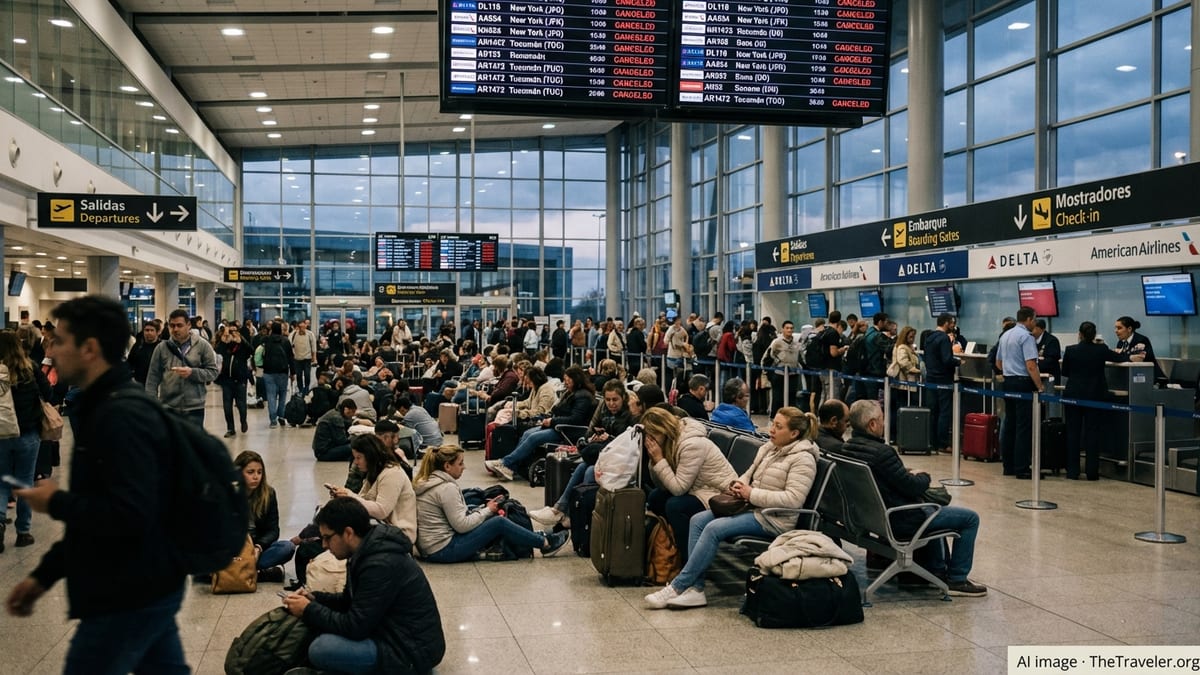
Hundreds of passengers were left stranded in Argentina on Sunday and Monday after Delta Air Lines and American Airlines scrubbed multiple services in and out of Buenos Aires, triggering knock-on disruption to routes linking New York and the northern city of Tucumán as a powerful winter storm crippled air travel across the United States.
Buenos Aires Travelers Caught in Transcontinental Turbulence
The cancellations at Buenos Aires’ main international gateway, Ministro Pistarini International Airport in Ezeiza, unfolded as airlines across the Americas struggled with the impact of Winter Storm Hernando in the northeastern United States. With New York’s main airports among the hardest hit, flight plans that normally connect Argentina to one of its most important long-haul markets quickly unraveled, leaving travelers sleeping in terminals and scrambling for scarce alternatives.
Operational data from flight-tracking and airline advisory sites on Sunday and Monday showed at least four flights involving Delta and American either canceled outright or severely disrupted on routes touching Buenos Aires, New York and onward domestic links that included Tucumán. The patchwork of scrapped departures and missed connections underscored how a weather event thousands of kilometers away could snarl travel plans in South America.
For frustrated passengers in Ezeiza’s departure halls, the causes of the disruption were often less important than the consequences. Long queues formed at airline counters as travelers tried to rebook, secure hotel vouchers or simply find out when they might be able to leave Argentina. Others faced the opposite problem, suddenly stranded in New York or other U.S. cities when their return flights to Buenos Aires were pulled from the schedule.
Some passengers bound for Tucumán, a major gateway to Argentina’s northwest, found themselves trapped in a chain reaction: with New York flights canceled or heavily delayed, they missed long-planned downline connections to the provincial capital. As domestic seats quickly filled up, agents warned that re-accommodation could stretch days into the future, effectively cutting off leisure and business trips just as Argentina heads into a key late-summer travel period.
Storm Hernando Paralyzes New York, Ripples to Argentina
The root of the Buenos Aires disruption lies in Winter Storm Hernando, a powerful system that forecasters say is one of the strongest to hit the U.S. Northeast in nearly a decade. By Monday, thousands of flights had been canceled across major hubs from New York and Boston to Philadelphia as blizzard conditions, near-zero visibility and stringent safety rules forced airlines to ground their fleets.
Delta announced over the weekend that it would suspend operations at its New York John F. Kennedy and LaGuardia hubs, as well as Boston Logan, through at least Tuesday, February 24, and issued a broad travel waiver covering dozens of airports across the region. American Airlines likewise rolled out flexible rebooking policies, encouraging passengers to move trips away from the storm window as authorities imposed emergency travel bans and shut down surface transport in several states.
With New York’s John F. Kennedy International Airport at the eye of the disruption, long-haul services that depend on the airport’s intercontinental connectivity were especially vulnerable. For carriers such as Delta and American, which operate transhemispheric routes linking Buenos Aires and New York either directly or through code-share partners, the decision to cancel flights was driven by a combination of airport closures, crew duty-time limits and the need to reposition aircraft once the storm passes.
Industry analysts note that severe winter events like Hernando tend to have an outsize impact on global aviation networks. A grounded aircraft in New York is one less available to operate the next leg to Latin America or to return passengers to the United States. When multiplied across fleets and hub complexes, the effect can rapidly cascade into cancellations far beyond the storm’s immediate footprint, as travelers in Buenos Aires and Tucumán are now experiencing.
Four Key Flights Scrubbed as Network Strain Mounts
Among the most visible disruptions for Argentine travelers were a cluster of four cancellations tied directly or indirectly to U.S. storm conditions and airline operational responses. At the long-haul level, at least one American Airlines service on the busy Buenos Aires to New York JFK route was marked as canceled over the Sunday to Monday period, removing a key overnight option for passengers trying to reach the United States or connect onward to other destinations.
Delta’s network showed similar strain. While its flagship Buenos Aires to New York service typically departs late at night from Ezeiza, the carrier’s systemwide cutbacks from New York due to the blizzard effectively slashed available capacity on this route. Passengers reported last-minute notifications that their flights had been withdrawn from the schedule, with staff attributing the move to the suspension of operations at JFK and LaGuardia under dangerous weather conditions.
Further upstream in the North American network, Delta and American also canceled feeder flights that normally supply passengers to and from Buenos Aires. Services from Caribbean and U.S. East Coast points into New York, including routes commonly used as connecting legs for Argentine-bound travelers, were among those pulled as airlines thinned schedules to weather the storm. For some passengers, the cancellation of these “invisible” segments proved just as disruptive as the loss of the long-haul flights themselves.
On the Argentine side, the disruption extended into domestic operations that hinge on stable long-haul arrivals. Flights linking Buenos Aires with cities such as Tucumán saw a spike in missed connections and same-day no-shows as inbound passengers failed to arrive on time from the United States. Several departures to the northwest region were subsequently canceled or consolidated, exacerbating the sense of isolation among travelers who had already endured an unexpected layover in Ezeiza.
Stranded Passengers Confront Long Queues and Limited Options
Inside Buenos Aires’ Ezeiza terminal, scenes familiar from major disruption events played out over the weekend. Families clustered around phone-charging stations as they tried to reach airline call centers. Backpackers unrolled sleeping bags in quiet corners of the departure level. Business travelers paced between gates, checking airline apps that showed their flights as “canceled” or “awaiting reschedule” while departure boards flashed a steady stream of red.
Airline staff, themselves under pressure, struggled to keep up with the volume of requests. Many passengers were left waiting hours just to speak with a representative, and those who did get through often faced limited rebooking options. With storms expected to affect New York and other East Coast hubs through at least Tuesday, seats on alternative flights quickly evaporated, and some travelers reported being offered re-accommodation several days out or via complex multi-stop itineraries.
For travelers bound to or from Tucumán, the challenge was particularly acute. Domestic capacity between Buenos Aires and the northern provinces has improved in recent years, but remains heavily concentrated at peak times and around holidays. When international connections misfire, spare seats on short-notice departures are hard to find, and weather-related disruption offers airlines little room to deploy extra aircraft or crews.
Hotel availability around the airport and in central Buenos Aires also tightened as the cancellations mounted. While both Delta and American said they were working to provide meal vouchers and overnight accommodation where policy and local regulations allowed, many passengers chose to stay with friends or relatives in the city or to pay out of pocket for rooms, hoping to claim reimbursement later under airline policies or international passenger-rights frameworks.
Airlines Activate Waivers and Recovery Playbooks
In response to the chaos, Delta and American activated standard disruption protocols, including broad travel waivers that allow affected passengers to change their travel dates without incurring change fees. Delta’s advisory covering East Coast winter weather listed New York’s airports among more than two dozen affected facilities and extended flexibility through February 24, enabling customers to rebook for later in the week once operations stabilize.
American issued similar guidance for its network, urging customers with itineraries touching the storm-hit region to check their flight status frequently and, where possible, voluntarily move their travel. Both carriers underscored that safety remained the primary consideration in deciding whether to operate flights into or out of New York during the height of the blizzard, even as they acknowledged the severe inconvenience the cancellations posed for international passengers.
Operationally, recovery from a disruption of this scale is measured not in hours but in days. Even after runways and taxiways have been cleared in New York, airlines must reposition aircraft stranded at outstations, rebuild crew rotations that were upended by weather-related duty-time limits, and gradually restore full schedules. For routes like Buenos Aires to New York and onward domestic links to places such as Tucumán, that means residual delays and occasional cancellations are likely to persist beyond the immediate storm window.
Industry observers say that the speed and transparency of airline communications will be critical in maintaining passenger trust. Real-time schedule updates, clear explanations of options and proactive rebooking offers can soften the blow of a canceled flight. At Ezeiza, some passengers praised airline staff for working late into the night to find creative routings via alternative hubs in Brazil, Chile or other U.S. cities, even as others vented frustration at what they saw as poor planning and a lack of timely information.
Impact on Tourism and Business Travel Between Argentina and the U.S.
The disruption comes at a sensitive time for Argentina’s tourism and business sectors. Late February typically sees a mix of leisure travelers returning from summer holidays, foreign visitors exploring Patagonia and the northwest region, and corporate passengers shuttling between Buenos Aires and major financial centers such as New York. Interruptions on key long-haul routes can ripple across hotel bookings, conference schedules and tour operations.
Travel agents in Buenos Aires reported a surge in calls from clients worried about upcoming trips to the United States, particularly those with nonrefundable hotel stays or event tickets in New York. Some agencies advised customers to build in extra buffer days on either side of crucial events or to route itineraries through alternative U.S. gateways less exposed to winter storms, such as Miami or Dallas, when feasible.
For Tucumán and other northern destinations, the knock-on effects included delayed arrivals for tour groups and individual travelers planning to explore the region’s vineyards, historical sites and nature reserves. Local operators said that while short-term cancellations were disruptive, the broader concern was reputational: recurring images of stranded passengers in Buenos Aires could deter potential visitors already wary of long-haul air travel.
On the corporate side, some multinational firms with offices in both New York and Buenos Aires shifted sensitive meetings online as it became clear that in-person attendance would be jeopardized. Economists note that while a single storm-driven disruption is unlikely to dent overall trade or investment flows, repeated shocks to connectivity can influence decisions about where to hold conferences and how frequently executives travel between hemispheres.
What Travelers Should Do Next
Travel experts say that passengers affected by the latest wave of cancellations should first confirm the status of every segment on their itinerary, not just the headline long-haul flight. With feeder services and domestic legs such as Buenos Aires to Tucumán also subject to disruption, it is crucial to ensure that rebooked flights connect smoothly and leave adequate time for possible delays.
Second, travelers are encouraged to make full use of the flexibility offered by Delta and American’s waivers. Shifting trips by a few days, accepting alternative routings via secondary hubs or even temporarily reversing direction to reach a viable connection point can significantly improve the chances of getting to or from Argentina within a reasonable time frame. In many cases, change fees are being waived, and fare differences may be reduced or eliminated within specified travel windows.
Third, passengers should carefully document all expenses incurred as a direct result of the cancellations, including meals, ground transport and lodging. While compensation rules vary depending on jurisdiction and the specific cause of the disruption, detailed records can strengthen any future claims under airline policies or national and international regulations governing passenger rights.
Finally, experts recommend that anyone planning upcoming travel between Buenos Aires, New York and regional Argentine destinations like Tucumán closely monitor forecasts and airline advisories over the coming weeks. As climate variability intensifies, meteorologists expect more frequent extreme weather events that could once again test the resilience of transcontinental air links, with ripple effects felt far from the storm clouds themselves.