

More news on this day
Travelers across North America and Europe are facing significant disruption after a wave of delays and cancellations at Charlotte Douglas International Airport, where major carriers including American Airlines, Spirit, Delta, Republic and Endeavor have scrapped at least 15 departures and delayed more than 100 flights, according to live flight-tracking data and airport status reports on March 25.
Get the latest news straight to your inbox!
Weather Turbulence and Network Strain Converge at CLT
Charlotte Douglas International, a key connecting hub in the southeastern United States, has been operating under strain as lingering storm systems and residual operational challenges from recent severe winter weather across the country combine to slow departures and arrivals. Publicly available meteorological data for the Carolinas and the broader East Coast indicate unsettled conditions following a series of powerful March storms that have affected large sections of the national air network.
Industry data show that Charlotte is particularly sensitive to convective weather, with fast-building thunderstorms and low ceilings regularly triggering ground stops and flow-control programs that ripple through airline schedules. In the current disruption, the mix of cancellations and extended delays suggests that carriers are not only responding to local weather, but are also repositioning aircraft and crews already out of place from earlier storms in the Midwest and Northeast.
Live airport status boards indicate that many of the affected flights at Charlotte are clustered in late afternoon and evening peaks, when tight turn times and heavy connection banks leave little margin for recovery. As delays build during the day, even short interruptions can tip the hub into rolling congestion, with arriving aircraft waiting for gates and outbound departures queued on crowded taxiways.
Major Carriers Cut and Delay Flights Across Their Networks
American Airlines, which operates its second-largest hub at Charlotte, appears to be bearing the brunt of today’s disruption. Publicly accessible flight-tracking platforms show American leading in both the number of delayed departures and the share of cancellations originating at Charlotte, reflecting the carrier’s dense schedule and reliance on the airport as a connecting node for East Coast, Midwest and transatlantic traffic.
Low-cost carrier Spirit Airlines has also logged multiple late departures out of Charlotte, particularly on domestic leisure routes into Florida and other Sun Belt destinations. Network maps and schedule data indicate that Spirit’s point-to-point model can sometimes limit cascading effects, but high aircraft utilization means that a delay on an early leg can still propagate quickly into the rest of the day’s flying.
Delta Air Lines, along with regional operators Republic Airways and Endeavor Air, has recorded a smaller but still notable number of affected flights linked to Charlotte. In several cases, delays are showing on services that either originate or terminate at other hubs but route through Carolinas airspace, underscoring how weather and congestion in one region can disrupt carriers that do not depend on Charlotte as a primary base.
Operational bulletins and airline-facing weather analyses available to the public emphasize that when multiple carriers share constrained airspace, even conservative schedule cuts can leave residual congestion. As American, Spirit, Delta and their regional partners trim or retime departures, they are effectively trading short-term reliability for reduced capacity, leaving some travelers with limited immediate rebooking options.
Ripple Effects Stretch to Canada, Europe and Beyond
The problems at Charlotte are not confined to domestic routes. Flight-status information shows knock-on delays and schedule changes for passengers traveling between the United States and Canada, with services touching hubs such as Toronto and Montreal experiencing late departures, missed connections and aircraft swaps as carriers try to preserve long-haul integrity while absorbing Charlotte-based disruption.
Transatlantic travel has also felt the impact. North Carolina’s primary international gateway handles a small but strategically important portfolio of flights to Germany, the United Kingdom and other European destinations, often feeding business and visiting-friends-and-relatives traffic from across the southeastern United States. When northbound departures from Charlotte depart late or miss their scheduled slots, downstream rotations from European airports can be forced into later departures or, in some cases, same-day cancellations.
Published coverage and historical performance data highlight how tightly timed transatlantic rotations can be vulnerable to even modest delays at a U.S. hub. Aircraft operating Charlotte to Frankfurt or London, for example, often return to service shortly after arrival in Europe. If a late departure from the United States collides with crew duty limits or overnight curfews abroad, airlines may have to consolidate flights or reroute passengers through alternative hubs such as Dallas Fort Worth, Atlanta or New York area airports.
Travelers connecting from smaller markets in the United States and Canada into these European services can face some of the most complex itineraries to recover. With 15 flights canceled and more than 100 delayed out of Charlotte, many passengers have been pushed onto multi-stop routings that add hours to their journeys and increase pressure on already busy gateway airports.
Passengers Confront Long Lines, Tight Connections and Limited Options
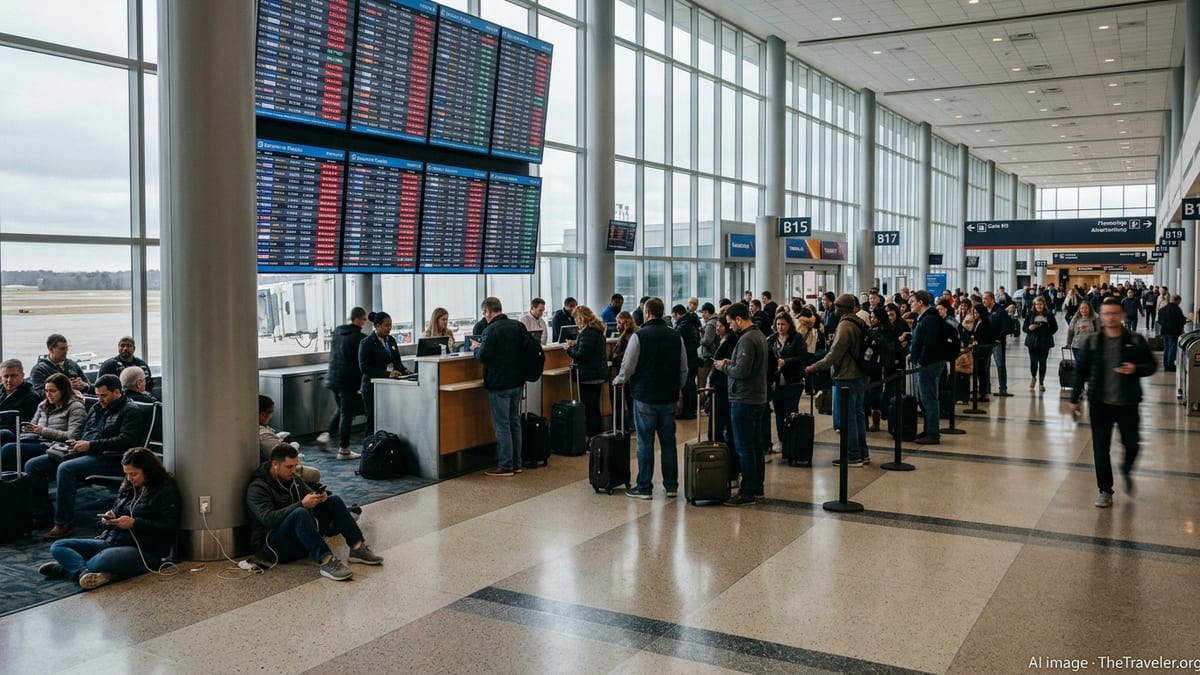
Inside the terminal, the operational stress has translated into familiar scenes: crowded concourses, lengthy queues at customer service desks and packed gate areas as rolling updates to departure times flash across information screens. Social media posts and user-generated travel forums from March show passengers describing extended waits for rebooking assistance and overnight stays when the last flights of the day cancel or depart full.
Historical on-time performance figures for Charlotte indicate that even on typical days, tight connection windows can prove challenging when weather or air traffic control programs intervene. During disruption events, passengers arriving from delayed feeder flights can miss onward departures by minutes, only to find that subsequent services are oversold or already impacted by earlier schedule cuts.
Publicly available consumer guidance from aviation regulators and advocacy organizations notes that passengers in these situations are often left to navigate a patchwork of policies. While Canadian and European rules provide defined compensation and care obligations in many cases, U.S. regulations largely focus on safety and disclosure rather than reimbursement, leaving goodwill and airline-specific customer service commitments to fill the gap.
As a result, travelers attempting to reach destinations in Canada, Germany or the United Kingdom via Charlotte may encounter different levels of assistance depending on whether their disrupted segment is governed by North American or European standards, and whether their itinerary is on a single ticket or split across carriers.
Outlook: Gradual Stabilization but Continuing Vulnerability
Forward-looking forecast products suggest that the worst of the current weather pattern may ease over the coming days, which could allow Charlotte Douglas and its tenant airlines to work through backlogs and gradually restore more predictable operations. American and other carriers typically deploy reserve aircraft, extended crew duty windows where permitted and schedule thinning to reset their networks after significant disruption.
However, operational analyses and past performance trends point to ongoing vulnerability at large hub airports like Charlotte as spring advances. The transition from winter storms to convective thunderstorm season in the southeastern United States can bring a different set of challenges, with sudden ground stops, lightning alerts and capacity reductions that are harder to forecast precisely.
Travel planners and corporate travel managers monitoring current conditions are likely to factor Charlotte’s recent difficulties into near-term routing decisions, especially for critical international trips. Some may temporarily favor routings through alternative hubs less exposed to the combination of East Coast weather and heavy banked schedules, even if that requires additional connections or slightly higher fares.
For now, publicly available data indicate that delays and cancellations at Charlotte Douglas remain elevated compared with a typical March weekday, and travelers connecting through the airport in the next 24 to 48 hours may continue to experience longer-than-usual journeys as airlines work to reposition aircraft and crews across their U.S., Canadian and European networks.