

More news on this day
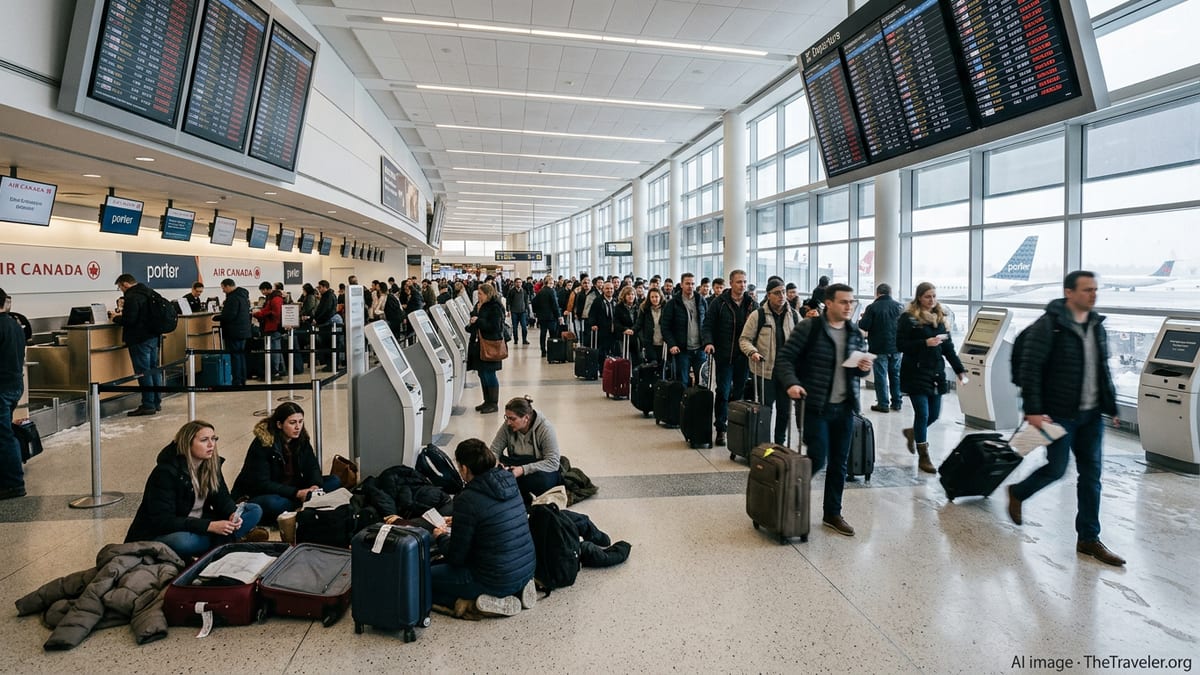
Travelers across Canada and the United States faced widespread disruption as Toronto Pearson International Airport reported 62 flight cancellations and more than 200 delays, affecting services operated by Jazz, Endeavor Air, Air Canada, Porter Airlines, Republic and other carriers and rippling across major hubs in New York, Sudbury, Washington, Orlando, Miami and additional destinations.
Get the latest news straight to your inbox!
Operational Strain at Canada’s Busiest Hub
Toronto Pearson, Canada’s largest and busiest airport, entered another period of heavy disruption as adverse weather and airfield constraints converged with already stretched airline operations. Publicly available tracking data for the current travel day show 62 cancelled departures and arrivals and well over 200 flights running late, pointing to a difficult start for thousands of passengers using the hub.
The bulk of affected services involve regional and transborder operations marketed by major carriers but largely flown by their partners. Flights under the Air Canada Express banner, many operated by Jazz, as well as services tied to U.S. regional operators such as Endeavor Air and Republic, feature prominently among the cancellations and extended delays. Porter Airlines, which has been rapidly expanding at Pearson, is also listed among the carriers facing schedule disruption.
Reports indicate that the pattern of delays began early in the day, during the morning peak, and has persisted into later banked departure waves. As a result, aircraft and crews have become out of position, amplifying knock-on effects throughout airline networks and limiting the ability of carriers to recover their schedules quickly.
Travel data platforms and local aviation observers note that even when weather conditions begin to improve, congestion, ground handling backlogs and crew duty-time restrictions can keep the operation under strain for many hours, creating a rolling effect that extends well beyond Toronto.
Ripple Effects Across New York, Washington and Other U.S. Gateways
The disruption at Toronto Pearson is radiating across key U.S. airports, particularly in the Northeast and along the East Coast. Flights linking Pearson with major New York-area airports, including LaGuardia and Newark, have seen a mix of outright cancellations and late departures, leading to missed connections and extended layovers for passengers traveling onward across the United States and internationally.
Endeavor Air and Republic, which operate a significant share of regional services for large U.S. network airlines, appear among the impacted operators on transborder routes. Delayed or cancelled departures from Toronto are feeding into congested schedules at New York and Washington, where limited gate availability and air traffic control spacing requirements can further slow recovery.
Washington-area airports, including Reagan National and Dulles, are reporting inbound services from Toronto arriving substantially behind schedule. Travelers connecting to domestic flights in the U.S. capital region have faced rebookings and, in many cases, overnight stays as evening delays compress connection windows.
Further south, Orlando and Miami are also feeling the knock-on effects. While weather in Florida remains comparatively more stable, flights from Toronto are departing late, resulting in after-midnight arrivals and disruptions to ground transportation and accommodation plans for holidaymakers and cruise passengers.
Regional Links to Sudbury and Other Canadian Cities Disrupted
The impact is not limited to cross-border travel. Regional routes within Canada using Toronto Pearson as a central hub have also been hit, with flights to and from smaller cities such as Sudbury experiencing cancellations and lengthy delays. For many communities, these services represent essential links for business, medical travel and family visits, leaving passengers with limited alternatives when the schedule unravels.
Jazz-operated flights under the Air Canada Express brand and services flown by Porter Airlines are central to these regional networks. When aircraft and crews are delayed on earlier segments, flights to smaller markets are often among the first to be rescheduled or cancelled, as airlines prioritize long-haul and high-demand trunk routes in their recovery plans.
Publicly accessible flight status boards show that some regional departures have been pushed back multiple times over the day, while others have been removed entirely as cancellations. Travelers attempting same-day returns or short business trips are particularly vulnerable, with many forced into overnight stays or last-minute changes to their itineraries.
Observers note that winter in Canada routinely exposes the fragility of regional connectivity, where even modest schedule disruptions at major hubs can cascade into days of limited service for smaller centers that depend on a thin network of daily flights.
How Weather and Runway Constraints Compound Delays
Recent periods of heavy snow, low visibility and high winds in southern Ontario have tested airport and airline resilience. At Pearson, reduced runway availability and de-icing requirements can significantly lower the arrival and departure rates, forcing air traffic managers to meter flights into and out of the airport and triggering ground delay programs that quickly translate into long lines of waiting aircraft and accumulating delays.
Observers tracking today’s operation report that Pearson has at times been operating with constrained runway configurations, which typically reduce the number of aircraft that can safely take off and land per hour. When combined with the need for extensive de-icing and careful separation between aircraft in poor weather, the result is a steep drop in capacity that airlines must absorb by delaying or cancelling flights.
Once the day’s schedule is disrupted, aircraft and crew rotations become increasingly difficult to manage. Airlines rely on tightly timed sequences of flights, and a delay of even an hour early in the morning can echo through multiple legs, often forcing carriers to proactively cancel later services to remain compliant with crew duty rules and maintenance requirements.
Industry analyses frequently point out that Pearson’s role as a global hub magnifies these challenges. Any significant reduction in throughput can quickly spread to connecting airports in the United States and abroad, where inbound delays from Toronto impact departure banks and international connections.
What Travelers Can Expect in the Coming Days
Based on the scale of today’s disruptions, publicly available information suggests that recovery may take time, particularly for airlines relying on complex regional networks and tight aircraft utilization. Even if weather conditions stabilize and runway capacity increases, residual delays may persist as carriers reposition aircraft and crews and work through backlogged passenger rebookings.
Travel and aviation trackers advise passengers booked to or from Toronto Pearson, as well as those connecting through New York, Washington, Orlando, Miami and affected regional cities, to monitor flight status frequently on the day of travel. Same-day schedule changes remain likely while airlines attempt to rebalance their operations and clear congestion.
Operational data and recent patterns at Pearson suggest that early morning flights the day after a major disruption can also be at risk, especially when aircraft overnighting at other airports arrive later than planned. Travelers with time-sensitive commitments may wish to allow additional buffer time or consider alternative routings where feasible.
While the current episode is one of many that have affected Toronto Pearson in recent winter seasons, it underscores the vulnerability of tightly interconnected airline networks. A localized surge of cancellations and delays at a single hub can swiftly become a multi-city event, affecting travelers far beyond the original point of disruption.