

More news on this day
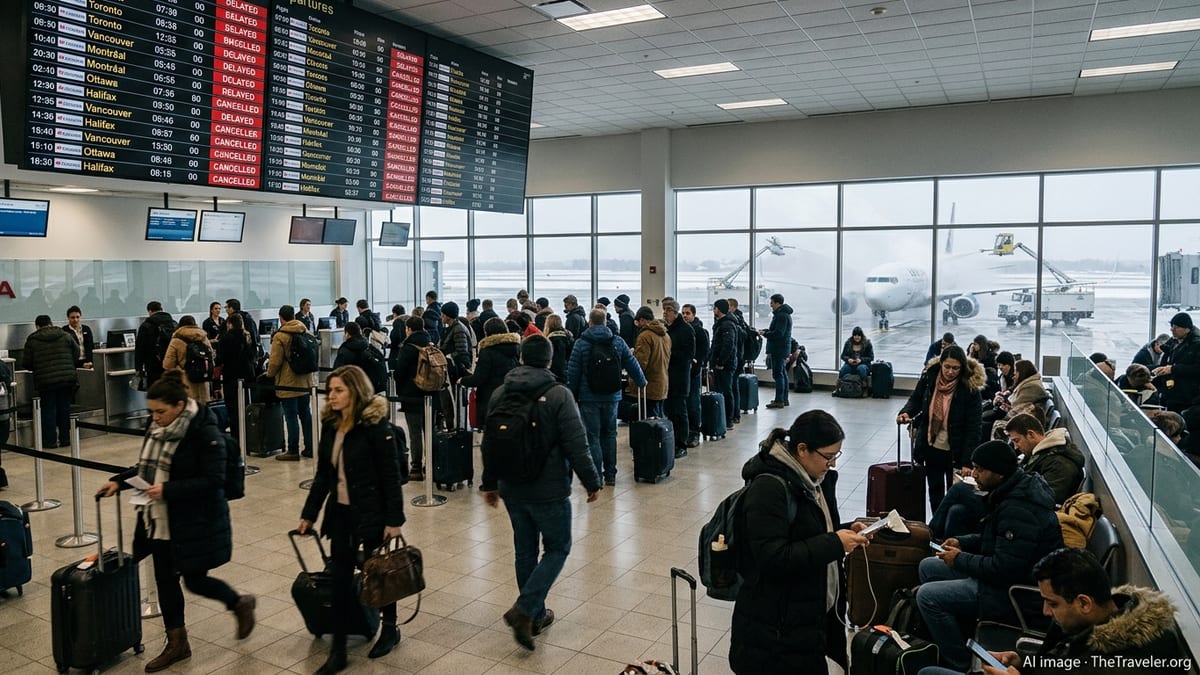
Hundreds of air travelers across Canada faced hours of disruption today as a late-winter storm system and knock-on operational challenges triggered at least 331 delayed and 28 cancelled flights at major hubs including Toronto, Vancouver, Montréal, Ottawa and Halifax, affecting services on Air Canada, WestJet, Jazz, PAL Airlines, Air Borealis, Porter Airlines and several smaller carriers.
Get the latest news straight to your inbox!
Weather System Keeps Canada’s Major Hubs On Edge
Today’s disruptions unfolded as Canada remained on the northern fringe of a powerful mid-March storm complex that has been sweeping across North America in recent days, combining heavy snow, high winds and rapidly shifting visibility in some regions with rain and low cloud in others. Publicly available weather data shows that the broader system has already produced blizzard conditions and widespread travel impacts in parts of the United States, with ripple effects extending into Canadian airspace as aircraft and crews fall out of position.
While conditions varied airport to airport, intermittent low ceilings, gusty crosswinds and periodic snow or freezing drizzle around key hubs pushed airport operations into a stop-and-go pattern. That environment typically reduces runway throughput, stretches de-icing resources and forces airlines to add extra buffer time between flights, a combination that tends to translate directly into mounting delays on departure boards.
In Canada’s busiest corridors, even modest weather-related slowdowns can quickly magnify into systemwide disruption. When traffic backs up at Toronto Pearson or Vancouver International, aircraft scheduled to continue on to Montréal, Ottawa, Halifax and smaller regional airports may arrive hours late or not at all, triggering a cascade of schedule changes that is felt well beyond the immediate storm track.
Toronto, Vancouver and Montréal Bear the Brunt
Toronto Pearson International and Vancouver International once again shouldered much of the strain, with real-time tracking data and airport information boards showing a dense band of delayed departures and arrivals across domestic and transborder routes. These two hubs, which anchor the national networks of Air Canada, WestJet and their regional partners, are particularly vulnerable when adverse weather shrinks usable runway capacity or slows ground handling.
At Montréal–Trudeau, operations also came under pressure as the knock-on effects from Toronto and western Canada met localized weather and congestion. Aircraft arriving late from other hubs compressed already-tight turn times and forced airlines to juggle which routes would depart first once gates, crews and de-icing equipment became available. For passengers, that often meant departure times creeping back in multiple small increments rather than a single, clearly defined delay.
The combination of late-arriving aircraft and weather-driven spacing requirements in the terminal area airspace slowed arrivals and departures into Canada’s three largest cities throughout the day. Hour-to-hour conditions were fluid, with some flights able to depart close to on time between bands of poor weather, while others waited for revised takeoff slots, additional de-icing or replacement crews that had themselves been delayed elsewhere in the network.
Ottawa, Halifax and Regional Routes Feel the Ripple Effect
Ottawa and Halifax, although smaller than the country’s primary hubs, saw outsized disruption relative to their usual traffic levels. These airports rely heavily on feed from Toronto, Montréal and, to a lesser extent, western gateways such as Vancouver and Calgary. When larger hubs slow down or temporarily reduce arrivals, connecting flights into regional centers are often among the first to be delayed, consolidated or cancelled.
In Atlantic Canada, publicly available flight-status boards showed scattered cancellations and broad delays on services linking Halifax with Toronto, Montréal and other eastern cities. Regional operators such as PAL Airlines, Air Borealis and feeder services branded under larger carriers had to adjust as aircraft and crews became misaligned with their planned rotations. In some cases, one long delay early in the day was enough to disrupt an entire chain of short-haul flights.
Ottawa experienced similar secondary impacts. As airlines prioritized limited aircraft and crew resources for the busiest trunk routes, some departures to and from the national capital shifted to later time slots or were paired with alternative connections. For travelers holding tight same-day itineraries, even a relatively small schedule change could translate into missed meetings, disrupted onward travel and unexpected overnight stays.
Airlines Stretch Operations Amid Compounded Strain
Network data and publicly available operational dashboards indicate that the day’s 331 delays and 28 cancellations were spread across most major Canadian carriers. Air Canada and WestJet, along with their regional partners Jazz and PAL Airlines, accounted for a significant share simply by virtue of their scale. Porter Airlines and other smaller operators were not spared, particularly on routes that depend on precise timing to maintain connectivity.
Weather-sensitive procedures added to the operational load. When precipitation and low temperatures coincide, every departure may require de-icing, a safety step that lengthens turn times and consumes limited equipment. Ground crews must also navigate slippery ramps and changing wind conditions, which can prompt temporary pauses for safety reasons even when runways remain open. Each of these small delays compounds across a tightly scheduled network.
Carriers have limited tools available on days like this. They can pre-emptively trim schedules, swap aircraft types to protect higher-demand routes, or consolidate lightly booked flights, but each option leaves some passengers facing longer waits or more complex connections. Recovery can take several days, particularly where aircraft and crews must be repositioned across a country as large as Canada.
Passengers Confront Long Lines and Complex Rebooking Choices
For travelers, today’s disruptions translated into crowded terminals, long customer-service queues and rapidly shifting options for rebooking. Reports from airports and social media posts described passengers tracking their flights across multiple apps and displays, only to see departure times move repeatedly as inbound aircraft, crews and weather conditions changed in near real time.
Canada’s Air Passenger Protection Regulations set out minimum standards for communication, care and, in some circumstances, compensation, but the practical experience can still be uneven. When delays are classified as caused primarily by weather or air-traffic constraints, financial compensation is often limited, even if travelers incur extra hotel, meal or ground-transportation expenses while they wait for a new departure.
Travel advisories and publicly available guidance frequently emphasize advance preparation on days like this: checking flight status before leaving for the airport, allowing extra connection time, traveling with essential medications and valuables in carry-on baggage, and understanding an airline’s rebooking policies. As today’s events showed, once a large portion of the national network is disrupted, options can narrow quickly, and those who act early are often best positioned to secure scarce seats on the first recovering flights.