

More news on this day
Air travel across the United States and Canada continued to unravel this weekend as a powerful storm system and rolling operational disruptions triggered hundreds of delays and cancellations from Savannah and Memphis to Raleigh and Toronto, with Philadelphia International Airport alone logging 144 delayed flights and 80 cancellations in a rapidly escalating travel crunch.
Get the latest news straight to your inbox!
Storm System and Thunderstorm Threat Spread Across Key Hubs
The latest round of disruption is unfolding alongside an evolving storm complex affecting large portions of the eastern United States from March 15 to March 17, 2026. Forecasts point to severe thunderstorms, strong winds and localized flooding that are already prompting schedule waivers and precautionary changes by major carriers.
Publicly available information on airline advisory channels highlights a growing list of airports covered by weather waivers, including Savannah, Raleigh-Durham and several other southeastern gateways. Travelers are being encouraged to shift flights within designated date ranges without change fees, a measure aimed at reducing the number of passengers stranded at terminals as conditions deteriorate.
In Canada, lingering impacts from an active winter season and ongoing system congestion are compounding the effect of the new storm band. Toronto, which has already experienced heavy weather and significant schedule strain in recent weeks, is again reporting knock-on delays as aircraft and crews struggle to reposition on time across the transborder network.
Although some routes are operating under clear skies, aviation analysts note that the interconnected nature of airline schedules means disruptions in one storm-hit region can quickly ripple to cities hundreds of miles away. Aircraft and crew arriving late to hubs such as Philadelphia or Toronto can cascade delays through subsequent departures, even in areas experiencing relatively calm weather.
Philadelphia International Becomes a Focal Point of Disruption
Against this backdrop, Philadelphia International Airport emerged as one of the most heavily affected U.S. hubs on Saturday, with operational data indicating 144 flights delayed and 80 canceled within a single reporting window. These figures place Philadelphia among the nation’s most disrupted airports for the day, underscoring its vulnerability during large-scale weather and system events.
Industry performance reports have previously highlighted Philadelphia’s sensitivity to congestion and weather, noting that a combination of tight runway capacity, dense schedules and East Coast airspace constraints can magnify the impact of even modest disturbances. The fresh wave of delays and cancellations illustrates how quickly conditions there can deteriorate once thunderstorms or low ceilings move into the region.
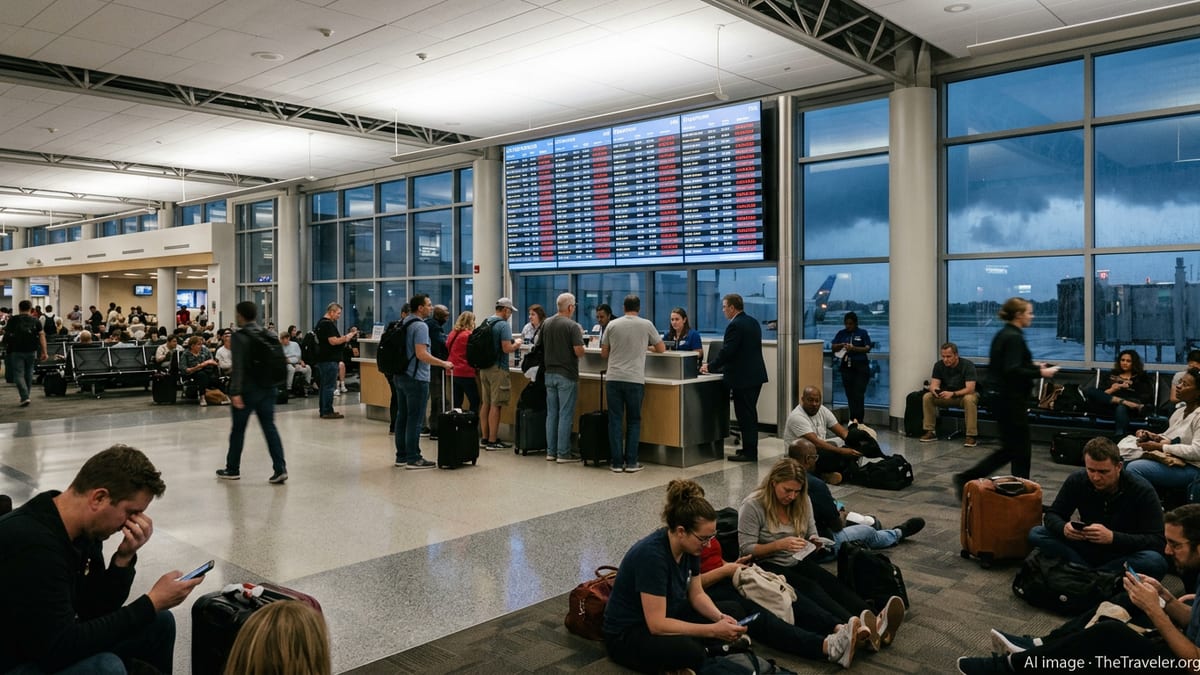
Passengers at Philadelphia reported crowded concourses, long lines at rebooking counters and departure boards dominated by red and yellow status indicators. With dozens of flights scrubbed outright and many more pushed back by hours, travelers scrambled for scarce alternatives, including same-day departures on other carriers or reroutes through less congested hubs.
Operational summaries show that both domestic trunk routes and shorter regional services were affected, with feeder flights to smaller communities particularly vulnerable. When these regional legs are canceled, travelers often face limited options for same-day recovery, amplifying the overall sense of disruption.
Ripple Effects Hit Savannah, Memphis, Raleigh, Toronto and Beyond
The turbulence was far from confined to Philadelphia. Across the Southeast and Mid-Atlantic, reports from airline operations and traveler accounts describe extensive knock-on impacts in secondary hubs and regional airports.
In Savannah, storms and air-traffic flow restrictions contributed to a string of afternoon and evening delays, prompting many passengers with onward connections to rebook through alternate cities. Memphis and Raleigh-Durham, both sitting near the core of the current thunderstorm corridor, saw rolling delays as carriers throttled departures to keep spacing between storms and to manage congestion at downline hubs.
North of the border, Toronto Pearson International Airport continued to grapple with a fragile recovery after a winter dominated by multiple major snow and wind events. While conditions at times appeared manageable on the ground, the cumulative effect of re-routed transborder flights, delayed inbound aircraft and weather-related ground holds elsewhere meant passengers in Toronto still encountered extended waits and missed connections.
Smaller and mid-sized airports across the U.S. Northeast and Great Lakes region also reported disruption, though often at lower absolute numbers. For travelers, the practical impact felt similar: crowded gates, limited rebooking options and growing uncertainty about when normal operations might resume.
Travelers Rush for Alternatives as Options Narrow
As delays lengthened through the day, passengers increasingly turned to alternative arrangements in a bid to salvage weekend plans. Car rental agencies at several affected airports reported brisk demand as travelers opted to drive midrange regional routes rather than wait for increasingly uncertain flights. In some locations, rental lots reached near-capacity, leaving late-arriving customers with few or no vehicles available.
Rail and intercity bus providers along major corridors such as the Northeast and Mid-Atlantic saw a parallel uptick in same-day bookings. While these services were not immune to weather-related slowdowns, they offered a measure of predictability for travelers facing repeated flight pushbacks or outright cancellations.
Digital tools played a growing role in how passengers navigated the disruption. Airline apps and third-party platforms offered real-time status updates and rebooking functionality, but high traffic occasionally led to slow response times or limited visibility into future seat availability. Experienced travelers emphasized the importance of monitoring developing patterns across multiple airports, not just the city of departure.
Even for those who managed to depart on schedule, anxiety about the broader system remained high. Many passengers facing connections in Philadelphia, Toronto or other constrained hubs braced for extended layovers or unexpected overnight stays as the day’s disruptions worked through the network.
Structural Strains and Seasonal Volatility Expose System Weaknesses
While the current wave of disruption has been catalyzed by a specific storm complex, analysts point to broader, longer-running pressures on North American aviation that help explain why such events produce outsized consequences. Staffing challenges in air traffic control and ground operations, tight aircraft utilization schedules and crowded airspace over key corridors all contribute to a system that has limited slack when weather turns volatile.
Recent federal and industry documents have underscored persistent shortages at some air traffic facilities, particularly in the busy Northeast corridor, which can lead to ground delays and flow-control measures even on marginal weather days. When severe storms sweep through the same region, these structural constraints intensify, forcing airlines to thin schedules and accept higher levels of delay and cancellation.
In Canada, a succession of powerful winter storms and operational interruptions during the 2025 to 2026 seasons has left airlines and airports working to rebuild resilience. Each new weather system intersects with an already stressed operating environment, where aircraft and crews are often out of position and recovery windows are short.
For travelers, the practical takeaway is that seasonal volatility across the U.S. and Canada is now more likely to translate into tangible disruptions at the airport. Consumer advocates recommend that passengers build additional buffer time into itineraries, especially when connecting through weather-prone hubs such as Philadelphia or Toronto, and remain prepared to pivot quickly to ground transportation or alternate routings when conditions begin to deteriorate.