

More news on this day
Storm Therese has swept across the Canary Islands, battering Tenerife with near 100 kilometre per hour winds, intense rainfall and rare mountain snowfall that disrupted transport links and reshaped the experience for residents and visitors across the island.
Get the latest news straight to your inbox!
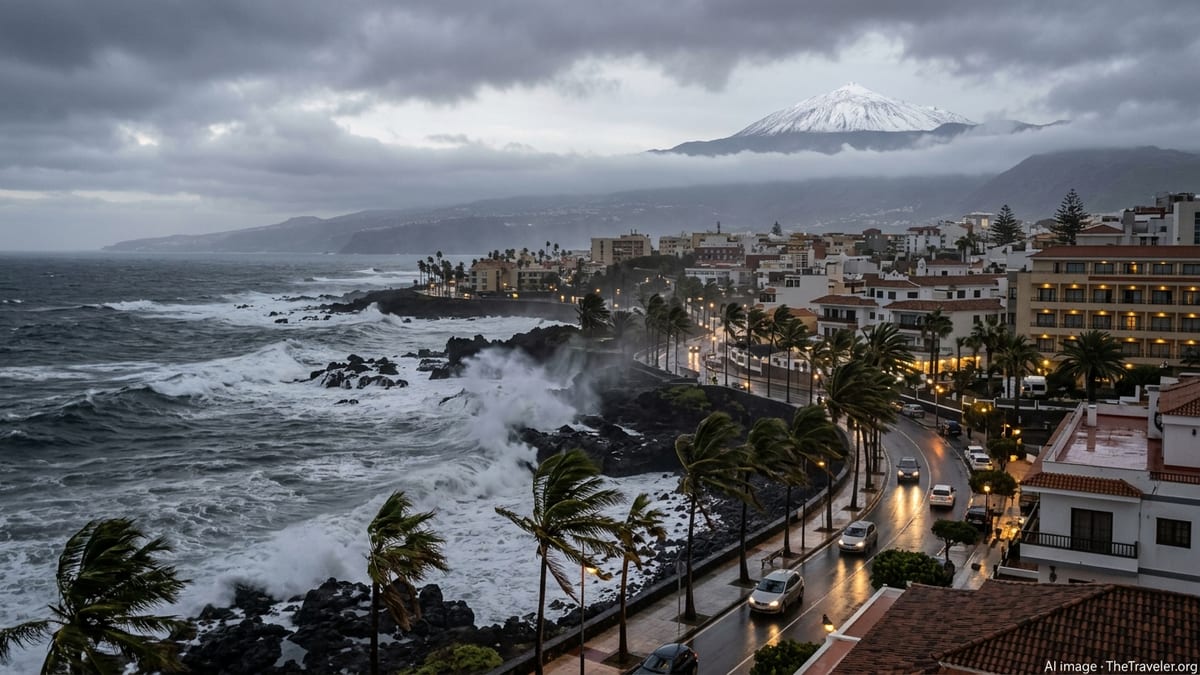
Powerful Atlantic storm slams into the archipelago
Publicly available meteorological data and regional media reports indicate that Storm Therese formed as a vigorous Atlantic low before curving toward the Canary Islands, reaching the archipelago with peak impacts over Tenerife. As the storm crossed the island, exposed ridges and higher elevations registered wind gusts approaching 100 kilometres per hour, while lower coastal areas endured squally conditions, rough seas and intermittent power interruptions.
Rainfall totals quickly climbed as moist Atlantic air fed into the system. Local press coverage and weather bulletins describe widespread downpours, with some gauges on the windward slopes of Tenerife collecting large accumulations in just a few hours. The combination of wind and rain produced rapidly changing conditions on the main tourist coasts, with palm trees bending in the gusts and visibility reduced by sweeping squalls.
The state meteorological service issued tiered alerts for wind, rain and coastal conditions across the islands, with Tenerife among the territories facing the most prolonged impacts. Ferry operators adjusted timetables in response to high waves, while some inter-island and mainland links experienced delays or cancellations as the storm’s strongest band moved through.
Snow transforms Teide and highland landscapes
Alongside the wind and rain at sea level, Storm Therese delivered a striking change in the high country of Tenerife. Cold air circulating around the core of the low combined with deep moisture to lower the snow line, bringing fresh accumulations to the slopes of Mount Teide and other elevated areas of the island’s interior.
Images shared by regional outlets show Teide National Park and surrounding ridges coated in white, with roads leading toward the summit zone partially covered by compacted snow and ice. According to operational updates from road and park authorities, sections of access routes to the higher viewpoints were closed or restricted while crews worked to clear snow, remove fallen rocks and assess the risk of ice.
For many visitors, the sudden contrast between stormy beaches and a snow-dusted volcanic cone highlighted the island’s dramatic vertical climate range. Tour operators adapted quickly, with some excursions rerouted to lower-level viewpoints and forest trails, while high-altitude trekking and sunrise tours to the summit area were temporarily suspended until conditions stabilised.
Transport disruption and localised flooding on Tenerife
The intense rainfall and strong gusts associated with Storm Therese triggered a series of localised impacts across Tenerife’s road and transport network. Media reports from the island describe temporary flooding in underpasses and low-lying urban stretches, particularly on the windward side where orographic uplift intensified the heaviest showers.
Drainage systems were briefly overwhelmed in some neighbourhoods, leading to minor street flooding and surface water on key routes linking resort areas with the main population centres. Traffic authorities issued advisories urging drivers to reduce speed, avoid waterlogged stretches and exercise caution on mountain roads where rockfalls, fallen branches and patches of ice were reported.
At Tenerife’s airports, operations continued under challenging conditions. Publicly accessible flight information showed a pattern of delays and occasional cancellations as strong crosswinds and reduced visibility coincided with peak storm periods. Airlines adjusted schedules and temporarily suspended some rotations, particularly during the most intense squalls, before gradually resuming normal activity as the system began to move away.
Impact on tourism and coastal activities
As one of Europe’s most popular winter-sun destinations, Tenerife felt the storm’s effects most visibly along its resort-lined coasts. Beachfront promenades in areas such as Costa Adeje, Playa de las Américas and Puerto de la Cruz saw high surf, blown sand and periods of driving rain that curtailed outdoor dining and watersports.
Lifeguard services and local councils temporarily restricted bathing and closed some access points where rough seas and powerful rip currents posed a risk. Surf conditions intensified along exposed shorelines, drawing experienced local surfers but prompting warnings against entering the water in less sheltered spots.
Hotel operators and tourism businesses monitored updates from meteorological and civil protection channels, adjusting activities to indoor or sheltered options while the worst of the weather passed. Reports from visitor forums and local media suggest that many travellers treated the event as a short-lived interruption, using the time to explore museums, historic town centres and inland villages less affected by coastal spray and wind.
Climate context and outlook for the Canary Islands
Storm Therese adds to a recent sequence of high-impact Atlantic systems that have affected the Canary Islands in recent seasons, bringing combinations of heavy rain, strong winds and, at times, unusual snowfall to the higher peaks. Climatological studies and expert commentary in European media have pointed to a trend toward more frequent episodes of intense precipitation linked to a warmer atmosphere capable of holding greater moisture.
Researchers focusing on the North Atlantic and subtropical eastern ocean have noted that shifts in storm tracks and blocking patterns can occasionally steer stronger low-pressure systems toward the Canary archipelago. When this coincides with cooler upper-level air, the result can be the kind of mixed rain, wind and snow event observed on Tenerife during this episode.
In response, regional planning documents and risk assessments increasingly highlight the need to adapt infrastructure, coastal defences and tourism operations to more volatile weather. For visitors, the main takeaway from Storm Therese is the importance of monitoring official bulletins, remaining flexible with itineraries and recognising that even traditionally mild winter destinations like Tenerife can occasionally experience powerful Atlantic storms that temporarily reshape the island’s familiar sunny image.