

More news on this day
A powerful late-winter storm system sweeping across the eastern United States has severely disrupted operations at Raleigh–Durham International Airport, triggering hundreds of delays and cancellations and turning one of the Southeast’s key air hubs into an epicenter of travel chaos.
Get the latest news straight to your inbox!
Storm System Slams a Key East Coast Hub
Publicly available weather and aviation data indicate that the storm system affecting Raleigh–Durham International Airport (RDU) between March 16 and March 18, 2026, is part of a broader North American storm complex bringing heavy rain, strong winds, and severe thunderstorms to much of the Mid Atlantic and Southeast. The same system has produced blizzard conditions in the Upper Midwest and High Plains, ice in parts of the Great Lakes region, and disruptive thunderstorms across the Carolinas and neighboring states.
As the storm shifted east, conditions over central North Carolina deteriorated, with bands of intense rainfall and embedded thunderstorms moving repeatedly over the Triangle region. The combination of low cloud ceilings, reduced visibility, and crosswinds near or above safe operating thresholds for some aircraft types prompted airlines to thin out their schedules and cancel large blocks of flights into and out of RDU.
Flight-tracking services show that, at the height of the disruption, RDU was reporting waves of cancellations and long strings of delayed departures and arrivals, mirroring similar patterns at major hubs along the East Coast. The rolling impact extended from early morning departures to late-evening arrivals, leaving many aircraft and crews out of position and compounding the disruptions into the following day.
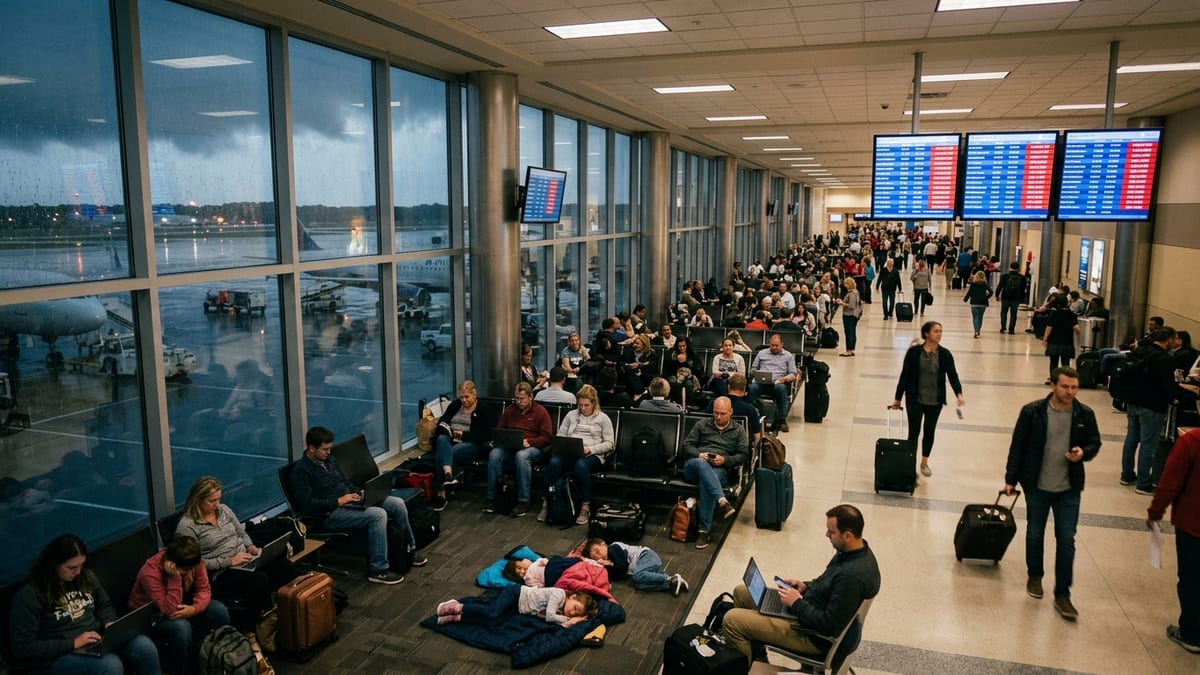
Reports from travelers across social platforms describe crowded concourses, long rebooking lines, and departure boards dominated by red cancellation notices as the storm peaked. Although RDU is accustomed to summer thunderstorms and occasional winter weather, the timing and geographic reach of this multi-day event left little room in the network for quick recovery.
Hundreds of Flights Scrapped as Airlines Reset Schedules
According to publicly accessible flight-status data, airlines serving Raleigh–Durham preemptively canceled a significant share of their scheduled operations for March 17 and March 18, especially during the afternoon and evening periods when the strongest storms and wind shear were forecast. These cancellations affected both mainline and regional flights, including key connections to major hubs such as Atlanta, Chicago, Newark, and Washington.
While the total number of affected flights at RDU continues to evolve as airlines make day-of adjustments, the disruption is being described in aviation tracking summaries as one of the more severe weather-related episodes for the airport in recent years. The impact was amplified by cascading delays across the national network, with aircraft bound for RDU held or canceled at origin airports due to ground stops and convective weather along their routes.
Some carriers issued weather waivers that allowed customers traveling through RDU and other East Coast airports on March 16 and March 17 to change their plans without additional fees, reflecting expectations of significant operational challenges. Travelers who were able to adjust their journeys to earlier or later dates often avoided the worst of the disruption, while those with limited flexibility found themselves facing overnight stays or multi-stop reroutings through less-affected hubs.
Industry observers note that large-scale cancellations, while disruptive in the short term, can sometimes reduce the duration of chaos by preventing extended backlogs of delayed flights. At RDU, the aggressive thinning of the schedule appears aimed at enabling a cleaner restart once the most volatile weather clears the region.
Ripple Effects Across the Triangle and Beyond
The storm’s impact at RDU has extended well beyond the airport perimeter, affecting business travelers, vacationers, and local residents with tight connections to national and international itineraries. Reports on regional forums and social channels indicate that some travelers diverted to or from other East Coast airports found themselves unexpectedly rerouted through Raleigh, only to encounter additional delays as the storm evolved.
Ground transport around the airport has also felt the strain. Ride-share wait times and taxi demand have increased as travelers with canceled evening flights searched for last-minute hotel rooms or alternative ways to reach nearby cities such as Charlotte, Richmond, and Washington. Hotel properties near the airport and along major interstate corridors around the Triangle have reported elevated same-day check-in activity as stranded passengers sought rooms when rebooked departures slipped to the following day.
The cancellations have also affected inbound traffic to the region, with visitors arriving for conferences, university events, and spring-break trips forced to adjust their plans. For some, rebooking has required routing through secondary hubs or accepting lengthy layovers in distant cities, underscoring how a single storm can stress the intricate web of domestic air travel.
Local economic impacts are still being assessed, but extended disruptions at airports like RDU can translate into reduced spending at nearby restaurants, rental car counters, and tourism-focused businesses when visitors arrive late, shorten their stays, or cancel trips entirely.
What Travelers Are Experiencing on the Ground
Travelers passing through Raleigh–Durham during the storm have reported a wide spectrum of experiences, from relatively smooth rebookings handled via airline apps to lengthy in-person waits at customer service counters. With many flights canceled in advance, passengers with flexible schedules have described proactively changing to earlier departures or opting to travel on days outside the main storm window, often securing seats before rebooking queues swelled.
Others arriving at the airport to find their flights canceled have faced more complicated choices. Some travelers have described being offered routings involving multiple connections and overnight layovers, while others have opted to abandon their original itineraries in favor of renting cars and driving to destinations within a day’s reach, such as Atlanta, Nashville, or northern Florida.
Security checkpoint conditions have fluctuated with the ebb and flow of the schedule. At times when large clusters of rebooked flights were scheduled within narrow time windows, lines have lengthened considerably, particularly in the early morning and late afternoon. During periods when cancellations dramatically reduced departures, security lines have reportedly moved more quickly despite heightened passenger frustration.
Dining and seating capacity inside the terminals has also been tested. Photos and descriptions shared publicly show crowded gate areas, with many travelers camped out near charging stations as they monitor airline apps and flight boards for updated departure times and gate changes.
How Long the Travel Turbulence May Last
Forecasts for central North Carolina suggest that the most intense thunderstorm activity tied to the current storm complex will gradually shift eastward late on March 18, with improving conditions expected into March 19. However, aviation analysts caution that the operational fallout at RDU and other affected airports could linger beyond the immediate weather window.
After a large, multi-day disruption, it can take airlines several additional days to reposition aircraft and crews, especially when the storm’s footprint is as broad as this system’s. Residual delays, scattered cancellations, and last-minute schedule changes at RDU are therefore possible even after skies visibly improve, particularly on routes dependent on aircraft arriving from still-recovering hubs in the Midwest and Northeast.
Travel experts generally recommend that passengers with flights through RDU over the next several days continue to monitor their reservations closely, make use of mobile notifications, and consider traveling with carry-on luggage only to increase flexibility in the event of missed connections or unplanned reroutes. Those with critical time-sensitive commitments may find it prudent to build additional buffer time into their itineraries until airline operations fully stabilize.
For now, Raleigh–Durham International Airport finds itself at the center of an East Coast travel tangle, as a powerful storm system tests the resilience of airline schedules, airport infrastructure, and traveler patience at the height of a busy late-winter travel period.