

More news on this day
Chicago O’Hare International Airport faced another turbulent travel day on April 4, as a mix of spring thunderstorms, heavy holiday crowds and tight airline schedules converged to produce 314 flight disruptions and fresh frustration for passengers moving through one of the country’s busiest hubs.
Get the latest news straight to your inbox!
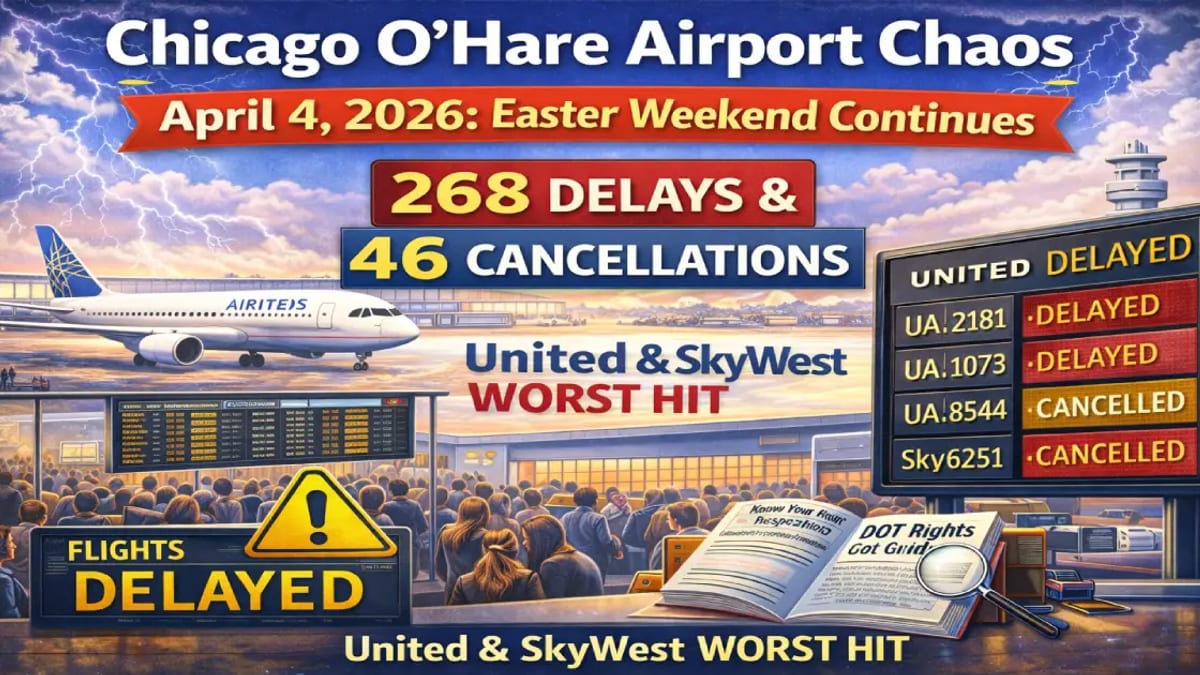
Weather Turbulence Meets Holiday Passenger Surge
The April 4 disruptions at O’Hare unfolded against an already strained backdrop for U.S. aviation, with weeks of rolling delays linked to late‑season winter weather and early spring storms across multiple regions. Forecasts had highlighted unstable conditions over the upper Midwest and Great Lakes, and radar imagery through the day showed bands of thunderstorms moving across northern Illinois and neighboring states.
Publicly accessible aviation and weather dashboards indicated that strong cells near Chicago prompted air traffic flow measures in the early morning and late afternoon periods, reducing the rate at which aircraft could land and depart. As is typical at complex hubs, even relatively short interruptions had a cumulative effect, leaving aircraft and crews out of position for later flights and inflating delay times as the day wore on.
The timing of the disruptions added extra pressure. The first weekend of April coincides with continued spring break travel and post‑Easter return flows, and recent coverage in national outlets has noted elevated passenger volumes nationwide during this period. At O’Hare, that meant thunderstorms were colliding not with a quiet weekday schedule but with banks of nearly full flights, turning each incremental delay into a significant customer service challenge.
In this context, the 314 recorded disruptions at O’Hare on April 4 formed part of a broader pattern rather than a stand‑alone weather blip. Data referenced in market analysis based on FlightAware statistics pointed to several thousand delays across the United States the same day, suggesting that issues at Chicago were both feeding into and receiving pressure from constraints at other major hubs.
Disruptions Concentrated Around Peak Banks
Operational data from the Chicago Department of Aviation’s public dashboard showed that delays at O’Hare were not evenly spread throughout the day. Early‑morning hours registered a cluster of late departures and arrivals, as overnight weather and inbound aircraft running behind schedule squeezed morning departure banks that are critical for onward connections.
Midday operations saw some improvement as traffic management initiatives eased and storm cells shifted east, with hourly counts of delayed flights dipping temporarily. However, by mid‑afternoon, another round of constraints associated with lingering thunderstorms and national airspace programs again tightened capacity. By evening, the cumulative result was 314 disruptions at O’Hare, including a mix of late departures, late arrivals and cancellations.
Observers of flight‑tracking feeds noted that even flights not directly routed through the worst weather were affected. Aircraft that had started the day in the Northeast or Texas often arrived late into Chicago, forcing crews up against duty‑time limits and prompting reassignments. These knock‑on effects mirrored patterns seen during other recent disruption episodes in early 2026, where localized weather triggered national network ripple effects.
While precise airline‑by‑airline breakdowns for April 4 were not immediately aggregated in public reports, earlier coverage of the spring disruption wave has highlighted that large network carriers and their regional affiliates, particularly those with heavy O’Hare schedules, are especially vulnerable when multiple banks are compressed by weather and traffic restrictions.
National Network Strain Amplifies Local Chaos
The turmoil at O’Hare on April 4 did not occur in isolation. Recent national reporting has described a “continuing wave of disruptions” across U.S. airports in spring 2026, attributing delays to a combination of severe weather, congested airspace at key hubs, and the lingering effects of earlier winter storms on airline schedules.
Market commentary based on FlightAware’s live statistics suggested that by early April 4, thousands of flights across the United States were already delayed, with Chicago, New York‑area airports, Boston and Dallas among the primary pressure points. These same analyses noted that thunderstorms near Chicago had led to average delay times of several hours on some routes in the preceding days, making O’Hare an outsized contributor to national totals.
Holiday demand intensified those pressures. Passenger counts at many major hubs remain elevated as carriers work through the tail end of spring break, and industry coverage indicates that aircraft are running with high load factors on numerous domestic and transatlantic routes. When flights are this full, options for reaccommodating disrupted travelers shrink, lengthening rebooking lines and extending the visible impact of each delay inside the terminals.
Reports from earlier in the season have also underscored how quickly localized issues at megahubs propagate. When an airport such as O’Hare slows down, connecting itineraries through secondary cities like Cleveland, Kansas City or Raleigh can also suffer, even when local conditions are calm. The April 4 figure of 314 disruptions at Chicago therefore represents not just a local headache but a contributing factor to wider network instability.
Regulatory Focus on O’Hare’s Chronic Congestion
The April 4 chaos landed amid growing regulatory attention on O’Hare’s congestion. In late February and March 2026, the Federal Aviation Administration published notices outlining plans for schedule reduction discussions at the airport, citing concerns about overscheduling, peak‑hour congestion and chronic delays. Public records show that stakeholders were invited to an early March meeting focused on potential voluntary schedule adjustments to improve on‑time performance.
These notices referenced an intent to reduce delays and cancellations by aligning planned operations more closely with the airport’s practical capacity, particularly during the busiest banks. While no formal caps on flights have been announced, the process signals a renewed effort to manage demand at O’Hare more proactively, drawing on similar approaches previously used at other congested hubs.
The April 4 disruption figures are likely to feed into that ongoing discussion. Although the day’s weather played a major role, the scale of knock‑on effects highlighted how sensitive the operation remains when schedules are tightly packed. Analysts following the issue have pointed out that even modest schedule thinning at peak times could create more buffer for recovery when thunderstorms or low clouds force temporary slowdowns.
At the same time, airline representatives in public forums have emphasized the importance of maintaining connectivity for smaller markets that rely on O’Hare as a primary link to the national and international network. Any future schedule adjustments would therefore need to balance delay reduction with preserving access, a tension that events like April 4 make more visible.
What Travelers Experienced on the Ground
Inside the terminals, the 314 disruptions translated into long waits at departure gates, crowded seating areas and frequent schedule changes on information boards. Local media imagery from recent peak‑travel weekends at O’Hare has already shown dense queues at security and check‑in, and April 4 appeared to follow a similar pattern as disrupted passengers sought rerouting or overnight accommodations.
Publicly available guidance from airlines and consumer advocates urges travelers caught in such scenarios to prioritize mobile apps and direct text or email alerts, which often update more quickly than terminal displays. During the April 4 episode, several large carriers encouraged customers via their digital channels to confirm flight status before heading to the airport and to consider voluntary rebooking where flexible policies allowed.
For those already at O’Hare, same‑day recovery options depended heavily on route and airline. On well‑served domestic routes, some passengers were likely shifted to later flights or alternate connections through other hubs. On transatlantic or late‑evening departures, however, limited frequencies meant that disruptions could extend into the following day, especially for travelers who had already experienced upstream delays before reaching Chicago.
Consumer advocates continue to highlight that U.S. regulations provide different levels of protection depending on whether a disruption is classified as weather‑related or as stemming from controllable operational issues. With thunderstorms playing a clear role in the April 4 slowdowns at O’Hare, many affected passengers may have encountered limited entitlements, amplifying frustration even as airlines worked to restore normal operations overnight.