

More news on this day
Thousands of passengers across the United States were left stranded or scrambling for alternatives this week as powerful late-winter storms and a protracted federal government shutdown combined to delay 4,123 flights and cancel 271 more at major hubs including Atlanta, Chicago, Houston, New York, Miami, and Detroit, disrupting operations for Delta Air Lines, Spirit Airlines, United Airlines, SkyWest, and other carriers.
Get the latest news straight to your inbox!
Storm System And Shutdown Combine To Cripple Major Hubs
Publicly available data from flight-tracking services and weather agencies indicate that a sprawling late-season storm system sweeping from the Midwest to the East Coast coincided with already stressed airport operations linked to the ongoing partial government shutdown. Heavy snow in the Upper Midwest, fierce crosswinds, and low visibility along the Eastern Seaboard narrowed runway capacity and forced crews to slow arrivals and departures at several of the nation’s busiest airports.
Atlanta’s Hartsfield-Jackson, Chicago O’Hare, Houston’s George Bush Intercontinental, New York-area airports, Miami International, and Detroit Metropolitan Wayne County all reported significant disruption windows, where a cascade of delays quickly translated into cancellations as crews and aircraft fell out of position. Travel industry analysts note that these interconnected hubs serve as critical nodes for domestic and international connections, multiplying the impact for passengers far beyond the immediate storm zone.
Reports indicate that airlines were already operating with less operational slack because of staffing pressures and extended security screening times during the shutdown period. When the storm complex arrived, the system’s limited resilience meant that even short ground stops or temporary runway closures triggered hours-long ripples through schedules across the country.
The result was a multi-day disruption that left thousands of travelers sleeping in terminals, rebooking onto later flights, or abandoning air travel altogether to try buses, trains, or one-way rental cars, particularly in regions where alternate airports were also heavily affected.
Delta, United, Spirit And SkyWest Shoulder Heavy Disruptions
According to aggregated flight-status tallies, network carriers and regional operators with dense schedules at the affected hubs bore the brunt of the 4,123 delays and 271 cancellations. Delta Air Lines, with a dominant presence in Atlanta and a strong footprint in Detroit and New York, saw large clusters of itineraries disrupted as storms and crew-placement challenges converged on already busy spring travel flows.
United Airlines, heavily reliant on Chicago and Houston as connecting hubs, experienced rolling delays that extended into subsequent days as aircraft arrived late and crews bumped up against duty-time limits. Observers tracking operations noted that even when weather cleared at one airport, downstream constraints at another hub often kept aircraft grounded or rerouted, slowing the recovery.
Low-cost carrier Spirit Airlines, which operates dense point-to-point schedules through Florida and other sunbelt destinations, was hit especially hard at airports like Miami, where storm-related capacity reductions forced ground delays and sequence shuffles. With thinner scheduling buffers and fewer spare aircraft, budget airlines can need longer to reset after a large weather event, leaving passengers facing tight rebooking options.
Regional operator SkyWest, which flies under the banners of multiple major airlines, also faced knock-on disruption as feeder flights into the big hubs were trimmed or canceled outright. That magnified the effect in smaller and midsize cities, where passengers often depend on a single daily connection to reach the national network.
Passengers Face Long Lines, Limited Options And Mounting Costs
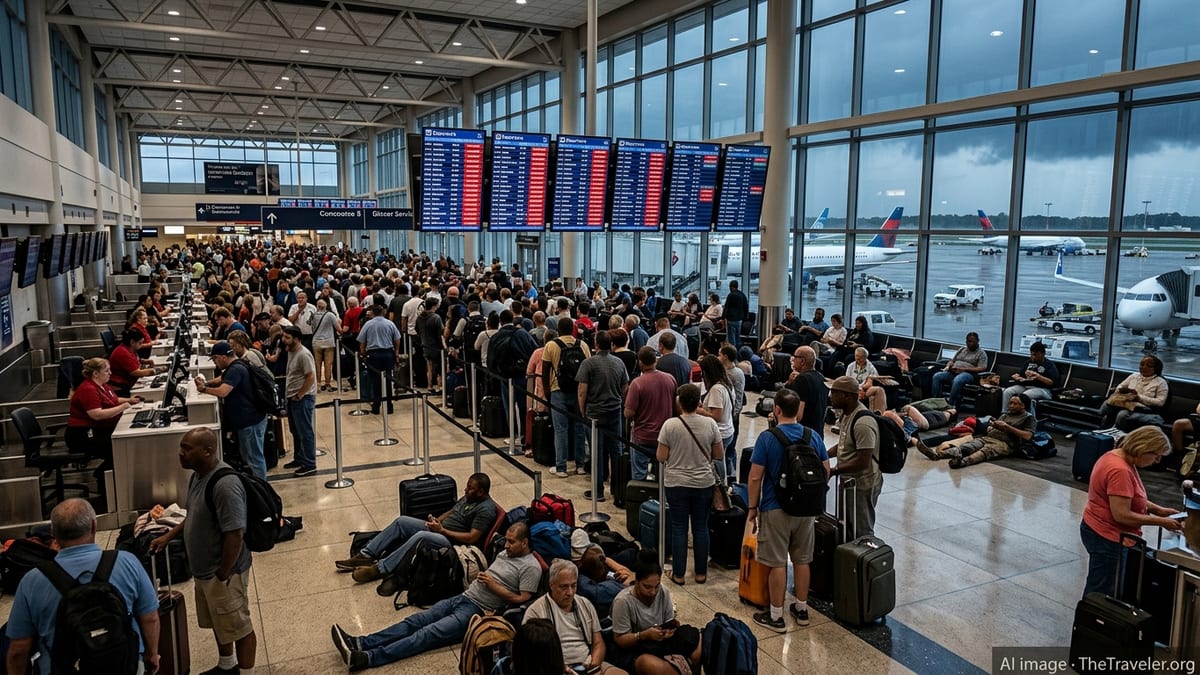
Scenes from terminals across the affected airports showed long lines at customer service counters, crowded gate areas, and departure boards filled with red and yellow delay codes. Travelers reported spending hours queuing to speak with airline agents, while others turned to mobile apps and call centers that themselves struggled to keep up with rebooking demand.
For many stranded passengers, the most immediate concerns were food, lodging, and onward transport. While individual airline policies vary depending on whether disruptions are categorized as controllable or weather-related, publicly available guidance from the U.S. Department of Transportation emphasizes that carriers are not always required to provide hotel rooms or meal vouchers when severe weather is the primary cause. That left some travelers paying out of pocket for unexpected overnight stays or last-minute tickets on competing routes.
The timing of the disruption, overlapping with early spring break travel and fans heading to major sporting events, heightened the strain. With planes already running near capacity, rebooking options were limited, and in some cases passengers were told the next available seat could be days away. Social media posts from multiple airports described families sleeping on the floor, travelers sharing phone chargers at crowded gate clusters, and rental car counters selling out in popular corridors.
For international passengers connecting through U.S. hubs, missed onward flights introduced additional complications, from reissued tickets and missed tours to the prospect of rearranging hotel stays overseas. Travel insurers and credit card protections may offset some of those costs, but only for travelers whose policies cover weather and government-related disruptions.
Wider Strains Expose Fragility Of The U.S. Air Travel System
Aviation reliability data from recent years shows that extreme weather, limited staffing, and tightly optimized schedules have made the U.S. aviation network increasingly vulnerable to large-scale disruption events. Analysts note that when multiple stressors arrive together, as with this storm complex and the prolonged shutdown, the system’s limited spare capacity becomes quickly visible to travelers.
Studies of historical delay patterns indicate that hubs like Atlanta, Chicago, New York, and Houston are particularly influential in propagating disruption because of their high share of connecting traffic. A ground stop at one major hub can trigger rolling delays at outstations hundreds or thousands of miles away as aircraft and crews miss their scheduled rotations, amplifying the effect of the original weather event.
Consumer advocates argue that the experience of passengers during this latest wave of delays and cancellations underscores the need for clearer, more consistent standards on passenger care, including transparent rules about meal vouchers, hotel accommodations, and rebooking options. They also point to the importance of better real-time communication, as many travelers reported learning of cancellations only after boarding times slipped repeatedly on information screens.
Industry groups meanwhile highlight long-term challenges such as aging air traffic control infrastructure, staffing constraints, and climate-linked increases in severe weather episodes. Each of these, they note, raises the likelihood that complex disruption events will continue to occur, particularly during peak travel seasons.
What Travelers Can Do As Recovery Continues
As airlines work through the backlog of delayed and canceled flights, recovery is expected to be uneven, with some airports clearing congestion faster than others. Travel experts advise that passengers still scheduled to fly through the affected hubs in the coming days closely monitor their flight status, sign up for airline text or app notifications, and consider shifting to earlier departures where possible to create additional connection buffers.
Publicly available guidance suggests that travelers facing long delays should document their disruption, save receipts for meals and hotels, and review their airline’s customer service commitments alongside any protections included with credit cards or travel insurance. In some cases, passengers may be eligible for reimbursements, credits, or alternative routing even when the underlying cause is categorized as weather.
For those yet to begin their trips, flexibility can be a valuable asset. Adjusting travel dates by a day or two, using secondary airports where feasible, or choosing flights earlier in the day can reduce exposure to cascading delays. Direct flights, while not always available or affordable, also remove one of the biggest points of failure in a stressed system: tight connections through already congested hubs.
While the latest disruption highlights the vulnerability of the U.S. air travel network to severe weather and operational strain, it also reinforces a familiar reality for frequent flyers. In an era of packed planes and minimal slack, a storm affecting a few key cities can quickly ripple across the entire map, turning a routine travel day into an unexpected test of patience and contingency planning.