

More news on this day
Early April brought some of the heaviest air travel disruptions of 2026 so far, as storms over the Northeast and operational constraints at key hubs combined to cripple flight schedules at Boston Logan International Airport and across the wider U.S. network.
Get the latest news straight to your inbox!
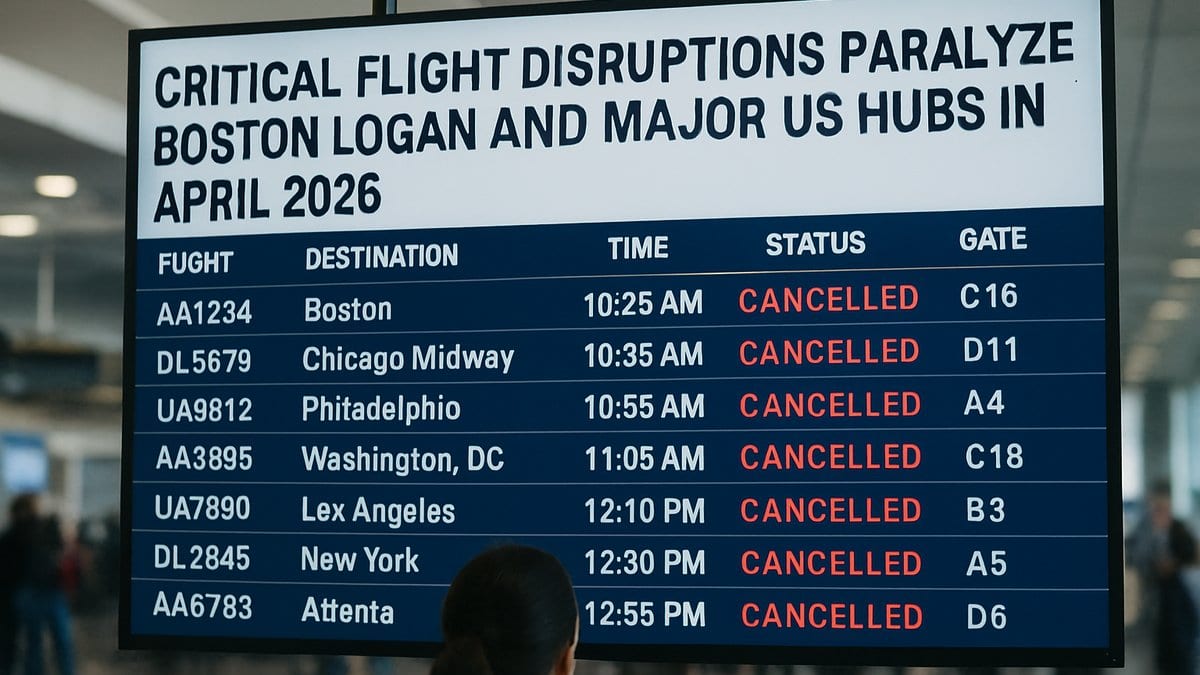
Boston Logan Hit Hard as Weather and Volume Converge
Publicly available flight tracking dashboards and aviation operations summaries for April indicate that Boston Logan has been among the most heavily affected airports as a series of fast-moving storm systems swept through New England. Low clouds, gusty crosswinds and bands of thunderstorms have periodically pushed the airport into ground-delay programs, sharply reducing the rate at which arrivals can be accepted.
Reports indicate that, at times, Boston’s arrival flow has been cut well below its scheduled capacity, forcing airlines to stack holding patterns, divert aircraft to nearby airports and preemptively cancel flights to prevent crews and planes from being stranded out of position. That has translated into extended lines at check-in and security, terminal crowding and long waits for rebooking, as disrupted flights in Boston reverberate through already tight nationwide schedules.
Historical performance data compiled by transportation analysts show that Boston Logan routinely experiences elevated delay rates whenever strong weather coincides with peak travel periods. Recent disruption patterns appear to match that profile, with the busiest banks of flights in the morning and late afternoon seeing the sharpest spikes in delays.
Travel coverage notes that travelers connecting through Boston have been particularly exposed, with missed onward departures leading to unplanned overnight stays and rebookings through alternate hubs. For some passengers, a single cancellation on a Boston leg has triggered a cascade of changes across entire multi-city itineraries.
Pressure Spreads Across Major U.S. Hubs
The turbulence at Boston has coincided with significant strain at other major U.S. hubs, amplifying the disruption for coast-to-coast and regional travelers. Recent tallies published by aviation news and travel industry outlets document large clusters of cancellations and delays centered on Chicago O’Hare, where a mix of unsettled weather and congestion has repeatedly forced regional and mainline carriers to trim schedules and slow operations.
Coverage focused on March 31 and April 1 notes that carriers such as United Airlines, American Airlines and several regional partners operating under their brands collectively canceled well over one hundred flights in the Chicago area and delayed well over one thousand more. Those disruptions rippled outward to cities including New York, Atlanta, Toronto and Detroit, where passengers encountered rolling knock-on delays even when local weather appeared calm.
The latest reports from TheTraveler.org also highlight widespread impacts at other hubs, including Philadelphia, Nashville, Chicago Midway and Hartsfield-Jackson Atlanta. At these airports, the same combination of convective storms, temporarily saturated airspace and tight turn times has pushed operations into extended recovery modes, with airlines attempting to reset networks overnight.
Travel analysts observing public data sets describe a familiar pattern: once delay percentages climb into double digits at multiple hubs simultaneously, recovery can take several days, particularly when aircraft and crews end up out of position. That dynamic has been visible across the first days of April, as on-time performance has lagged seasonal norms at many large airports.
San Francisco Arrival Cuts Add a West Coast Bottleneck
While storms over the East and central United States have dominated early April disruption, developments on the West Coast are adding another pressure point. According to aviation coverage, the Federal Aviation Administration has recently limited the number of arrivals permitted at San Francisco International Airport as part of a safety-driven policy shift and ongoing runway work.
Public reports state that San Francisco’s arrivals are being reduced from roughly 54 per hour to about 36, both to accommodate a runway construction project and to address concerns about simultaneous operations on closely spaced parallel runways. Airlines have been notified of the new constraints and are adjusting schedules, but observers expect persistent delays and tighter connection windows at one of the region’s busiest international gateways.
Industry analyses note that San Francisco already ranks among U.S. airports with some of the highest delay percentages during poor weather, particularly when low clouds and Pacific storms interfere with visual approaches. The newly imposed limitations appear set to magnify those tendencies during the construction period, with implications for transcontinental and transpacific routes that feed through the airport.
For travelers originating in or connecting through Boston and other East Coast cities, the San Francisco bottleneck introduces an additional complication. Even when departures from the Northeast are able to leave on time, onward journeys to the Bay Area may face holding patterns, gate holds or missed slots on arrival, stretching total trip times well beyond scheduled durations.
Recent Ground Stops Highlight System Vulnerabilities
The latest turbulence at Boston Logan and other hubs is unfolding against a backdrop of recent systemwide scares that have underscored the fragility of the national aviation network. In late March, for example, airports serving Washington, D.C., Baltimore and parts of Virginia briefly halted all flights after a strong chemical odor was detected at a key air-traffic control facility. According to published coverage, the Federal Aviation Administration implemented temporary ground stops at Ronald Reagan Washington National, Washington Dulles, Baltimore-Washington International and several regional airports while the issue was investigated.
Although operations resumed later the same evening, the incident produced a wave of secondary delays as flights inbound to and outbound from the capital region were forced to hold, divert or cancel. Those disruptions added further stress to an already stretched network and illustrated how a localized technical or safety issue can quickly translate into nationwide consequences.
Travel industry reporting also points to earlier episodes during the first quarter of 2026 when severe thunderstorms and temporary airspace closures in the southern United States triggered hundreds of delays and cancellations in a single day. Each of these events, while limited in time, has contributed to a perception among frequent travelers that the system is operating close to its capacity limits, with little margin to absorb shocks.
Academic studies of disruption patterns within the U.S. National Airspace System have identified a small but growing set of days each year that qualify as severe disruption events, characterized by geographically widespread delays and cancellations. The first days of April 2026 appear to be joining that category, with Boston Logan and other high-volume nodes bearing much of the impact.
What Travelers Are Facing and How Carriers Are Responding
The most visible effect of the current disruption cycle has been at the terminal level, where passengers at Boston Logan and other affected hubs have faced rolling gate changes, shifting departure times and crowded rebooking queues. Publicly available accounts from travelers describe hours-long waits to speak with airline agents, as well as competition for limited hotel rooms near major airports when evening cancellations pile up.
Aviation consumer advocates note that under federal regulations, travelers whose flights are canceled or significantly changed for reasons within the airline’s control may be eligible for refunds rather than only vouchers or credits. However, weather-related disruptions and air-traffic control constraints typically fall into a different category, leaving many passengers dependent on airline goodwill policies and travel insurance coverage.
Airlines, for their part, have been attempting to stabilize schedules by trimming vulnerable flights in advance, consolidating lightly booked services and reassigning aircraft to protect core trunk routes. Some carriers have issued travel waivers for Boston, Chicago, San Francisco and other hubs, allowing passengers to change travel dates or routings without additional fees when certain conditions are met.
Travel advisors interviewed in recent coverage recommend that passengers build additional buffer time into connections, particularly when itineraries pass through multiple disruption-prone hubs. They also suggest accepting alternative routings through secondary airports when offered in airline apps or customer-service channels, as these can sometimes sidestep the worst of the congestion even if they are less direct on the map.