

More news on this day
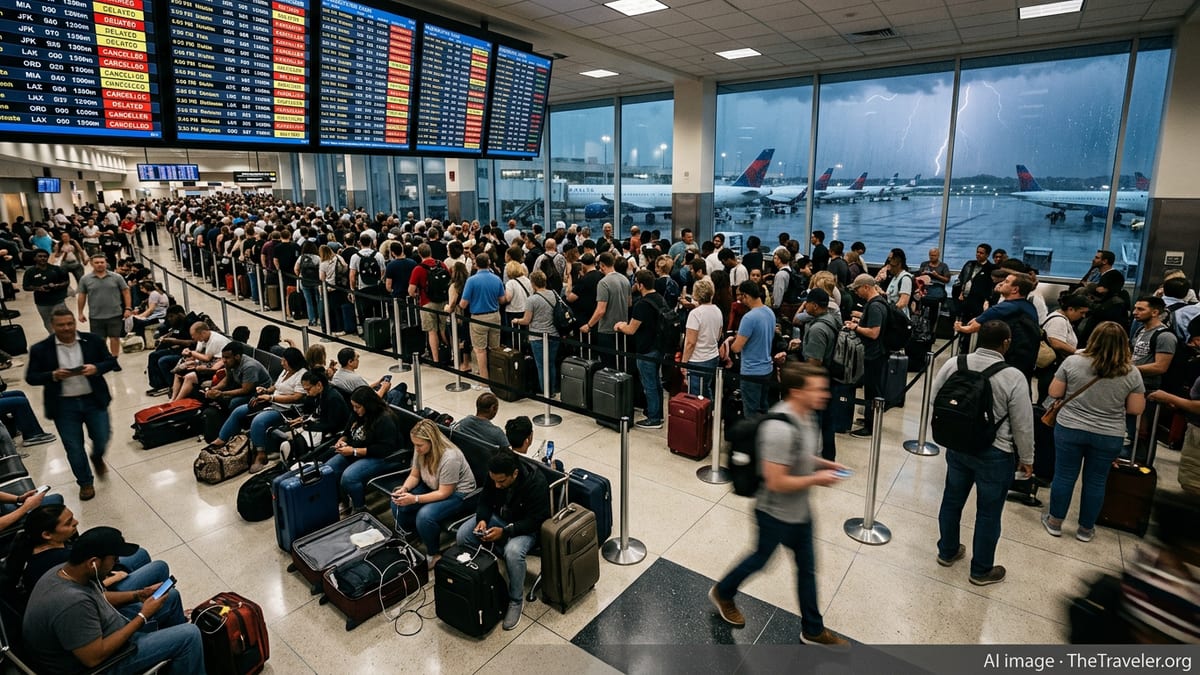
Severe storms sweeping across the Eastern United States and mounting Transportation Security Administration staffing strains have converged to create a fresh air travel crisis, with Atlanta, Charlotte, New York’s John F. Kennedy and Newark Liberty among the major hubs reporting widespread delays, cancellations and hours-long security lines as passengers brace for another difficult travel day.
Get the latest news straight to your inbox!
Storm System Triggers Ground Stops and Cascading Delays
A powerful storm complex affecting much of the eastern half of the country since March 13 has intensified travel disruptions at some of the busiest airports in the United States. Public weather analyses describe an extensive extratropical system bringing high winds, severe thunderstorms, and pockets of wintry weather from the Midwest through the Southeast and up the East Coast, a combination that has repeatedly forced air traffic managers to throttle arrivals and departures at major hubs.
According to airline and tracking data summarized in published coverage, more than 10,000 flights across the United States were delayed or canceled on Monday, March 16, as the storms moved through key corridors. Ground delay programs and temporary ground stops were reported at the three main New York City airports, including John F. Kennedy International and Newark Liberty, as well as at Reagan National near Washington, Charlotte Douglas, Atlanta’s Hartsfield-Jackson and Houston’s George Bush Intercontinental.
Passengers at these airports have described long stretches on tarmacs, abrupt cancellations the night before departure and day-of schedule overhauls as carriers attempt to reposition aircraft and crews around the storm bands. Travel waivers published by major U.S. airlines for March 16 and March 17 include Atlanta, Charlotte, New York-area airports and other East Coast gateways, allowing affected customers to change plans without additional fees.
Atlanta and Charlotte Emerge as Pressure Points
Hartsfield-Jackson Atlanta International, the nation’s busiest airport by passenger volume, has again become a focal point of system-wide disruption. As severe thunderstorms and strong winds passed through northern Georgia, reports from flight tracking services and travelers pointed to large numbers of delayed and canceled departures, with ripple effects stretching into connecting cities across the South, Midwest and Northeast.
Recent traveler accounts from Atlanta over the past week have highlighted both weather-related delays and earlier operational strains, including lengthy diversions and tarmac waits when storms or air traffic constraints limited arrivals. Those issues have compounded the impact of Monday’s severe weather, leaving some flights without available crews, even once storms temporarily shifted away from the airport.
Charlotte Douglas International, another key connection point for domestic and transatlantic traffic, has faced a similar squeeze. Publicly shared airline communications and traveler reports indicate that early-morning departures there have been pushed into late evening or canceled outright as carriers wait for safe operating windows and for aircraft to arrive from other storm-affected airports, including Atlanta and New York.
New York and Newark Face Wind, Lightning and Volume Constraints
In the New York metropolitan area, high winds, low clouds and embedded thunderstorms have significantly reduced the capacity of John F. Kennedy International, LaGuardia and Newark Liberty International. Air traffic control programs described in aviation community updates reference extended spacing between arrivals, rerouted departures and periodic flow restrictions into already congested airspace.
Airlines have responded with rolling waves of delays and cancellations that have left terminals crowded with stranded passengers seeking rebooking options. Because many flights into the New York region originate from already disrupted hubs such as Atlanta, Charlotte and Houston, cancellations in one part of the network have quickly led to aircraft and crew shortages elsewhere, deepening the crisis.
Observers note that the combination of severe convective weather and high baseline demand during a busy spring travel period is particularly challenging for New York and Newark. These airports routinely operate near capacity in good conditions, leaving little margin when storms force controllers to reduce arrival and departure rates.
TSA Staffing Strain Fuels Hours-Long Security Lines
Even where weather has momentarily improved, passengers are encountering another bottleneck: security screening. Publicly available information and traveler accounts from Hartsfield-Jackson over the past several days describe unusually long TSA lines, with some standard screening checkpoints reportedly listing waits of more than an hour at peak times.
Social media posts and discussion threads from the Atlanta region on March 15 and March 17 describe travelers arriving more than two hours before departure and still missing flights due to extended queues, as well as reports of expedited screening lanes closing earlier than expected. While TSA has not released detailed, real-time staffing figures, recent federal data and prior public statements from the agency have pointed to ongoing challenges recruiting and retaining screeners at the country’s busiest airports.
Similar complaints have surfaced at other large hubs during recent weather events, as illness, overtime fatigue and uneven staffing levels intersect with surging passenger volumes. Industry analysts note that when storms cancel or delay large blocks of flights, departing passengers often bunch into narrower windows once operations resume, putting sudden, intense pressure on already strained security checkpoints.
Network-Wide Strain Leaves Travelers Scrambling
The combination of severe storms and security staffing stress has left airlines struggling to stabilize their schedules. Published turbulence and storm outlooks for the Mid-Atlantic and Northeast on March 16 suggest that convective weather may persist into the evening, raising the risk of additional last-minute flow restrictions and aircraft reroutes just as carriers attempt to recover from earlier disruptions.
Travel forums and airline communications advise passengers to build in significant extra time at airports like Atlanta, Charlotte, JFK and Newark, monitor flight status closely and consider rebooking to later in the week where feasible. Some travelers have reported opting for long-distance drives rather than risk missed connections through the most affected hubs.
Operational data from recent seasons show that major U.S. hubs such as Atlanta and New York’s airports have repeatedly ranked among the nation’s most delay-prone during periods of active weather. As this latest storm cycle coincides with chronic staffing pressure at security checkpoints, industry observers warn that the current disruptions may take several days to fully resolve, and that future severe weather outbreaks this spring could again expose the system’s limited resilience.