

More news on this day
A fresh wave of flight disruptions is rippling across the United States as severe storms collide with ongoing Transportation Security Administration staffing strains, snarling operations at key hubs including Atlanta, Charlotte, New York’s John F. Kennedy, and Newark and leaving thousands of travelers facing cancellations, diversions, and long delays.
Get the latest news straight to your inbox!
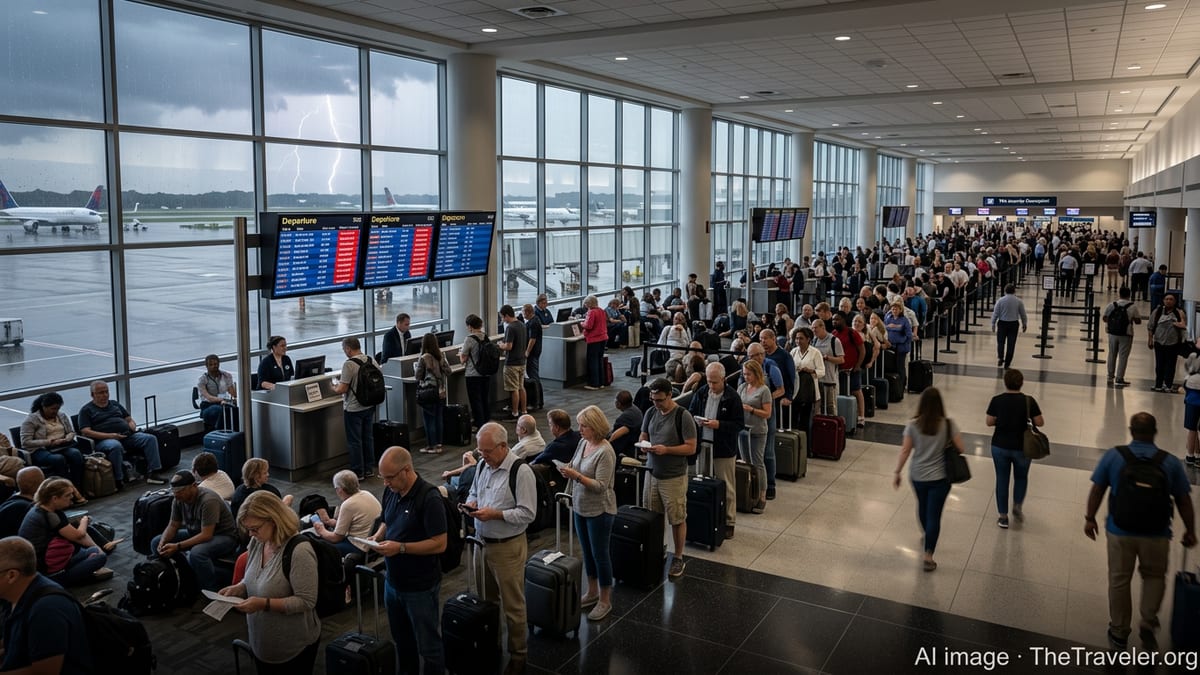
Storm Systems Collide With Busy Spring Travel
Powerful storm fronts sweeping across the East and Southeast in mid-March are triggering ground stops, reduced arrival rates, and extended tarmac holds at some of the nation’s most critical airports. Publicly available Federal Aviation Administration advisories show that traffic into New York’s three major airports, as well as Charlotte Douglas International Airport and Hartsfield-Jackson Atlanta International Airport, has been throttled at times due to high winds, thunderstorms, and low visibility.
Social media posts from passengers on March 16 and 17 describe long lines of aircraft waiting to depart, with some flights diverted to alternate airports after being unable to land during the worst of the weather. Travelers report circling patterns over the Carolinas and mid-Atlantic before flights were rerouted to less congested fields while storms passed through the corridor from Atlanta to New York.
In Newark and at John F. Kennedy, reports indicate that storm-related air traffic management programs have led to cascading delays, with inbound flights held at origin airports and crews timing out after extended waits. Similar patterns have been observed during recent major winter storms, when New York-area hubs and Atlanta together accounted for several thousand cancellations in a single day as snow, ice, and wind made safe operations more difficult.
The timing is particularly challenging for airlines and passengers alike, with March business travel ramping up and spring-break demand peaking on key routes between the Northeast, the Southeast, and major connecting hubs. As a result, even short-lived ground stops and capacity reductions can quickly translate into multiday disruptions for travelers attempting to reach secondary cities through these hubs.
Atlanta and Charlotte Emerge as Southeastern Pressure Points
Hartsfield-Jackson Atlanta International, the world’s busiest airport by passenger volume, has again become a focal point of the disruption. Recent hail and severe thunderstorms in the region prompted temporary halts to arrivals and departures, according to widely shared passenger accounts and live flight-tracking data, leading to long lines at customer service desks and a rush for rebookings on already crowded later flights.
In online forums, travelers connecting through Atlanta on March 17 describe abrupt cancellations, crowded concourses, and confusion as rolling thunderstorms forced airlines to repeatedly adjust schedules and crew assignments. Some passengers reported being advised to arrive three hours early solely to clear security and navigate shifting gate assignments, only to face additional hours of delay once boarded.
Charlotte Douglas International is experiencing similar pressure as a major connecting hub in the storm zone. Weather-related arrival and departure metering into Charlotte has rippled across its domestic network, particularly on east coast and Midwest routes. Flight-tracking dashboards show clusters of cancellations involving flights linking Charlotte with Atlanta, New York, and mid-Atlantic airports, compounding the challenges for travelers attempting same-day connections.
These disruptions recall recent winter events in which storms stretching from Texas through the Carolinas and into the Northeast forced widespread cancellations at Atlanta and Charlotte. In those cases, both airports saw hundreds of flights scrubbed in a single day as airlines opted to preemptively thin schedules when safe turnaround times could no longer be guaranteed.
TSA Staffing Strains Deepen Airport Bottlenecks
Weather alone does not explain the current wave of disruption. Published coverage over recent weeks has highlighted growing strain on TSA staffing levels at major U.S. airports, particularly during peak morning and evening departure banks. Travelers in Houston, New Orleans, Atlanta, and other large hubs have reported security waits stretching past two hours during busy periods.
Recent analysis of TSA throughput data and queue analytics at large hubs suggests that even modest shortfalls in staffing can sharply slow checkpoint processing at airports that handle tens of millions of passengers per year. Atlanta, New York’s JFK, and other major hubs are especially sensitive because they operate at such high baseline volumes that any reduction in open lanes can leave queues quickly snaking through terminal lobbies.
In online travel communities, passengers transiting Atlanta and Charlotte in mid-March describe a patchwork of experiences: some encounter relatively short lines outside of peak hours, while others report extremely long waits that jeopardize tight connections, particularly when flights have been rescheduled due to weather. At several airports, travelers note that TSA PreCheck and standard lanes alike can become overwhelmed when storm-related rebookings push more passengers into the same time window.
Publicly available commentary from travel analysts indicates that these staffing challenges intersect with a complicated operational backdrop that includes a recent federal government funding lapse and broader labor-market tightness in the aviation sector. While full checkpoint closures remain rare, partial lane reductions and overtime limitations can still slow screening and amplify the impact of any weather-related disruption.
New York and Newark Face Repeated Weather and Capacity Shocks
The New York metropolitan area’s three major airports are again at the center of a national air travel crunch. LaGuardia, JFK, and Newark collectively operate in some of the country’s most congested airspace, and they are highly exposed to both coastal storm systems and inland thunderstorm complexes moving up the eastern seaboard.
Recent severe weather has triggered traffic management programs that limit arrivals, extend departure queues, and at times require airlines to hold flights at the gate until conditions improve. Passengers have reported diversions of New York-bound flights to secondary airports when storms temporarily made it unsafe to land or when arrival slots at all three New York-area airports were saturated.
These events come on the heels of major winter storms earlier in 2026, when published storm summaries documented thousands of cancellations and delays centered on JFK, Newark, and other Northeast hubs over just a few days. In that episode, Newark alone saw hundreds of flights canceled as heavy snow, strong winds, and reduced visibility made operations difficult and forced airlines to scale back schedules.
Current disruptions are somewhat different in character, driven more by rapidly forming thunderstorms and high winds than by prolonged snow events. However, the effect on travelers is similar: extended holds, diversion to unfamiliar airports, overnight stays after missed connections, and significant challenges rebooking flights during an already busy travel period.
Passengers Confront Cascading Delays and Limited Options
For passengers, the combination of storms, hub congestion, and TSA staffing constraints is translating into a familiar pattern of missed connections, stretched-out journeys, and unexpected overnight stays in hub cities. Across social platforms, travelers describe spending hours in customer service lines at Atlanta, Charlotte, JFK, and Newark as they compete for the few remaining seats on later departures.
When multiple hubs are affected simultaneously, as is currently the case along the eastern corridor, options for rerouting become more limited. Airlines may run out of available seats on alternative same-day flights, leaving travelers to accept next-day or even multi-day delays, particularly on heavily booked leisure routes tied to school holidays and spring-break travel.
Travel advisors and consumer advocates observing the situation are urging passengers to build in extra time for connections through weather-exposed hubs, monitor airline apps closely for rolling rebooking offers, and consider traveling with only carry-on luggage to increase flexibility if last-minute itinerary changes are needed. Many also emphasize the value of checking real-time security wait estimates where available and arriving earlier than usual at airports currently reporting staffing challenges.
As storm systems continue to pulse along the East and Southeast and as major hubs grapple with tight staffing at security checkpoints, conditions remain fluid. Travelers planning to pass through Atlanta, Charlotte, JFK, Newark, and other large airports over the coming days may face shifting departure times and extended waits, underscoring the continued fragility of the U.S. air travel system when weather and workforce pressures converge.