

More news on this day
Hundreds of travellers were left stranded across Buenos Aires on Thursday as severe thunderstorms over the Argentine capital forced major disruptions at Ministro Pistarini and Jorge Newbery airports, delaying at least 44 flights and cancelling nine services operated by Aerolineas Argentinas, Flybondi, JetSMART, LATAM and other carriers.
Get the latest news straight to your inbox!
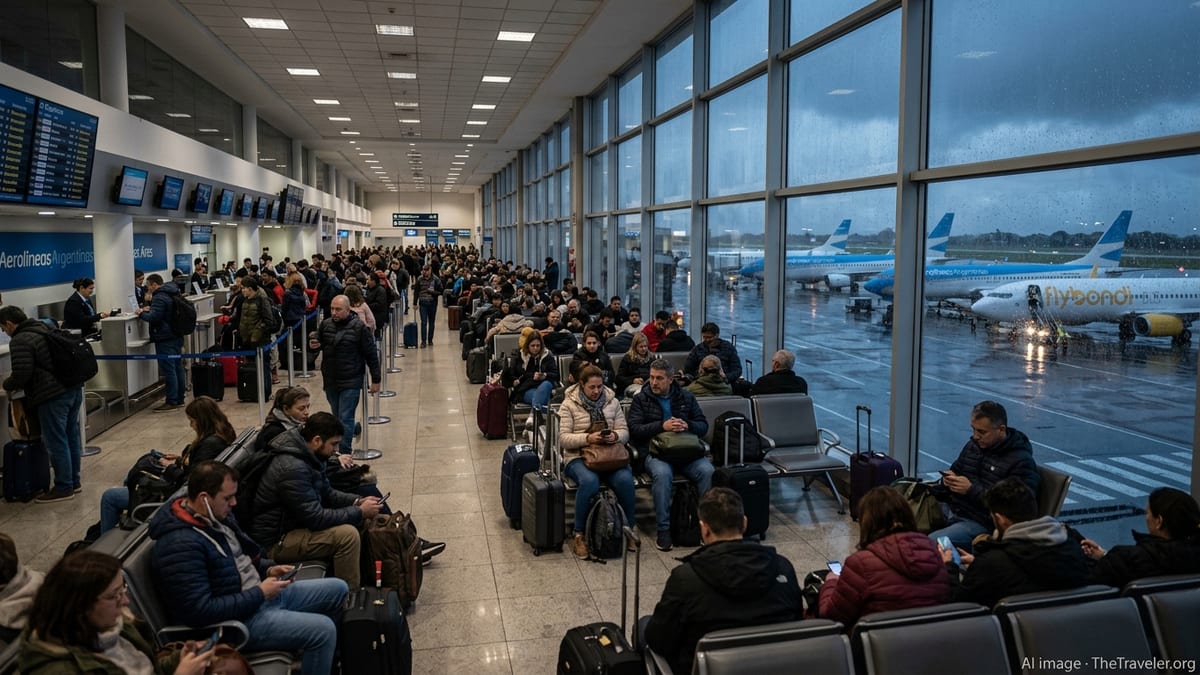
Thunderstorms Trigger Widespread Disruption Across Both Airports
Operations at Buenos Aires’ two main airports, Ministro Pistarini International Airport at Ezeiza and Aeroparque Jorge Newbery near the city centre, were severely affected as bands of intense rain and electrical storms swept over the metropolitan area. Publicly available flight tracking data showed rolling delays building from the early afternoon, with departure and arrival boards at both hubs gradually filling with postponements as storm cells lingered over the region.
By the evening peak, local media reports indicated that a combined total of 44 flights serving the capital’s airports had been delayed, while nine were cancelled outright. The disruption hit both domestic and regional routes, affecting connections to major destinations such as Córdoba, Mendoza, Bariloche and international links to neighbouring countries. Visibility reductions, lightning in the vicinity of the airfields and the need for additional spacing between aircraft contributed to a sharp slowdown in movements.
Operational procedures during severe weather generally require extended separation between landings and departures, as well as temporary ground stops when lightning is detected close to ramp areas. In Buenos Aires, those constraints translated into aircraft waiting in long sequences for take-off slots and inbound flights forced into holding patterns or diversions. For passengers, the result was hours spent in crowded gate areas and check-in halls as airlines worked through revised schedules.
Airport operators warned via public communications channels that further knock-on disruption remained possible into the night as airlines attempted to reposition aircraft and crews. Travellers were urged in local coverage to remain at their departure terminals and monitor airline apps and airport information boards for the latest status of their flights.
Major Carriers From Aerolineas Argentinas To Low-Cost Rivals Affected
The disruption rippled through almost every airline active in the Buenos Aires market, from national flag carrier Aerolineas Argentinas to low-cost operators Flybondi and JetSMART, along with regional services branded under the LATAM group and other South American carriers. According to publicly accessible schedules, Aerolineas Argentinas bore a significant share of the delayed operations, particularly on domestic trunk routes linking Buenos Aires with key provincial cities.
Flybondi and JetSMART, which focus on point-to-point low-cost services, also experienced route-level interruptions that were immediately visible on flight-tracking platforms. These airlines serve a network of domestic destinations from both Ezeiza and Aeroparque, so simultaneous weather restrictions at the two airports quickly constrained their ability to rotate aircraft and maintain on-time performance across the day.
LATAM’s Argentina-bound operations, which include regional services to and from neighbouring countries, likewise faced changes in departure times and aircraft routing. Some flights were held on the ground at origin airports to avoid extended airborne holding near Buenos Aires, while others saw their departure slots pushed back repeatedly as storm activity persisted. Passengers connecting in Buenos Aires to onward regional or long-haul services were among those most vulnerable to missed connections and overnight delays.
Industry data published over recent months has highlighted the sensitivity of Argentina’s increasingly busy domestic market to adverse weather, given the concentration of traffic through the capital’s two primary hubs. Thursday’s events once again underscored how quickly operations at Ezeiza and Aeroparque can become saturated when airspace restrictions are imposed for safety reasons.
Passengers Confront Long Waits, Rebooking Challenges And Airport Congestion
For many travellers, the operational details translated into a day of uncertainty, queueing and frustration. Social media posts and images shared by passengers showed densely packed check-in lines and departure halls at both airports, with travellers seated on the floor or clustered around scarce power outlets as they waited for updates. Some reported multiple successive delay notices before eventual cancellation messages arrived.
Publicly available guidance from airlines serving the Argentine market indicates that standard options during such disruption typically include free rebooking on later flights, refunds for cancelled services, or in some cases re-accommodation on other carriers when capacity allows. However, when numerous flights are affected at once, available seats on later departures can quickly run short, leaving some travellers facing extended overnight waits in the terminal or forced last-minute changes to hotel and ground transport plans.
Online travel forums and recent passenger accounts from across Argentina have frequently described similar scenarios during previous weather or operational disruptions, with travellers citing long lines at service desks and difficulties reaching call centres to confirm alternatives. Thursday’s storm-related disruption appeared to follow a comparable pattern, with passengers relying heavily on airline mobile apps and third-party tracking tools as they attempted to piece together evolving information.
Families with small children, tourists on tight itineraries and business travellers with same-day commitments were among those most impacted by the cascading delays. With both of Buenos Aires’ main airports affected at the same time, the usual fallback of transferring to the other terminal in search of an earlier departure was largely unavailable.
Spotlight On Airline Reliability In Argentina’s Competitive Market
The latest disruption has renewed attention on airline punctuality and reliability in Argentina, an issue that has drawn scrutiny as traffic recovered strongly in 2024 and 2025. Public data and previous coverage have pointed to recurring punctuality challenges for several carriers, especially on busy domestic routes where tight turnarounds and congested peak periods leave little margin to absorb weather or operational shocks.
Flybondi in particular has faced criticism in recent years for a pattern of significant delays and cancellations, while travellers have also voiced concerns about frequent schedule and airport changes on some Aerolineas Argentinas services. JetSMART and LATAM, though generally perceived in published commentary as more stable operators, are not immune to the network-wide ripple effects of severe weather episodes like the one that hit Buenos Aires on Thursday.
Aviation analysts cited in earlier reports on Argentina’s domestic market have noted that low-cost models can be especially exposed to disruption when aircraft utilisation is high and spare capacity is limited. When a storm or technical issue removes even a single aircraft from its planned sequence, subsequent flights may be delayed for hours as the schedule attempts to recover. With multiple airlines now competing aggressively on price from Buenos Aires, the cumulative effect can quickly be felt across the country’s wider air transport network.
At the same time, industry observers point out that extreme weather patterns have become a more prominent factor in operational planning for airlines across South America. Seasonal thunderstorms, heavy rainfall and occasional flooding around major cities like Buenos Aires have led carriers to review contingency plans, including the use of buffer time between rotations and pre-emptive schedule adjustments when adverse conditions are forecast.
What Travellers Can Do As Disruptions Continue
With residual delays likely as airlines work to restore normal operations, travel advisers routinely recommend that passengers flying to or from Buenos Aires build additional time into connections, particularly when linking domestic and international segments. Same-day onward travel involving airport changes between Aeroparque and Ezeiza is considered especially vulnerable when weather or congestion disrupts traffic flows.
Consumer guidance available from local aviation and transport bodies generally encourages passengers to check flight status directly via airline channels before departing for the airport, keep contact details updated in booking profiles to receive notifications, and retain receipts for any extra expenses incurred during significant delays or cancellations for potential reimbursement under applicable regulations.
Travel planners also suggest that visitors unfamiliar with Buenos Aires factor ground transport logistics into their contingency plans. Heavy rain and storms can slow road traffic between the city centre and both airports, extending typical journey times and adding another layer of uncertainty for travellers attempting to salvage missed or rebooked departures.
For now, airlines operating in and out of the Argentine capital are expected to continue adjusting their schedules as they absorb Thursday’s disruption. With demand for both domestic and regional travel remaining robust, the performance of carriers during high-pressure events such as severe weather episodes is likely to remain a focal point for passengers choosing between Aerolineas Argentinas, Flybondi, JetSMART, LATAM and their competitors on key routes.