

More news on this day
Severe spring storms colliding with heavy hub traffic at Charlotte Douglas International Airport are causing widespread delays and cancellations this week, stranding passengers and disrupting flight schedules across the United States.
Get the latest news straight to your inbox!
Powerful Storm System Slams a Major Southeast Hub
A large storm complex sweeping across the Central and Eastern United States from March 13 to 17 has delivered high winds, intense thunderstorms and disruptive bands of rain to key aviation corridors, including North Carolina. Public meteorological analyses describe the system as a powerful extratropical cyclone spawning blizzard conditions in the Upper Midwest and severe weather, including damaging winds and tornadoes, across the Lower Mississippi Valley, the Southeast and the Carolinas.
As the system pushed east, Charlotte Douglas International Airport, one of the country’s busiest hubs, found itself repeatedly in the path of fast-moving storm lines. Thunderstorms, lightning in the vicinity of the airfield and low clouds prompted traffic-flow restrictions and intermittent ground stops, reducing the number of arrivals and departures the airport could safely handle each hour.
The timing of the storms has been especially problematic. Much of the rough weather has overlapped with peak morning and evening bank periods, when hundreds of connecting passengers arrive in Charlotte within tight windows. With visibility and wind conditions fluctuating, and lightning occasionally forcing ramp closures, even brief interruptions have quickly cascaded into hours of disruption.
Delays at Charlotte Quickly Spread Across the U.S. Network
Charlotte Douglas serves as a critical domestic and international hub, particularly for connections along the East Coast and between the Southeast, the Midwest and Texas. When weather degrades operations at a hub of this scale, flight-tracking data and recent coverage show that delays and cancellations mount not only in North Carolina but at dozens of spoke airports nationwide.
On the busiest days of the current storm pattern, thousands of U.S. flights have been delayed or canceled, with Charlotte frequently among the airports with the highest disruption counts. Similar patterns were seen earlier in the year during major winter storms, when airlines preemptively cut schedules in and out of Charlotte to preserve safety, trimming thousands of seats from the network on affected days.
Because many Charlotte flights operate as part of complex multi-leg rotations, an aircraft delayed on one segment can arrive late for the next, compounding disruptions as the day progresses. Reports from recent events describe delays at Charlotte averaging more than an hour when thunderstorms line up along approach paths, with departure queues building on the taxiways and arriving flights placed in airborne holding patterns or rerouted.
Why This Week Is Especially Risky for Nonessential Trips
For travelers considering new bookings through Charlotte in the coming days, several factors increase the risk of a significantly disrupted trip. First, the storm complex that affected the Midwest and High Plains continues to push bands of unsettled weather into the Mid-Atlantic and the Carolinas, meaning that further rounds of thunderstorms and low ceilings remain possible even as the core system weakens.
Second, airlines are still working through the backlog created earlier in the week. When hundreds of flights are canceled or heavily delayed in a short period, it can take days to fully rebalance aircraft and crew schedules. Publicly available airline operations updates during recent winter and spring storms indicate that rebooking surges strain seat availability, particularly on popular business and leisure routes touching hub airports like Charlotte.
Third, Charlotte’s role as a major connection point magnifies the impact on multi-leg itineraries. A disruption on a single inbound flight can cause travelers to miss onward connections, with limited options to be rebooked the same day when load factors are already high. Social media posts and passenger accounts from earlier weather events at Charlotte describe long lines for rebooking assistance, hotel availability tightening quickly around the airport and travelers facing overnight or multi-day waits for open seats.
For these reasons, travel experts and consumer advocates often recommend that passengers who have flexibility avoid scheduling discretionary trips through heavily impacted hubs while storm systems are still active and the recovery window is uncertain.
Passengers Face Crowded Terminals and Tight Rebooking Options
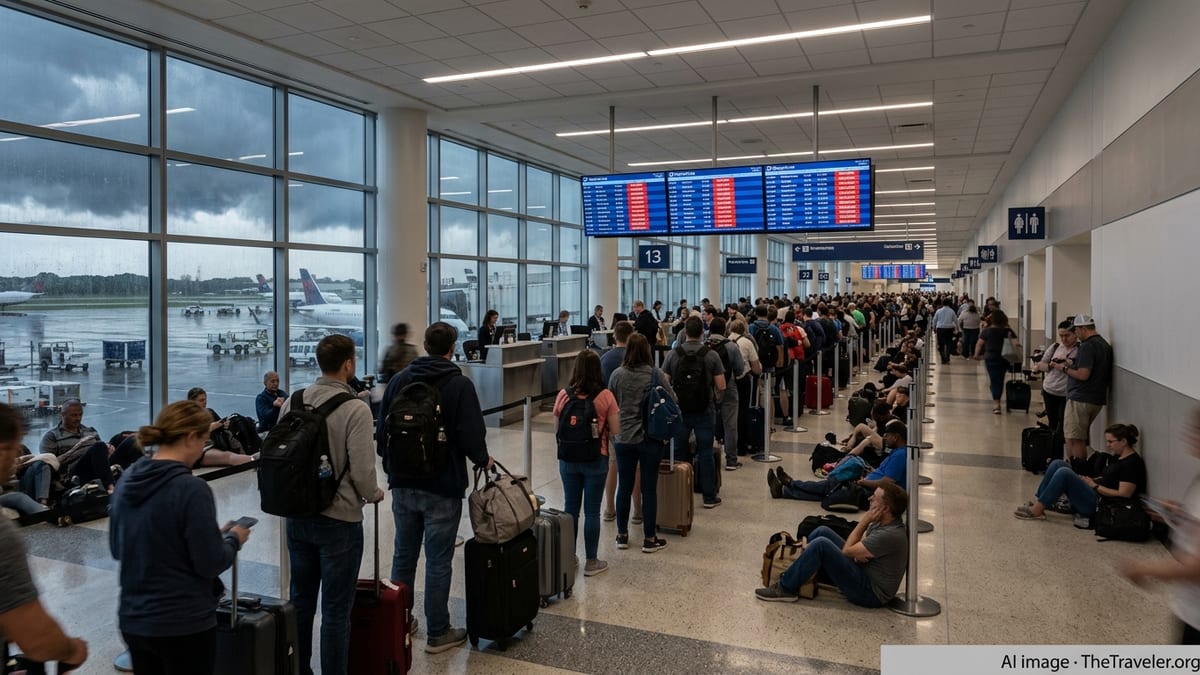
Scenes emerging from Charlotte this week echo previous severe-weather episodes at the airport. Travelers report crowded concourses, congestion at customer service counters and long waits to secure alternate flights after cancellations. With thunderstorms interrupting operations intermittently rather than shutting them down for a single, well-defined period, some flights operate on time while others are delayed for hours, leaving passengers struggling to interpret departure boards that change frequently.
According to recent travel-industry guidance, recovery from large-scale weather disruptions is constrained by aircraft availability, crew duty limits and airport capacity. Even after storms move away, airlines must position planes and crews back into place, and air traffic managers may continue to meter arrivals into busy hubs such as Charlotte to prevent gridlock on taxiways and in the air.
When disruptions follow other recent storms, as has occurred in early 2026, the system has less slack. Networks are already stretched by previous cancellations, and spare aircraft that might normally be used to recover schedules may instead be out of position or undergoing maintenance. This leaves fewer options to add extra sections or reposition flights, deepening the impact on travelers stuck mid-journey.
Why Rethinking U.S. Travel Plans Around Charlotte Makes Sense Now
With the broader U.S. air system still absorbing the shock of repeated winter and early-spring storms, the latest wave of severe weather in the Carolinas underlines the vulnerability of hub-focused itineraries. For passengers who have not yet locked in tickets, routing choices made this week could significantly influence the likelihood of spending long hours in an airport seat instead of at a destination.
Publicly available advisories from airlines in recent storms illustrate that carriers sometimes issue travel waivers for cities in the projected path of severe weather, including Charlotte. These waivers can allow travelers already booked through the region to change dates or routings without change fees, within certain parameters. For those with essential trips, monitoring for such policy updates and proactively adjusting plans away from the most at-risk travel days can reduce exposure to major delays.
For discretionary travel, postponing or choosing routings that avoid currently stressed hubs may be the most reliable way to sidestep the worst of the disruption. With forecasts signaling that unsettled weather will linger and operational recovery may extend beyond the immediate storm window, Charlotte Douglas International Airport is likely to remain a focal point of U.S. airline challenges in the short term, making it a less-than-ideal choice for time-sensitive journeys.