

More news on this day
Severe storms sweeping across the eastern United States have pushed Charlotte Douglas International Airport into days of disruption, with cascading delays, ground stops, and missed connections rippling across one of the nation’s busiest hubs just as spring travel peaks.
Get the latest news straight to your inbox!
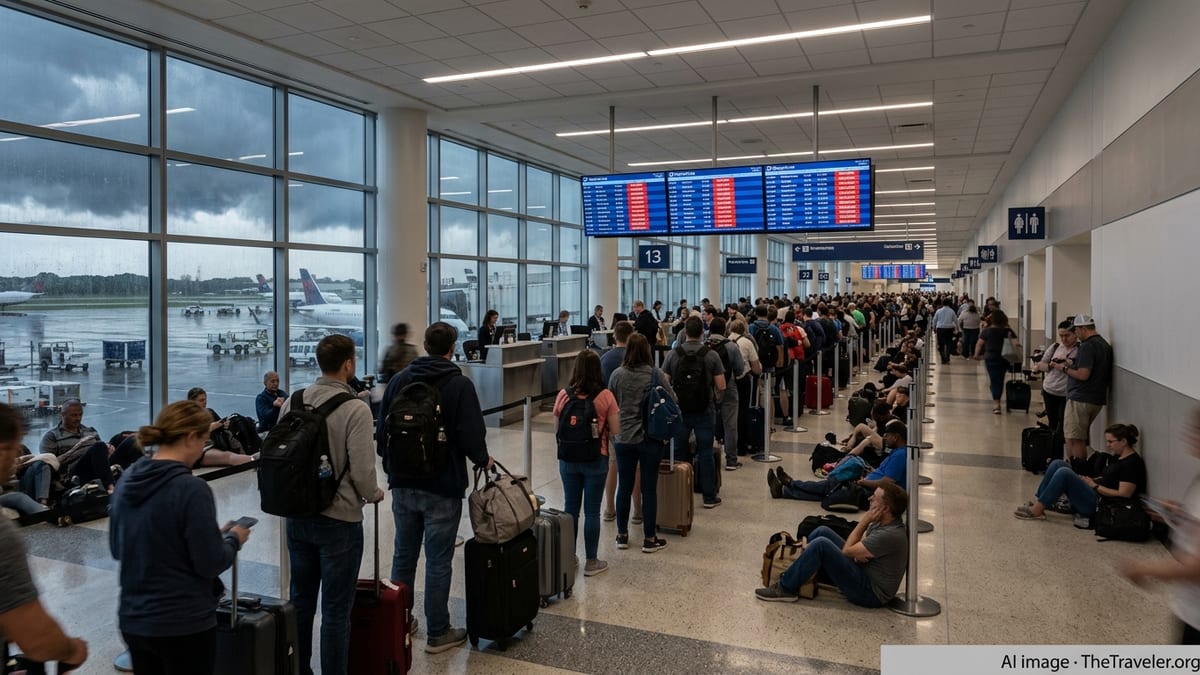
Storm System Slams a Critical Southern Hub
The latest round of travel turmoil centers on a powerful March storm complex that has hammered large sections of the Midwest and East with snow, high winds, and severe thunderstorms. As the system moved into the Carolinas between March 16 and March 18, Charlotte Douglas International Airport (CLT) found itself squarely in the path of fast-changing weather and tight airspace restrictions.
Charlotte’s role as a major connecting hub means any slowdown there quickly reverberates across domestic and international routes. Flight-tracking data and airline alerts over the past 48 hours show waves of departure and arrival delays, rolling from the early morning bank of flights through the late-night schedules. Even short periods of heavy rain, lightning in the vicinity, or low clouds can trigger ground holds that stack aircraft on taxiways and in holding patterns.
When combined with a broader storm pattern that has already strained airports from Chicago and New York to Atlanta, the conditions around Charlotte have turned a localized weather event into a network-wide disruption. Travelers whose journeys simply pass through CLT are experiencing missed connections, unscheduled overnights, and rebookings deep into the week.
For those planning to start or end trips in the Carolinas, the practical result is an airport that looks and feels overwhelmed, even when skies briefly clear. Departures are leaving out of sequence, arrivals are bunching up, and published timetables bear little resemblance to what actually happens at the gate.
Ground Stops, Gridlocked Gates, and Tired Crews
Behind the scenes, Charlotte’s weather challenges have triggered a series of operational constraints that travelers rarely see but certainly feel. Publicly available Federal Aviation Administration advisories indicate that, at times, flow restrictions and intermittent ground stops have slowed traffic into and out of the region as thunderstorms and low visibility pass through key air corridors.
These measures are designed for safety and to prevent too many planes from converging on the same airspace or runway configuration at once. However, even short-lived restrictions can create a sharp backlog at a busy hub. When arrivals bank faster than gates can be turned, aircraft wait on the ramp for an available parking spot, passengers remain seated long after touchdown, and outbound flights miss their scheduled departure slots while crews race to complete turnarounds.
Charlotte’s tightly choreographed arrival and departure pushes leave little margin when thunderstorms or strong wind shear intrude. Operational commentary shared by aviation workers in recent weeks highlights how quickly CLT’s runway and taxiway system can hit capacity when the weather closes in, forcing airlines to hold flights on the ground at origin cities until there is room to land in North Carolina.
Compounding the weather are crew-duty limits and equipment positioning challenges. When storms disrupt multiple days of flying, pilots and flight attendants can time out before completing their next leg, and aircraft end up in the wrong cities for the following morning’s schedule. The current storm pattern, layered on top of already heavy spring traffic, has created precisely that kind of rolling operational hangover for carriers using Charlotte as a backbone hub.
Why Travelers Across the U.S. Feel Charlotte’s Pain
On paper, a thunderstorm over Charlotte might look like a local inconvenience. In practice, disruptions at CLT reach far beyond the Carolinas. As a major connecting point for east coast, Midwest, and Sun Belt routes, any reduction in capacity at Charlotte forces airlines to re-time, reroute, or cancel flights across the United States.
Recent national tallies show thousands of delays a day as the current storm complex has marched east, with Charlotte listed among the hardest-hit hubs. Even travelers flying between two cities with clear skies can be caught off guard if their aircraft or crew is scheduled to pass through CLT earlier in the day. The result is a chain reaction of late departures, tighter connection windows, and missed international links.
Once a hub falls several hours behind schedule, catching up is difficult. Flight operations specialists note that airlines may hold certain departures on the ground to avoid burdening an already congested airport with more arrivals than it can safely process. That strategy protects overall safety and reduces airborne holding, but it also means passengers far from North Carolina suddenly find their flights delayed “due to air traffic control” or “due to earlier weather,” even when local conditions seem calm.
For travelers with tight itineraries, meetings, or onward train and hotel bookings, the practical implication is clear. CLT’s weather troubles translate into missed events, unexpected overnight stays, and additional costs across a wide swath of the network. The storm may sit over the Southeast, but its footprint stretches coast to coast through the web of connections anchored in Charlotte.
Why You May Want to Rethink a U.S. Trip Routing Through CLT
The timing of this disruption could hardly be worse for leisure and business travelers. The current storms coincide with the ramp-up of spring break and major sports events, a period when aircraft are already flying near capacity and spare seats for rebooking are limited. When hundreds of flights through a hub like Charlotte are delayed or canceled over several days, recovery options quickly narrow.
For anyone considering a U.S. itinerary that depends on smooth connections through CLT in the coming days, this environment raises real risks. With airlines working to untangle backlogs from earlier in the week, seats on later flights are being used to absorb displaced passengers. That makes same-day or even next-day alternatives harder to secure, particularly on popular routes in and out of major metropolitan areas.
Travel-planning guidance from airline and airport resources consistently suggests building more time into connections during volatile weather patterns and avoiding last departures of the day when storms are expected. In the current situation, some travelers may wish to go further by selecting routings through less-affected hubs, opting for nonstop flights where possible, or adjusting trip dates away from the peak of the storm’s impact on the Southeast.
While no major airport is immune to severe weather, Charlotte’s central role in several domestic networks means that even modest storms can cause disproportionate disruption when schedules are tight. Given this week’s conditions, travelers booking new trips or making last-minute changes may benefit from considering alternate gateways to reduce the odds of getting stranded.
How to Navigate If You Cannot Avoid Charlotte
For those who must travel through CLT despite the current turmoil, careful preparation can soften the blow. Airline and aviation data specialists emphasize the importance of monitoring multiple sources of information, as airline apps, airport boards, and independent flight-tracking tools can update on different timelines. In fast-moving weather scenarios, the most accurate departure and gate details often appear close to departure time, rather than hours in advance.
Building in generous connection times is especially important in Charlotte right now. With ramp congestion, shifting gate assignments, and periodic ground stops, even flights that ultimately depart may leave significantly later than scheduled. Longer layovers provide a buffer when inbound flights are held in the air or on the ground, and they reduce the need for costly last-minute hotel stays if a connection is missed.
Travelers are also being urged by published travel advice to pack essential medications, chargers, and a change of clothes in carry-on bags, given the elevated risk of unplanned overnight stays away from home. When storms disrupt multiple hubs at once, baggage systems and rebooking desks face intense pressure, and checked bags are more likely to be separated from their owners when itineraries are rebuilt on the fly.
In the days ahead, Charlotte Douglas International Airport is expected to keep working through the backlog created by the current storm system even after the worst of the weather moves on. Until airlines fully stabilize their schedules, anyone planning a U.S. trip that touches CLT should approach their plans with caution, flexibility, and a willingness to reroute if conditions begin to deteriorate again.