

More news on this day
Thunderstorms sweeping across the Chicago area have left thousands of United States travelers stranded at O’Hare International Airport, as regional and major carriers including Envoy Air, Republic Airways, United Airlines, GoJet and SkyWest report 105 flight cancellations and 1,241 delays affecting key routes to Toronto, Detroit, Portage and other cities.
Get the latest news straight to your inbox!
Thunderstorms Trigger Ground Disruptions at Major Midwestern Hub
Publicly available flight-tracking data and industry reports indicate that storms over northern Illinois have forced extended ground holds and rerouting at O’Hare, one of the country’s busiest connecting hubs. The combination of lightning, low clouds and heavy rain has periodically slowed arrival and departure rates, creating long queues both in the air and on taxiways.
Operational summaries show that the latest wave of disruptions centers on 105 cancellations and 1,241 delays involving a mix of regional and mainline operators. Envoy Air, Republic Airways, GoJet and SkyWest, which operate many of the feeder flights under major airline brands, appear prominently in the tally, alongside United Airlines, the dominant carrier at O’Hare.
The impact has been amplified by O’Hare’s role as a primary transfer point for domestic and cross-border itineraries. Even short weather-related pauses can cascade across tightly timed schedules, leaving aircraft and crews out of position for subsequent departures.
While thunderstorms are a routine feature of Midwestern weather, the timing of this system in the middle of a busy travel period has magnified its effect, catching large numbers of connecting passengers mid-journey and forcing many to seek overnight accommodation or substantial rebookings.
Regional Carriers Bear Brunt of Cancellations and Delays
Available data show that regional airlines operating under contract for larger network carriers are bearing a significant share of the disruption. Envoy Air and Republic Airways, which handle extensive short-haul services for American Airlines, Delta Air Lines and United Airlines, are among the most affected by the O’Hare bottleneck.
SkyWest and GoJet, both key operators of regional jets across the central and upper Midwest, also appear in cancellation and delay tallies linked to the storm system. Because these carriers typically operate high-frequency routes with smaller aircraft, a relatively small number of cancellations can translate into a large number of displaced passengers.
United Airlines, which relies heavily on its O’Hare hub for domestic and international connectivity, is experiencing knock-on effects as regional feeder disruptions ripple into its mainline network. According to published coverage that compiles airport- and airline-level statistics, the combination of regional and mainline delays is contributing to rolling schedule adjustments throughout the day.
Industry analyses suggest that recovery can be particularly challenging for regional operators, which have fewer spare aircraft and tighter crew rosters than larger mainline fleets. Once extended delays set in, the process of realigning aircraft, crews and gate space often stretches into subsequent operating days.
Key Routes to Toronto, Detroit, Portage and Beyond Disrupted
The storm-related delays at O’Hare are disrupting traffic on several important cross-border and regional corridors. Reports indicate that services linking Chicago with Toronto and Detroit have been notably affected, as aircraft and crews cycling through O’Hare face rolling ground restrictions and departure holds.
Flights to smaller markets such as Portage and other regional communities are also experiencing schedule instability. These routes, generally served by regional jets with limited daily frequency, are especially vulnerable when one or two rotations are canceled or significantly delayed, leaving travelers with fewer immediate alternatives.
The ripple effects extend beyond the Midwest. Connections from Chicago to the Northeast, the Great Plains and parts of the South are facing knock-on delays as aircraft arrive late from O’Hare, prompting revised departure times at downstream airports. For some passengers, a weather delay on a short feeder leg is resulting in missed long-haul connections and multi-stop rerouting.
Travel media coverage notes that disruptions on routes connecting major financial and industrial centers can have broader economic implications, as business travelers, logistics personnel and visiting professionals face last-minute changes to meetings and on-site commitments.
Stranded Travelers Confront Long Lines and Limited Options
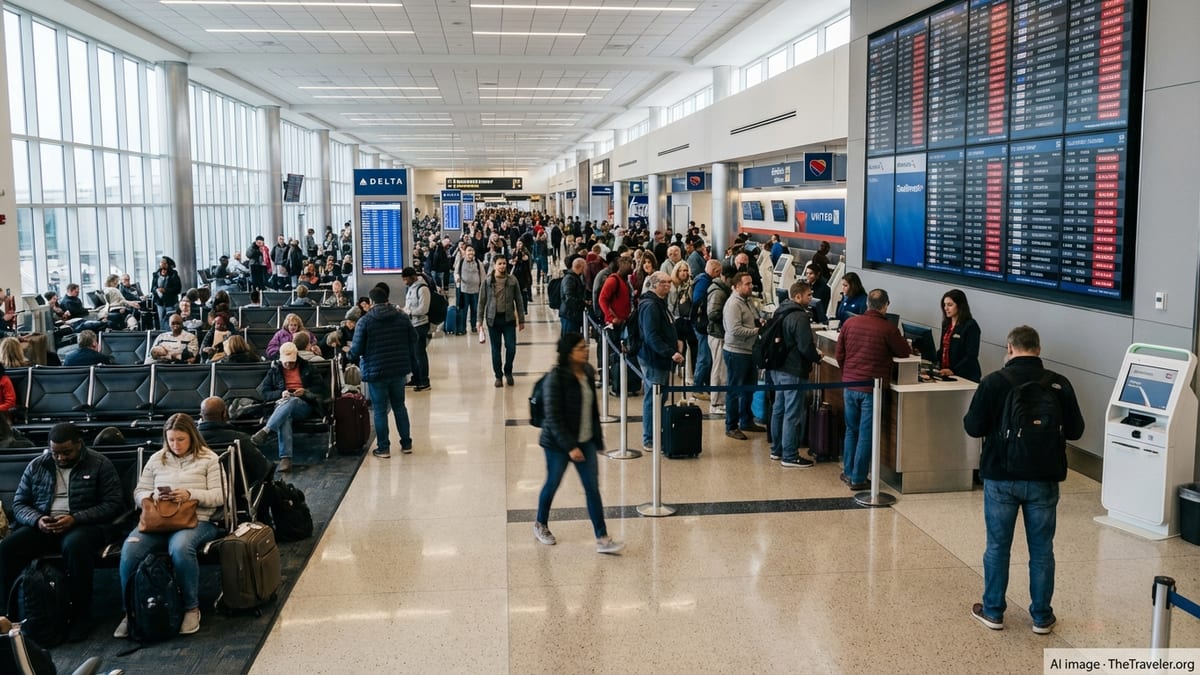
At O’Hare’s terminals, the operational strain is being felt most acutely by stranded travelers facing long waits at ticket counters, gate podiums and customer service centers. Photos and descriptions shared via public channels depict crowded departure halls as passengers attempt to secure new itineraries or same-day stand-by seats after missed connections.
According to travel-industry reporting, rebooking has become more complex as available seats on alternate flights quickly fill, particularly on high-demand routes to Toronto, Detroit and other major hubs. With aircraft already scheduled near capacity, airlines have limited slack to absorb large numbers of displaced passengers within the same travel day.
Some travelers are reportedly opting to shift to rail or rental cars for shorter regional journeys when possible, especially between Midwestern cities connected by interstate highways. However, those bound for Canada or longer domestic routes often have little choice but to wait for the next available flight.
The surge in disruption also affects airport services, from concessions and lounges to ground transportation. Extended dwell times for thousands of passengers can strain food and seating capacity, while late-night arrivals and departures complicate shuttle, taxi and rideshare availability.
Weather Volatility Highlights Ongoing Vulnerabilities in U.S. Air Travel
The severe thunderstorms impacting Chicago highlight how quickly localized weather can upend national air traffic patterns. Transportation data released in recent months show that extreme weather remains a persistent driver of delays and cancellations across U.S. carriers, even as airlines invest in operational technology and schedule buffering.
Analysts note that regional carriers such as Envoy Air, Republic Airways, GoJet and SkyWest often feature prominently in delay and cancellation figures when storms hit large hubs. Their aircraft operate at the outer edges of major networks, where single disruptions can propagate along multi-stop sequences of short segments.
Travel and aviation coverage also points to tight staffing, high load factors and congested airspace as factors that limit the system’s resilience. When severe weather disrupts a major hub like O’Hare, there are relatively few open seats available across the broader network to quickly re-accommodate stranded passengers.
With forecasts calling for continued weather variability in key aviation corridors, industry observers suggest that travelers may face more frequent episodes of large-scale disruption. For now, the hundreds of cancellations and more than a thousand delays centered on Chicago underscore the sensitivity of U.S. air travel to a single storm system at a pivotal hub.