

More news on this day
Severe spring storms sweeping across northern Illinois on April 2, 2026, triggered extensive flight disruption at Chicago O’Hare International Airport, stranding thousands of travelers and rippling delays across the United States air network.
Get the latest news straight to your inbox!
Thunderstorms Hit Key Midwest Hub at Peak Travel Hours
The latest round of storms arrived before dawn on Thursday, bringing lightning, torrential rain, and wind gusts strong enough to slow ground operations at one of the world’s busiest hubs. Publicly available aviation data and local weather coverage indicate that an early morning thunderstorm line moved directly over O’Hare, forcing air traffic managers to reduce arrival and departure rates as visibility dropped and cells passed near active runways.
According to published coverage summarizing airport operations, a formal ground stop briefly froze many departures from O’Hare during the early morning window, with flights held at gates or on taxiways while the most intense cells moved through the airfield environment. Departure delays in that initial wave were generally measured in tens of minutes, but they pushed the tightly scheduled hub into a backlog that grew throughout the day as additional storms fired over the region.
By late morning, national flight-tracking boards showed Chicago near the top of U.S. airports for both cancellations and delays. Reports compiled by regional outlets described hundreds of affected flights at O’Hare alone, with cancellations climbing into the high hundreds and delays into the low thousands as airlines trimmed schedules, rerouted aircraft, and attempted to reset operations between storm bands.
The disruption coincided with an already active severe weather pattern across the Midwest this spring, amplifying concern among travelers who have recently experienced multiple weather-related interruptions at Chicago and other major hubs.
Hundreds of Flights Scrubbed as Backups Spread Nationwide
Operational data reviewed by news organizations and travel trackers on April 2 pointed to a classic hub-closure cascade: once thunderstorms and associated ground stops reduced O’Hare’s hourly capacity, airlines began proactively canceling flights they were unlikely to operate safely or on time. Those targeted cancellations, while intended to stabilize schedules later in the day, added up quickly for passengers booked through the airport.
Outlets covering the storm’s impact on air travel reported that more than 700 flights were ultimately canceled at O’Hare, with more than 1,400 additional flights delayed as the system worked through the backlog. The majority of affected flights were domestic, but disruptions also touched transborder and long-haul international routes, particularly those relying on aircraft and crews cycling through Chicago on earlier segments.
The knock-on effects radiated far beyond Illinois. Because O’Hare serves as a central hub for multiple major U.S. carriers, weather-related cancellations there can strand aircraft several legs away. Airports from the East Coast to the Mountain West reported scattered delays tied back to aircraft or crews scheduled through Chicago, according to airline status boards and media summaries. Some routes saw rolling delays of two hours or more as carriers attempted to reposition planes and comply with crew duty limits following weather holds.
Airlines activated standard severe-weather waivers for Chicago-originating, arriving, or connecting passengers, allowing many to rebook once it became clear that storms and airspace constraints would last through much of the day. Even with those options, reports from social media and local coverage depicted long lines at customer service counters and crowded concourses as travelers scrambled for alternate routings.
Travelers Confront Long Lines, Missed Connections and Diversions
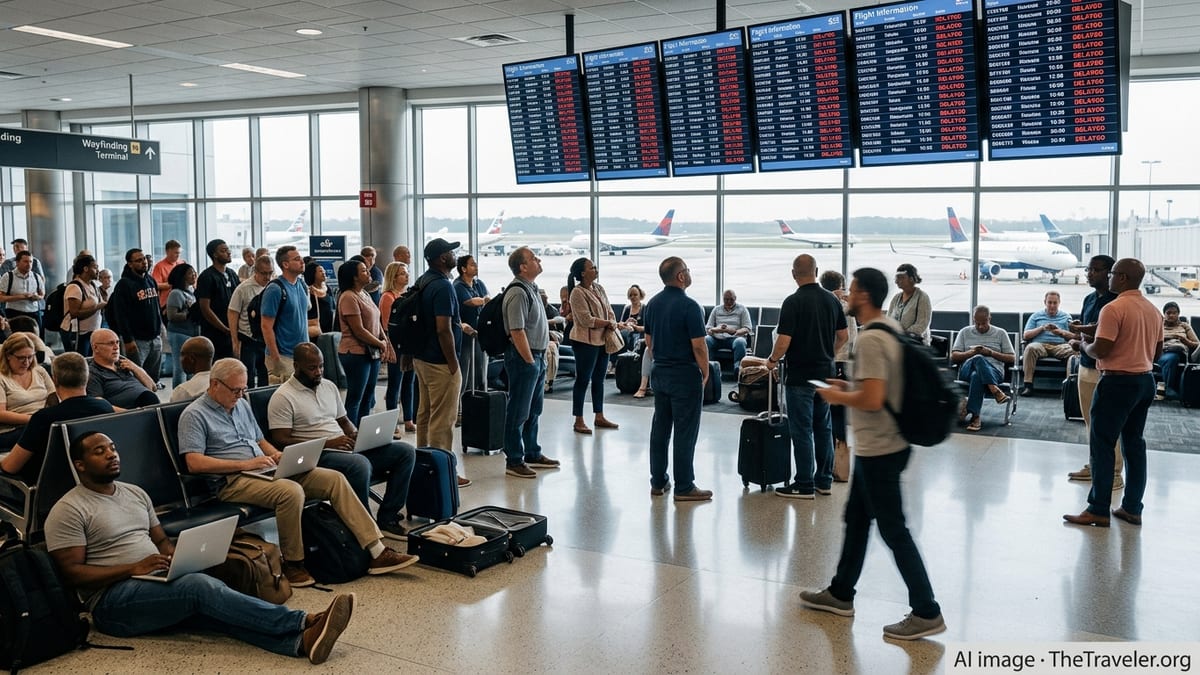
For passengers on the ground at O’Hare, the situation unfolded in familiar but frustrating fashion. Publicly available accounts from travelers described departure boards filling with red “canceled” and “delayed” markers as the morning progressed, along with gate changes, rolling estimated departure times, and periodic announcements tied to weather holds in the Chicago terminal area.
Some inbound flights diverted to nearby airports during the strongest storms, based on flight-tracking snapshots and regional airport boards showing unscheduled arrivals. Those diversions prevented aircraft from reaching Chicago during key afternoon banks, further constraining the number of flights airlines could operate once conditions improved. Passengers aboard diverted aircraft often waited for refueling, crew checks, or updated routings before continuing to O’Hare or on to other hubs.
Within the terminals, security checkpoint and customer service lines appeared to lengthen as the thunderstorm threat lingered into the evening. Reports from local media and online travel communities referenced waits of an hour or more at some points as rescheduled passengers converged on the airport for newly assigned flights, while others sought hotel vouchers or stand-by options after missed connections.
Despite the chaos, published information from airport status pages and airline trackers suggested that a limited number of flights continued to operate throughout the day, particularly in windows between the most intense storm cells. However, the unpredictable timing of thunderstorms meant that even flights initially listed as “on time” could face abrupt holds or last-minute cancellations.
Storms Cap a Turbulent Weather Season for O’Hare
The latest outbreak of storm-related disruption comes at the tail end of an already volatile late winter and early spring for Midwestern aviation. Meteorological summaries highlight a series of strong systems in March 2026, ranging from high-wind events to severe thunderstorms and even blizzard conditions elsewhere in the region, each bringing episodic slowdowns or stoppages at Chicago’s main hub.
Aviation analysts note that O’Hare is particularly susceptible to thunderstorm-related disruption because of its heavy traffic volumes, intersecting runway layout, and position near the core of Great Lakes storm tracks. When strong convective cells line up over northern Illinois, controllers often must sharply reduce the number of safe arrival and departure slots, which quickly reverberates through airlines’ network schedules.
Recent storms have also highlighted how staffing strains and tight aircraft utilization can magnify weather shocks. Public commentary from pilots and passengers in recent weeks has pointed to lengthy taxi queues, extended holding patterns, and last-minute gate changes when Chicago experiences even routine convective activity, suggesting that the system is operating with limited margin when severe weather strikes.
For airlines, the April 2 storms represent another reminder that schedule resilience at major hubs remains a challenge in an era of increasingly erratic weather. As carriers and airport operators review performance data from the event, they are expected to examine how ground handling capacity, runway use, and proactive cancellations shaped the eventual scale of disruption.
What Travelers Can Expect in the Coming Days
While thunderstorms that sparked the worst of Thursday’s delays were expected to move east by Friday, aviation forecasters and airline updates indicated that lingering disruptions could continue as carriers work through displaced crews and aircraft. Travelers connecting through O’Hare over the next several days are being advised, in public-facing guidance, to monitor flight status frequently and allow extra time for connections.
Industry guidance based on past severe weather events suggests that the most heavily affected period is typically the first 24 to 36 hours after a major ground stop or mass cancellation wave. During that window, passengers may encounter last-minute aircraft swaps, altered routings, and occasional oversold situations as airlines consolidate lightly booked flights or bring in larger aircraft to clear backlogs.
For those with flexibility, travel experts recommend considering early-morning departures in the days immediately following major storms, as those flights are more likely to start the day with rested crews and positioned aircraft, reducing exposure to cumulative delays. Conversely, evening departures may remain more vulnerable if another round of weather or airspace constraints arises and compounds earlier hiccups in the schedule.
With the peak summer travel season approaching and long-range outlooks hinting at another active season for severe weather in the central United States, observers say the April 2 turmoil at O’Hare offers a preview of how quickly conditions can deteriorate when storms align with high traffic volumes at a critical national hub.