

More news on this day
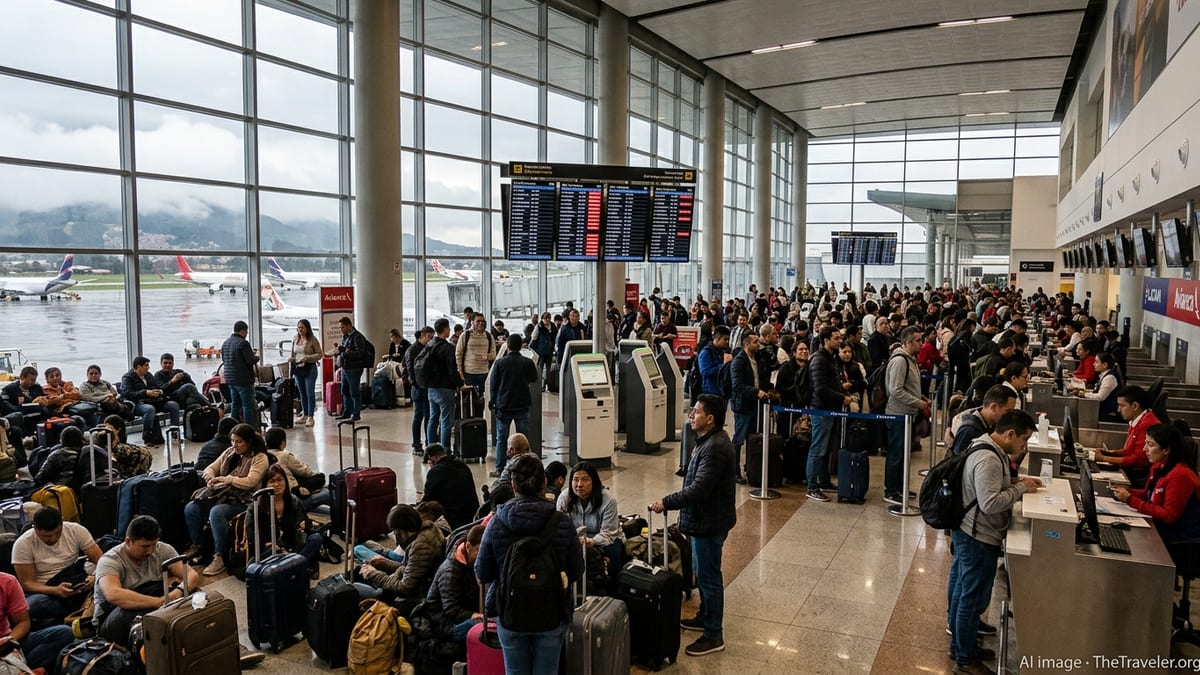
Hundreds of airline passengers were left stranded across Colombia as major airports in Bogotá, Medellín, Cartagena, Cali, Barranquilla, Bucaramanga and Cúcuta reported dozens of cancellations and hundreds of delays, disrupting operations for Avianca, LATAM Colombia, Copa Colombia, JetSMART, Clic Air and other carriers.
Get the latest news straight to your inbox!
Severe Weather Triggers Widespread Operational Disruptions
Publicly available flight-tracking data and local media coverage indicate that intense storms and deteriorating visibility around several of Colombia’s busiest hubs led to a cascade of schedule disruptions within a single operational window. In total, 68 flights were reported canceled and at least 347 services delayed, with the greatest concentration of disruption at Bogotá’s El Dorado International Airport, the country’s primary aviation hub.
The weather system moved across central and northern Colombia, affecting both departures and arrivals at airports serving Medellín, Cartagena, Cali, Barranquilla, Bucaramanga and Cúcuta. These cities anchor Colombia’s domestic network, so any sustained interruption in operations tends to ripple outward quickly, complicating aircraft rotations and crew assignments nationwide.
Available reports describe a combination of heavy rain, low ceilings and thunderstorms in key corridors, prompting temporary runway closures and tighter air-traffic flow controls. As aircraft were held on the ground or diverted, congestion built up on aprons and taxiways, further slowing the recovery of normal operations even after conditions began to improve.
Airlines operating within Colombia routinely prepare for seasonal storms, but the combination of adverse conditions across several airports at once significantly reduced the system’s overall resilience. The result was a sharp, concentrated spike in delays, with some flights pushed back multiple times before ultimately being canceled.
Major Carriers Hit Across Domestic and Regional Networks
The disruptions affected a wide range of airlines serving Colombian routes. Published schedules show Avianca and LATAM Colombia, the country’s two largest carriers by market share, bearing a substantial share of the cancellations and delays, particularly on trunk routes linking Bogotá with Medellín, Cali, Cartagena and Barranquilla.
Copa Colombia, which connects secondary Colombian cities to its parent airline’s Panama City hub, also saw its operations slowed as inbound and outbound services were re-timed. JetSMART, a newer low-cost entrant in the Colombian market, and regional operator Clic Air were similarly impacted, especially on shorter domestic hops where even brief airport closures can force entire rotations to be rescheduled.
The impact was not limited to purely domestic traffic. International passengers transiting through Bogotá, Medellín and Cartagena faced missed connections and extended layovers as departure banks were thinned out or consolidated. In practice, this meant that a weather-related hold on a short domestic leg could cause travelers to miss long-haul flights to North America, Central America or other South American destinations.
Operational data and airline communications reviewed as part of public reporting suggest carriers attempted to prioritize flights with large numbers of connecting passengers, while shifting some point-to-point services to later slots. However, limited spare aircraft and crew availability constrained how quickly airlines could re-protect travelers on the same day.
Passengers Confront Long Lines, Rebookings and Overnight Stays
Social media posts and traveler accounts reflected mounting frustration as passengers at affected airports encountered long queues at check-in counters and customer service desks. With so many flights disrupted in a short period, options for same-day rebooking rapidly diminished, particularly on popular domestic routes such as Bogotá to Medellín and Bogotá to Cartagena.
Many travelers reported being offered alternative itineraries involving multiple stops or departures significantly later in the day. In some cases, passengers accepted routings through less direct city pairs simply to secure a seat, while others opted to postpone travel entirely, especially when their plans involved tight schedules or onward international connections.
In larger hubs such as Bogotá and Medellín, media coverage noted that some passengers required overnight stays while waiting for available flights, with hotels near airport corridors quickly filling up. Travelers without confirmed rebookings often chose to remain in terminal areas, hoping for last-minute seats opened by no-shows or additional aircraft brought into service.
Because Colombian consumer regulations differentiate between disruptions caused by weather and those linked to operational issues under airline control, affected passengers navigated varying levels of assistance. Publicly available guidance from consumer advocates highlighted the importance of keeping documentation of delays and cancellations for any later claims or complaints.
Key Hubs Underscore Colombia’s Air Travel Vulnerability
The concentration of cancellations and delays in Bogotá, Medellín, Cartagena, Cali, Barranquilla, Bucaramanga and Cúcuta underscores how central these airports are to Colombia’s transport system. El Dorado in Bogotá functions as the main national and international gateway, while Rionegro’s José María Córdova Airport for Medellín and Cartagena’s Rafael Núñez Airport provide critical links to coastal and regional destinations.
When adverse weather limits operations at several of these facilities at once, the effect can resemble a temporary shutdown of major ground transport corridors. For many Colombian cities, particularly those in mountainous regions, air travel remains the most practical way to connect with the capital and other economic centers, leaving passengers with few immediate alternatives when flights are interrupted.
Observers note that Bucaramanga’s Palonegro Airport and Cúcuta’s Camilo Daza Airport, though smaller than Bogotá or Medellín, play an outsized role in regional connectivity. Even a modest number of cancellations at these airports can strand passengers for longer periods, as frequencies are lower and there are fewer overlapping services from competing carriers.
The latest disruption adds to an emerging pattern in which concentrated weather events and infrastructure constraints periodically expose the limits of Colombia’s aviation capacity. Industry analysis has long pointed to the geographic and meteorological challenges of operating in a country dominated by mountain ranges and rapidly changing weather systems.
Recovery Efforts and Ongoing Travel Advice
As weather conditions gradually improved, airlines began working through backlogs by operating additional sections where possible, upgauging aircraft on select routes and swapping aircraft assignments to move stranded travelers from the most affected airports. Publicly available flight data showed delays easing in the hours after the most intense disruption, though some knock-on effects persisted into subsequent rotations.
Travel industry commentators recommend that passengers planning to fly within Colombia during periods of unsettled weather build extra buffer time into itineraries, particularly when making tight connections through Bogotá or connecting between domestic and international flights. Early morning departures are often favored by frequent flyers seeking to reduce exposure to afternoon storms that commonly affect Andean and coastal airports.
Travelers are also encouraged by consumer organizations and aviation-focused outlets to monitor both airline notifications and independent flight-tracking platforms for real-time updates. In recent disruptions, passengers who proactively rebooked through mobile applications or call centers sometimes secured alternative options more quickly than those waiting for in-person assistance at the airport.
While the latest wave of cancellations and delays appears to be a short-lived weather-driven event, it highlights the importance of contingency planning for anyone relying on Colombia’s busy domestic network. For airlines, it serves as another reminder of how quickly operations can be knocked off balance when multiple key airports across the country face adverse conditions at the same time.