

Thousands of passengers were stranded or severely delayed at Denver International Airport on Wednesday as a fast-building line of storms triggered 86 cancellations and more than 1,000 flight delays, snarling operations for SkyWest, Southwest, United and their regional partners and disrupting travel across the Mountain West, the Southwest and the Upper Midwest.
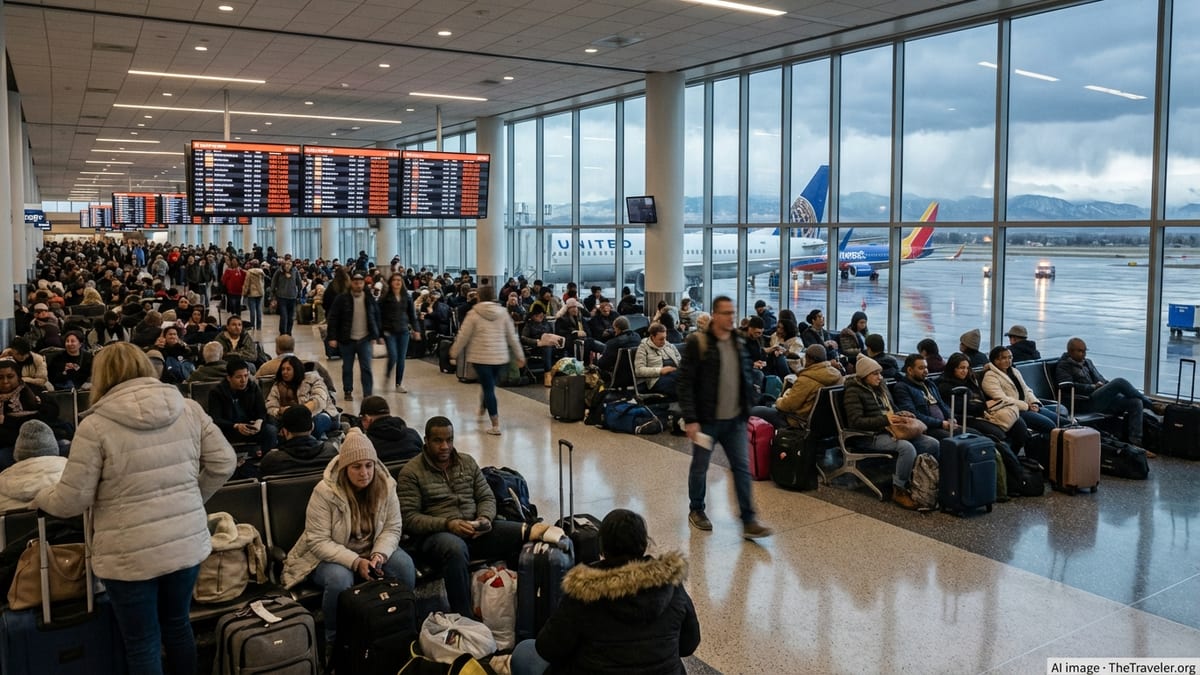
Weather Turmoil Turns Denver Into a Chokepoint
Denver International Airport, one of the country’s busiest hubs and a key connective node for transcontinental travel, saw operations slow to a crawl as thunderstorms intensified over the metro area and the High Plains. Federal air-traffic managers issued a series of ground delay programs to space out arrivals and regulate departures, forcing airlines to hold aircraft at gates and on taxiways while storms moved through critical approach paths.
By late afternoon, flight-tracking services reported more than 1,000 delayed flights in and out of Denver, alongside 86 cancellations concentrated among SkyWest, Southwest and United. Average delays pushed past an hour on many routes, with some arrivals held at their origins for much longer as airlines attempted to avoid compounding congestion in Denver’s crowded airspace.
The weather-triggered slowdown came during a traditionally busy winter travel period, amplifying frustration among passengers trying to make connections to smaller regional destinations. With Denver serving as a primary transfer point between coasts and interior cities, even a few hours of disruption can send ripple effects through the national aviation network.
Airport officials said crews worked continuously to manage lightning safety protocols on the ramp, adjust runway configurations and maintain safe distances between aircraft operating around developing storm cells. But the combination of volatile weather and heavy demand left airlines little choice but to delay and cancel flights in significant numbers.
SkyWest, Southwest and United Bear the Brunt
SkyWest, which operates regional flights for several major carriers including United and Delta, emerged as one of the hardest-hit operators in Denver’s latest bout of disruption. Its regional jets form the backbone of service to smaller airports in the Mountain West, and delays to those flights quickly multiplied as crews and aircraft fell out of position.
Southwest Airlines, a dominant presence at Denver and a popular choice for leisure travelers, also reported hundreds of delays. The carrier’s point-to-point network can be especially vulnerable when a major station like Denver experiences weather-related ground stops. Aircraft that should be turning quickly between cities instead sat idle, awaiting clearance from air-traffic control or ground crews as lightning and heavy rain slowed ramp operations.
United Airlines, Denver’s largest tenant and a primary hub carrier, wrestled with the dual challenge of protecting a dense bank of connecting flights while maintaining long-haul departures to coastal and international destinations. Delays in Denver forced schedule adjustments throughout United’s network, and passengers reported being rebooked through alternative hubs as the carrier tried to spread the operational strain.
For many travelers, the airline distinctions mattered little. Gate areas across concourses saw crowds building as rolling delay estimates crept later into the evening, departure boards filled with red and orange alerts, and rebooking lines stretched as customer service agents worked to find scarce seats on remaining flights.
Regional Routes Ripple: Santa Fe, Tucson, Salt Lake City and More
The disruption at Denver quickly cascaded outward to smaller and midsize cities that depend on regular connections through the Colorado hub. Flights between Denver and Santa Fe, often operated by regional partners like SkyWest, saw mounting delays as aircraft arriving late from other cities failed to turn on time. Travelers headed to northern New Mexico for work trips, ski vacations and cultural tourism faced hours-long waits and, in some cases, overnight stays in Denver.
Southbound routes to Tucson were also affected, with both Southwest and United adjusting schedules as storms moved through Denver and connecting banks began to unravel. Passengers reported missed onward connections to Mexico and other Southwest destinations as late-arriving flights from the East Coast could no longer feed tightly timed departures.
In Salt Lake City, another key western hub, Denver-linked flights experienced knock-on effects as crews and aircraft arriving from Colorado were delayed. Airlines at Salt Lake were forced to retime some departures and swap aircraft where possible, attempting to keep at least part of the schedule intact while Denver worked through its backlog.
Even smaller markets such as Appleton in Wisconsin and Cheyenne in neighboring Wyoming felt the shockwaves. With only a handful of daily connections to Denver, each cancellation or multi-hour delay had an outsized impact, leaving travelers with limited alternate routing options and forcing some to consider long drives or overnight hotel stays to reach their destinations.
Cheyenne and Appleton Highlight Fragility of Small-Market Links
The situation in Cheyenne illustrated how vulnerable smaller communities can be when a megahub like Denver experiences severe disruption. With few nonstop options beyond regional links to Denver, even a short ground stop in Colorado can effectively cut off air access for hours. Passengers heading to or from Wyoming’s capital saw flights delayed, retimed or consolidated, with some rebooked through later Denver departures that themselves remained uncertain.
In Appleton, a regional gateway for northeastern Wisconsin, the story was similar. A limited schedule meant that a single cancellation could wipe out half a day’s connectivity to the Denver hub, complicating both business travel and family trips. Some passengers reported being offered routings through other hubs in Chicago or Minneapolis, adding hours of travel time and increasing the risk of further missed connections.
Airline analysts note that these smaller markets are especially sensitive to disruptions because regional aircraft and crews are carefully scheduled with little slack. When a Denver-to-Appleton flight returns late, that aircraft may be earmarked for a different route later in the evening, causing a chain reaction of delays across several cities.
For local airports and tourism boards in places like Cheyenne and Appleton, such episodes reinforce longstanding concerns about reliability. While partnerships with large hub airports like Denver are vital for economic connectivity, they also expose smaller communities to the full brunt of weather and operational shocks that originate hundreds of miles away.
Inside the Passenger Experience: Crowded Gates, Long Lines, Fraying Nerves
Inside Denver International Airport, the human toll of the disruption played out in crowded concourses, fully booked restaurants and lounges, and lengthy waits for basic customer service. Families bound for ski towns, desert getaways or business meetings huddled around power outlets to keep phones charged, refreshing airline apps that often showed shifting departure times and changing gate assignments.
Some travelers reported sitting aboard aircraft that pushed back from the gate only to park on taxiways as ground controllers regulated the flow of takeoffs during lightning alerts. Others found themselves queued in long lines at customer service counters after learning that their evening departures had been canceled entirely and that hotel vouchers were in short supply.
Parents with young children scrambled to find snacks and quiet corners, while international passengers with limited English relied on hurried announcements and airport staff to navigate unfamiliar procedures for rebooking and overnight stays. The mood across terminals ranged from weary resignation among seasoned road warriors to visible frustration from vacationers seeing precious days chipped away by forces beyond their control.
Social media feeds filled with images of packed gate areas and screenshots of cascading delay alerts, amplifying public attention on Denver’s operational struggles. While airlines stressed that safety considerations would always take precedence over schedule, that message was small comfort to travelers staring down missed weddings, lost business opportunities and nonrefundable hotel nights.
Operational Chess: Ground Stops, Deicing and Crew Timeouts
Behind the scenes, the disruption at Denver underscored the complex choreography required to run a major hub in adverse conditions. When thunderstorms and associated lightning move into proximity of active runways and ramp areas, airlines must temporarily halt ramp work to protect ground crews, delaying everything from baggage loading to aircraft pushbacks. Even short suspensions, repeated over the course of a day, compound into sizable delays.
In addition to weather holds, airlines had to contend with air-traffic control programs designed to meter the flow of flights into Denver’s constrained airspace while storms lingered nearby. These ground delay programs required carriers to keep aircraft at their origin airports until specific departure windows opened, preventing uncontrolled queues from forming in the skies over Colorado.
Winter conditions brought an additional layer of complexity in some parts of the day, as dropping temperatures and passing cells triggered deicing requirements. Each aircraft needed a meticulous spray of anti-icing fluid prior to departure, a process that can take 10 to 30 minutes or longer and requires specialized vehicles and crews. When multiple banks of departures all need deicing at once, lines for those services grow and departure times slip further.
Crew scheduling constraints represented another pressure point. Pilots and flight attendants operate under strict federal duty-time regulations that cap how long they can be on the clock without rest. As delays stretched, more crews neared or exceeded their legal limits, forcing airlines to cancel or further delay flights even after the worst of the weather had passed. Finding replacement crews on short notice, especially for regional flights, proved challenging.
National Knock-On Effects and Airline Recovery Plans
Denver’s troubles did not remain local. As one of the top connecting hubs in the United States, the airport’s slowdown translated into rolling disruptions across multiple time zones. Flights bound for Denver from coastal hubs such as Los Angeles, San Francisco, Chicago and New York faced departure holds and retimings, pushing late-evening Denver connections to cities like Santa Fe, Tucson and Appleton past reasonable operating hours.
Airlines responded with a mix of tactical measures designed to stabilize their networks as conditions slowly improved. Some carriers proactively consolidated lightly booked flights, moving passengers onto fewer, fuller departures in order to free up aircraft and crews for the most critical connections. Others added larger aircraft on select routes to absorb stranded passengers, even if that meant temporarily reducing frequency.
Rebooking policies were relaxed throughout the day, with fee waivers extended for passengers willing to shift their travel to later dates or reroute through alternative hubs. While these measures helped alleviate some pressure, they also extended the disruption’s impact over multiple days as deferred travelers competed for limited seats on subsequent flights.
Industry experts noted that the Denver episode highlighted the delicate balance airlines must strike between tightly optimized schedules that maximize aircraft utilization and the need for resilience in the face of increasingly volatile weather patterns. As hubs like Denver continue to grow in both size and importance, the consequences of even a single stormy afternoon can reverberate across the country.
Advice for Travelers Using Denver and Other Weather-Prone Hubs
The latest wave of cancellations and delays at Denver offers several practical lessons for travelers passing through major weather-prone hubs. Aviation experts consistently recommend booking earlier flights in the day when possible, as schedules tend to be less disrupted in the morning and more options exist for same-day rebooking if problems arise.
Passengers connecting through Denver, especially those bound for smaller markets like Santa Fe, Cheyenne or Appleton, are often advised to build extra layover time into their itineraries. While longer connections may be less convenient on paper, they provide valuable buffer against the types of cascading delays that unfolded during the latest storm system.
Keeping airline apps updated and enabling alerts can help travelers react quickly to gate changes, rolling delay estimates or automatic rebookings. For those facing cancellations, contacting airlines through multiple channels, including phone, app messaging and social media, can sometimes yield faster assistance than waiting in line at a crowded airport help desk.
Ultimately, the scene at Denver illustrated a recurring reality of modern air travel: when a major hub hits operational turbulence, the impacts are rarely confined to one city. From Tucson’s desert runways to Salt Lake City’s mountain-framed approaches and the smaller terminals in Santa Fe, Appleton and Cheyenne, thousands of passengers were reminded that the nation’s airways are only as reliable as their most weather-battered chokepoints.