

More news on this day
Spring storms sweeping across large parts of the United States are rippling through Los Angeles International Airport, where rolling delays and targeted cancellations are disrupting operations for major domestic and international airlines at the height of the Easter travel period.
Get the latest news straight to your inbox!
Storm System Sends Disruption Ripple Through LAX
According to publicly available flight tracking data for April 5, a fresh round of severe weather over central and eastern parts of the country has coincided with a spike in late and canceled flights at Los Angeles International Airport. While conditions in Los Angeles have been comparatively stable, thunderstorms and unsettled weather along key transcontinental and transborder routes are limiting capacity at several hubs, pushing knock-on disruption into LAX arrivals and departures.
Recent national tallies for the Easter travel window show hundreds of cancellations and several thousand delays across the United States, with airports in Atlanta, Chicago, Dallas and Houston handling a large share of the disruption. As flights into and out of those hubs run behind schedule or are scrubbed altogether, aircraft and crews that normally rotate through Los Angeles are arriving late or not at all, forcing airlines to consolidate schedules and adjust departure times on short notice.
Operational summaries compiled from aviation dashboards indicate that LAX has repeatedly appeared among the top U.S. airports for delays during the first week of April, even on days when local weather has been largely cooperative. The pattern reflects a national air traffic system under strain from volatile spring conditions, high passenger volumes and still-tight staffing in some parts of the airline and ground handling workforce.
Major Carriers Hit as Cancellations Target Key Routes
Publicly accessible flight-status boards on Sunday list delays for a broad cross-section of carriers at LAX, including the large U.S. network airlines and several foreign flag carriers that link Southern California with Asia-Pacific, Europe and Latin America. Reports from travel-industry outlets describe dozens of flights departing late and a smaller but still significant number canceled outright, with impacts concentrated on long-haul and hub-to-hub services where aircraft utilization is typically high.
Coverage focused on Los Angeles over the past several days has highlighted recurring schedule issues on flights operated by American Airlines, Delta Air Lines and United Airlines, along with disruptions affecting Alaska Airlines, Air Canada and selected Asia-based carriers. Routes connecting LAX to Chicago, Dallas–Fort Worth, Atlanta, New York and major Canadian and Pacific gateways show some of the highest rates of schedule changes as storms interfere with operations at both ends of the journey.
Published aviation data for earlier in the week already showed LAX contending with more than 200 delayed flights in a single day, as well as clusters of cancellations that removed entire roundtrips from the timetable. Today’s storm-driven disruption is adding another layer of complexity for airlines that were already working to realign aircraft rotations following earlier bouts of unsettled national weather.
National Weather and System Constraints Amplify the Impact
Meteorological summaries for the first days of April describe a pattern of strong frontal systems and severe-weather outbreaks across the Midwest, South and East Coast, including thunderstorms, high winds and localized flooding. Those conditions have prompted a mix of ground delay programs, en route flow restrictions and reroutings at various times, reducing the effective capacity of the national airspace system and creating longer-than-usual travel times on key corridors.
At the same time, industry analysis published in recent days points to a U.S. aviation network still adjusting to demand that has returned to or exceeded pre-pandemic levels. Busy schedules leave airlines with limited spare aircraft and crews, meaning that a single weather-related delay in one region can quickly cascade into missed connections and aircraft mismatches elsewhere, particularly at coastal gateways such as Los Angeles.
Federal performance reports and previous construction impact assessments have also noted that runway and taxiway works at major airports, including in California, can introduce temporary bottlenecks that contribute to departure queues and airborne holding during peak periods. While LAX has kept its core infrastructure available during the current storm episode, the broader context of constrained capacity at other hubs has made it more difficult to absorb irregular operations without visible disruption to passengers.
Travelers Face Crowded Gates and Tight Connection Windows
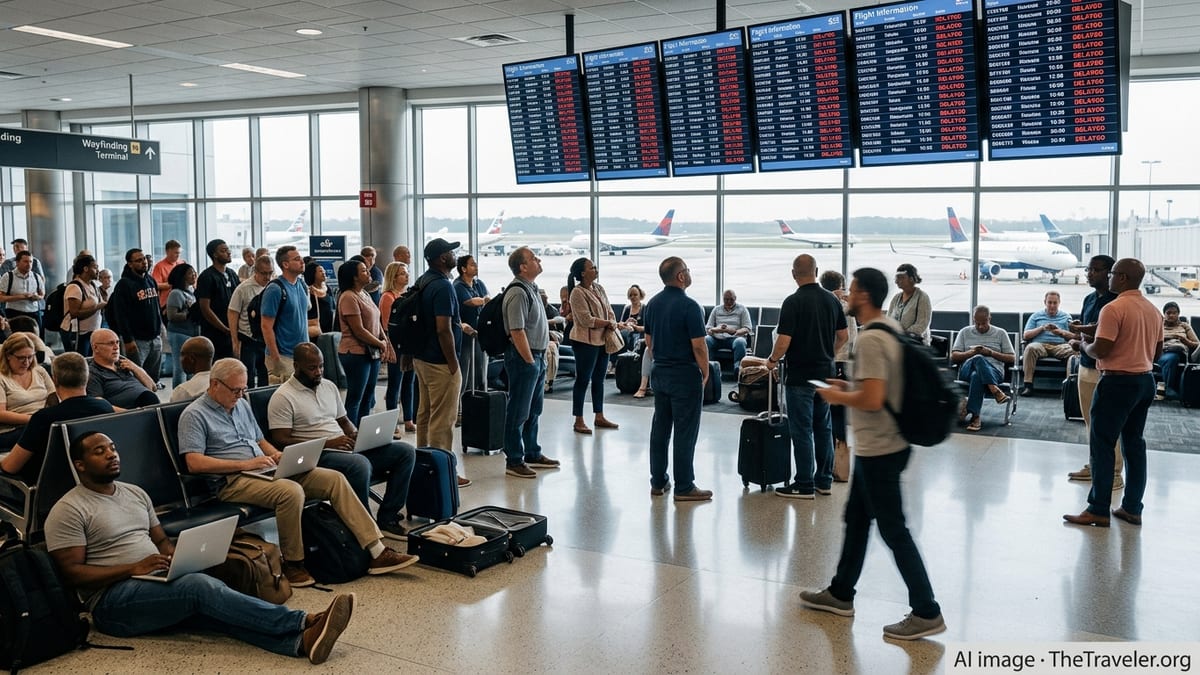
For passengers on the ground in Los Angeles, the latest wave of weather-related disruption is most visible in the form of crowded gate areas, packed standby lists and departure boards dominated by yellow and red status indicators. Reports from previous disruption days this week describe long lines at customer service counters as travelers seek rebooking options, flight credits or hotel assistance when overnight stays become unavoidable.
Connections are proving particularly vulnerable. When inbound flights run late from storm-affected hubs, some travelers are arriving in Los Angeles after their onward departures have already closed, leaving fewer options to complete itineraries the same day. In some cases, airlines are consolidating lightly booked flights or swapping aircraft types to better match capacity with demand, creating further schedule adjustments and seat reassignments.
Despite the turbulence, security screening and terminal access at LAX have generally remained within typical ranges during the current weather episode, according to recent crowd-sourced reports and airport operations summaries. The main pinch points are instead occurring at the gate and on the airfield, where tightly choreographed turnarounds are more likely to break down when arrival flows from other regions become unpredictable.
What Travelers Can Do as Storms Continue
With volatile spring weather expected to persist across parts of the country, aviation analysts caution that the pattern of rolling delays and periodic cancellation spikes could continue to affect LAX and other major hubs in the coming days. Travelers with imminent departures are being advised by airlines and travel counselors to monitor flight status closely, particularly for itineraries involving connections in storm-prone regions.
Industry guidance emphasizes the value of using airline mobile apps and websites to track schedule changes and request rebooking, since digital tools can sometimes offer alternative routings before airport queues grow long. Passengers on international journeys or on the final leg of multi-city itineraries are encouraged to pay particular attention to minimum connection times and the risk that tight layovers could evaporate if an upstream storm system slows departures.
Consumer-rights information from government and advocacy organizations notes that passengers are generally entitled to a refund when a flight is canceled and they choose not to travel, even on nonrefundable tickets. However, compensation for weather-related delays varies by jurisdiction and airline policy, and travelers are urged to review the specific conditions attached to their bookings as the spring storm season continues to test the resilience of the U.S. air travel system and key gateways such as Los Angeles International Airport.