

More news on this day
Air travelers across the United States are facing another turbulent stretch of delays at major airports, as storms, staffing pressure and new capacity limits converge to slow the nation’s already stretched aviation network.
Get the latest news straight to your inbox!
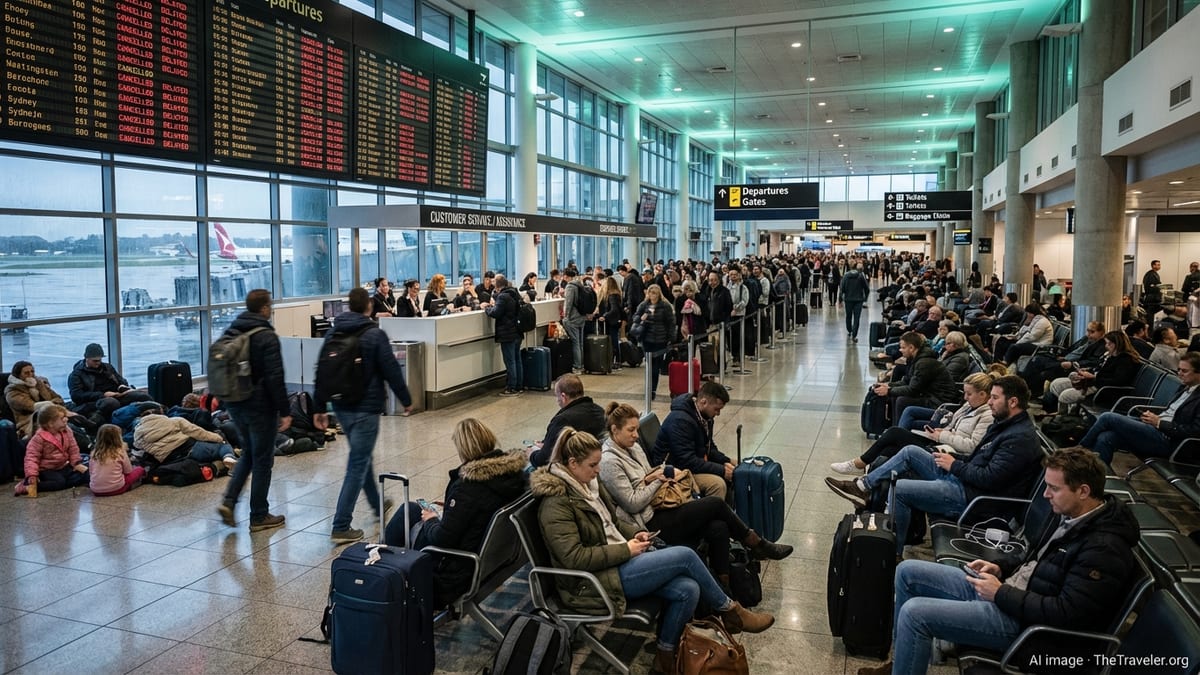
Spring storms trigger cascading gridlock at major hubs
Successive late-winter and early-spring storm systems have repeatedly disrupted flight schedules at some of the country’s busiest hubs in recent weeks. Reports indicate that severe weather on March 16 and 17 led to more than 1,800 cancellations and around 1,200 delays across seven large airports, including Atlanta, Chicago O’Hare, Houston, New York and Miami. Ground stops and ground delay programs limited the flow of arrivals as blizzards, thunderstorms and high winds moved across key corridors.
Additional storm fronts later in March produced thousands more cancellations and delays, particularly at New York and Chicago airports, where congestion is already high even in clear conditions. Travel coverage from aviation-focused outlets describes queues stretching from security checkpoints into parking areas as disrupted passengers converged on terminals, all competing for scarce rebooking options.
The pattern has continued into early April. Recent data collated from flight-tracking services shows that on April 5 more than 3,900 flights were delayed and over 400 cancelled across the United States, with Dallas Fort Worth, Chicago O’Hare and Atlanta again among the hardest hit. Travel analysts note that these clusters of severe weather are arriving during a busy spring break and Easter travel period, amplifying the impact on passengers.
Industry observers point out that modern hub-and-spoke airline networks have very little slack. When storms close or slow a single major hub, aircraft and crews quickly end up in the wrong places, federally mandated crew rest rules begin to bite, and delays spread outward to airports that may not be experiencing any bad weather at all.
Runway and capacity constraints deepen bottlenecks
On top of weather disruptions, new capacity limits at key airports are expected to add to delays through the busy travel months ahead. At San Francisco International Airport, a combination of runway construction and a permanent rule change on how closely spaced parallel runways can be used has led the Federal Aviation Administration to cut permitted arrivals from 54 per hour to 36. Publicly available information on the change notes that the adjustment is intended to address safety concerns in crowded Bay Area airspace while work continues on airport infrastructure.
In Chicago, local reporting indicates that the FAA is in talks with major carriers about trimming summer schedules at O’Hare International Airport due to concerns that planned flight volumes could exceed what the airport can reliably handle. O’Hare is already undergoing a long-term expansion and modernization program, which involves construction that can further limit flexibility and contribute to congestion at peak times.
Similar capacity pressures are being cited at other coastal hubs, including airports serving New York and the Boston and Los Angeles regions. Analyses of federal delay statistics compiled by aviation and travel research sites show that these large coastal gateways consistently rank among the top airports for the share of flights arriving late, reflecting the combined effects of crowded airspace, tight schedules and frequent weather disruptions.
While capacity curbs and construction are aimed at improving safety and long-term efficiency, travelers passing through these airports in 2026 are likely to see more holding patterns on the tarmac, slower turnaround times at gates and longer queues inside terminals as operations adjust to the new limits.
Staffing strains at security and in the air traffic system
Staffing remains another pressure point that is aggravating airport delays, particularly at security checkpoints and in air traffic control facilities. The ongoing partial shutdown of the U.S. Department of Homeland Security, which began in mid-February, has left the Transportation Security Administration operating under prolonged strain. Published coverage of the shutdown’s impact describes increasing wait times at some security checkpoints and notes that hundreds of officers have left the agency during the dispute.
With spring break and major sporting events drawing heavy crowds, the combination of high passenger volumes and limited staffing has translated into longer lines and missed flights at some airports even on clear-weather days. Travel outlets report that when storms or other disruptions force last-minute rebookings, surges of passengers often arrive at security simultaneously, overwhelming checkpoints that are already short of staff.
Behind the scenes, the broader air traffic control system is also grappling with staffing and modernization challenges. Industry analyses drawing on federal transportation statistics point to years of underinvestment in technology and a slow pipeline for training new controllers. While the core system continues to function safely, these constraints leave less margin to absorb surges in traffic or recover quickly after a disruption, increasing the likelihood that small delays will snowball into wider gridlock.
Academic research examining flight delay patterns over the past decade suggests that congestion effects are becoming more pronounced across the wider network, not only at the largest hubs. This trend means that smaller and mid-size airports are increasingly caught in the ripple effects when major nodes such as Chicago, Atlanta or New York experience operational stress.
Passengers face a patchwork of airline performance
Recent operational data indicates wide variation in how individual airlines are weathering the latest disruptions. Coverage of delay statistics from early April shows that several large U.S. carriers each recorded more than 800 delayed flights in a single day, with dozens of cancellations layered on top. Impacts were most visible at hub airports, where carriers rely on tightly banked schedules to connect passengers between flights.
Global on-time performance rankings compiled for February 2026 suggest that, on average, airlines still complete a substantial majority of flights on schedule, but that a significant minority arrive late or are cancelled. Industry analysts caution that these headline percentages can obscure the harsh experience on peak disruption days, when thousands of passengers are stranded in terminals as aircraft and crews fall out of position.
Some carriers have responded by thinning schedules slightly, building more connection time into itineraries or rebalancing flights across hubs to spread risk. However, competitive pressure and demand recovery have pushed many to keep aircraft utilization high, maintaining a system in which even short disruptions can ripple outward for days.
For travelers, the result is an uneven landscape. Two passengers departing at the same time from the same airport may have very different experiences depending on which airline they fly, the resilience of that carrier’s schedule at a given hub, and how exposed their route is to storm-prone regions or capacity-constrained airports.
What the turbulence means for upcoming travel seasons
Travel analysts expect that the combination of volatile weather, infrastructure work and staffing challenges will continue to test the U.S. aviation system through at least the peak summer season. Forecasts point to a busy period for leisure travel, and airlines have scheduled aggressive capacity at many hubs to capture demand.
Regulators and airport operators are attempting to blunt the impact by enforcing capacity limits where necessary, maintaining ground delay programs during storms and pushing ahead with modernization projects. Airline executives, in public comments and earnings discussions summarized across financial and aviation news outlets, have highlighted investments in new technology and operational control centers designed to improve recovery times after disruptions.
Even with these efforts, recent weeks have underscored how quickly the system can become strained. From the January and February winter storms that cancelled tens of thousands of flights nationwide to the March and April clusters of delays at New York, Chicago, Dallas and Atlanta, the 2026 travel year is already marked by recurring episodes of “aviation gridlock.”
For now, travelers heading through major U.S. airports are being advised by consumer advocates and travel experts to build in extra time, monitor flight status closely and prepare for the possibility that even routine trips may be slowed by factors far beyond their control.