

More news on this day
Travelers at New York’s John F. Kennedy International Airport faced another day of disruption on March 23, with publicly available tracking data showing at least 14 flight cancellations and hundreds of delays affecting services operated by Delta Air Lines, American Airlines, JetBlue and other carriers on routes linking the United States with Europe and the Middle East.
Get the latest news straight to your inbox!
Storm System and Network Strain Snarl JFK Operations
The latest wave of disruptions at JFK comes in the wake of a series of March storm systems that moved across the Midwest and into the eastern United States, contributing to widespread operational challenges at major hubs. Published coverage of the recent weather pattern describes strong winds, bands of heavy rain and lingering snow in some regions, conditions that tend to slow departures and arrivals and reduce the number of flights that can safely operate each hour.
As airlines adjust schedules across their networks in response to storms, delays often cascade into airports that are not directly experiencing severe conditions. Aviation analysts routinely note that JFK, as one of the country’s busiest international gateways, can be particularly vulnerable when disruptions hit earlier flights in the chain, especially at other coastal hubs and transatlantic gateways.
Data from flight-tracking platforms on March 23 indicated a familiar pattern at JFK: a modest number of outright cancellations combined with a much larger volume of delayed departures and arrivals. While 14 cancellations may appear limited in isolation, the associated knock-on delays across dozens of other services can leave terminals crowded and aircraft and crew out of position for long-haul departures.
The impact at JFK also reflects broader pressures that have built up in the U.S. aviation system through the winter of 2025–2026, including periodic winter storms, high seasonal demand and continuing efforts by airlines and airports to staff critical operations such as ground handling, maintenance and security screening.
Major Carriers Hit: Delta, American and JetBlue
Delta Air Lines, American Airlines and JetBlue, all with significant operations at JFK, were among the carriers most visibly affected by Sunday’s disruptions. Publicly available schedules show these airlines operating a large share of transatlantic services from New York, as well as key links to the Middle East either directly or via alliance and codeshare partners.
For Delta, JFK is a strategic transatlantic hub feeding destinations in Western Europe and beyond. When departure slots compress because of weather or air traffic control constraints, long-haul flights that require extended turnaround times and rested crews can be particularly difficult to reschedule, increasing the likelihood of late-evening delays or cancellations. Recent consumer reports and social media posts from February and March have highlighted long waits for rebooking on some disrupted Delta services touching JFK.
American Airlines, which operates from a different terminal complex at JFK, has likewise faced rolling schedule adjustments during recent storm events. The airline’s transatlantic bank and its connections through partner hubs in London and other European cities mean that delays originating in New York can reverberate into morning arrivals in Europe, complicating onward connections for business and leisure travelers.
JetBlue, historically one of JFK’s largest operators by daily movements, has also drawn scrutiny this winter as disruption events have intersected with its dense schedule of domestic and international departures. Public complaints documented online in late February and early March describe extended delays at JFK and LaGuardia, including instances where passengers waited hours for updated departure information or alternative arrangements after flights were canceled.
Transatlantic and Middle East Routes See Ripple Effects
The turmoil at JFK on March 23 has been especially challenging for travelers flying to and from Europe and the Middle East, routes that tend to operate at or near capacity during peak seasons. Long-haul flights often depend on precise timing to meet night curfews at overseas airports, secure limited arrival slots and align with banked connections for onward journeys.
When departures from New York push back significantly, carriers sometimes have to re-time or cancel services entirely to avoid landing outside permitted operating windows in cities such as London, Paris, Rome, Tel Aviv or Doha. Publicly available schedules and tracking feeds on Sunday showed several JFK-originating transatlantic flights departing behind schedule, as well as a small number of cancellations on long-haul routes.
Inbound flights from Europe and the Middle East can also be caught in the disruption cycle. Aircraft arriving late into JFK may miss their scheduled slots for onward domestic legs or return services, leading airlines to consolidate passengers onto fewer departures. That can translate into longer layovers for travelers in transit and, in some cases, unplanned overnight stays in New York when no same-day alternatives are available.
Travel industry observers point out that the complex nature of modern airline networks means a single day of storm-driven delays can generate residual disruption for several subsequent days. Aircraft and crew displaced by Sunday’s schedule changes at JFK may not fully return to planned rotations until midweek, particularly on long-haul routes that require extended duty and rest periods.
Passenger Experience: Crowded Terminals and Tight Connections
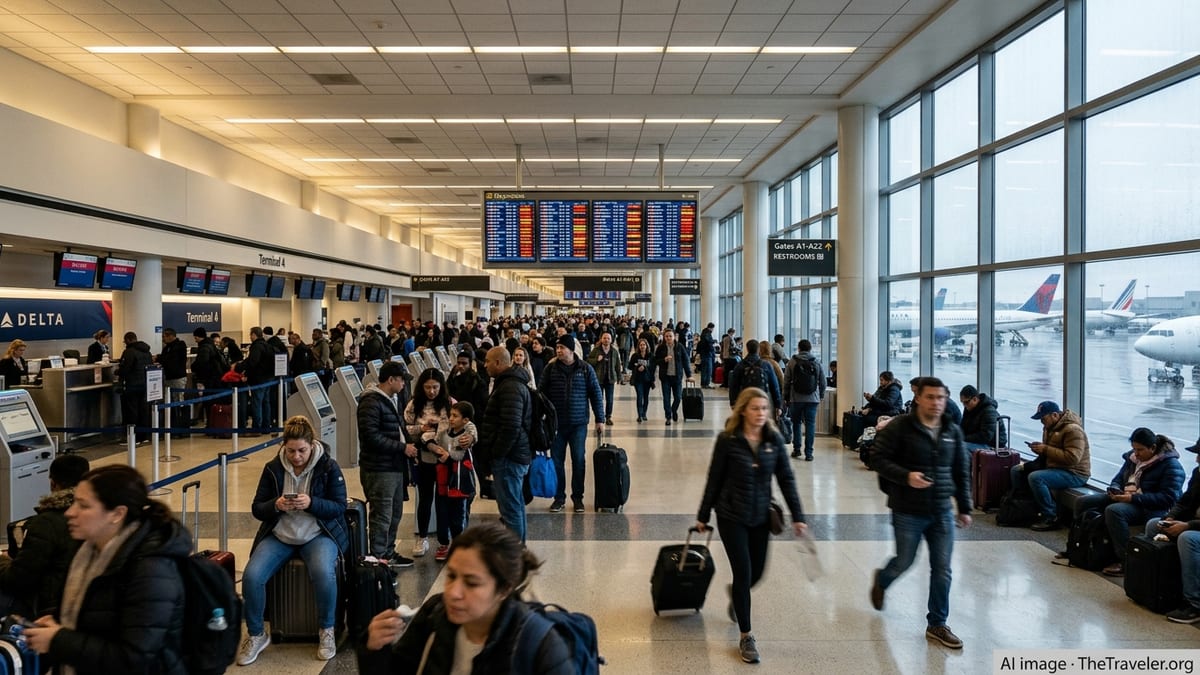
By Sunday afternoon, images and first-hand accounts circulating on social platforms depicted busy departure halls and long lines at customer service counters at JFK. While conditions varied by terminal, many travelers reported tight connection windows, rebookings onto later flights and uncertainty over the status of onward journeys to secondary European and Middle Eastern destinations.
Publicly available information from travel forums in recent weeks has highlighted recurring themes during irregular operations at JFK: congestion at check-in and security, difficulty in reaching airline agents by phone, and limited availability of alternative flights on peak travel days. These challenges are often more acute for passengers on complex itineraries involving multiple carriers or separate tickets.
Families and long-haul travelers have also raised concerns about limited seating and charging points in some gate areas when large numbers of flights are delayed simultaneously. With evening departures to Europe and overnight services to the Middle East often departing within a compressed time window, even minor shifts in departure times can quickly fill holding areas and strain airport amenities.
In response to recurring disruption events across the U.S. network this winter, consumer advocates have encouraged travelers to build in longer connection times, travel with essentials in carry-on luggage and familiarize themselves with airline policies on hotel vouchers and meal support during weather-related delays and cancellations.
What Travelers Can Expect in the Coming Days
Looking ahead, weather forecasts for the northeastern United States in the final week of March indicate a gradual easing of the latest storm system, but aviation experts caution that the full effects of Sunday’s disruption at JFK may linger. Recovery periods often depend not only on local conditions but also on how quickly airlines can reposition aircraft and crews around their global networks.
Travelers with upcoming flights through JFK over the next several days are likely to encounter busy terminals and occasional schedule adjustments, especially on routes connected to Europe and the Middle East. Publicly available guidance from airlines and the U.S. Department of Transportation consistently recommends checking flight status frequently, using airline apps to receive real-time updates and confirming any tight connections before heading to the airport.
Some carriers have also activated flexible travel policies during recent storm periods, allowing passengers booked on affected dates to change their travel plans without standard change fees or fare differences. While policies differ by airline and fare type, passengers who can shift to earlier or later departures may find more options and less congestion.
Observers note that the current episode at JFK is part of a broader pattern of weather-related volatility and operational strain across the U.S. air travel system in early 2026. For one of the world’s busiest international gateways, even a day with 14 cancellations and several hundred delays is a reminder of how tightly interconnected global air travel has become, and how quickly conditions can change for passengers heading between North America, Europe and the Middle East.