

More news on this day
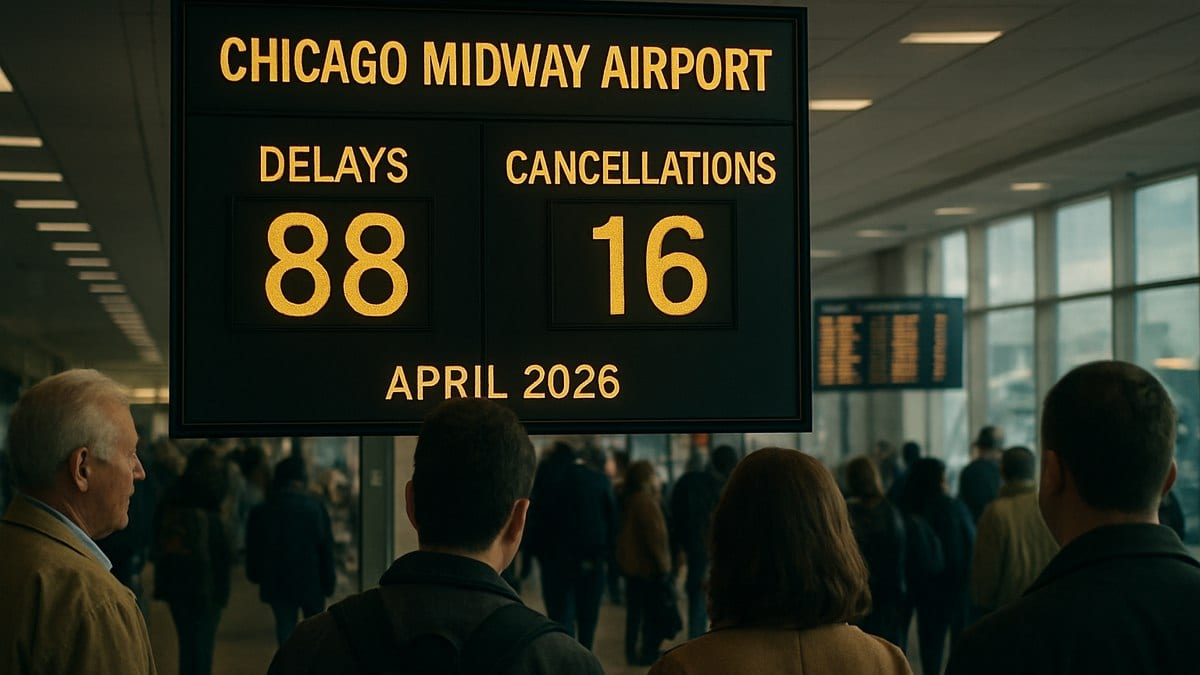
Chicago Midway International Airport saw at least 88 flight delays and 16 cancellations in early April 2026 as spring thunderstorms and air-traffic constraints rippled through the national aviation system, complicating travel plans for hundreds of passengers.
Get the latest news straight to your inbox!
Weather Systems Converge Over Chicago
The early April disruption at Chicago Midway coincided with a broader spell of unsettled spring weather across the Midwest and Eastern United States. Publicly available weather and aviation bulletins describe bands of thunderstorms, gusty winds and pockets of low visibility moving repeatedly through the Chicago area over several days, prompting traffic-management programs in the regional airspace.
Recent regional coverage of Chicago’s early April storms notes that convective cells and fast-moving fronts brought heavy rain, hail and strong winds to parts of northern Illinois. Those conditions tend to limit the number of arrivals controllers can safely accept at busy fields, including Midway, forcing airlines to slow their schedules and hold or reroute flights until conditions stabilize.
Flight-tracking dashboards and municipal aviation data for the first days of April 2026 reflect how quickly such weather can translate into operational strain. While Midway did not see the extreme cancellation totals reported at some larger hubs earlier this spring, the combination of 88 delays and 16 cancellations in a short window still represented a significant interruption for a predominantly point-to-point airport heavily used by leisure and visiting-friends-and-relatives travelers.
Meteorologists and aviation planners often highlight Chicago as particularly vulnerable in transitional seasons, when late winter patterns overlap with early warm-season thunderstorms. The April 2026 episode followed a series of late-winter storms across the central United States, and the lingering instability appears to have played a role in the turbulence now affecting Midway’s operations.
How 88 Delays and 16 Cancellations Ripple Through the Network
On paper, 16 cancellations at a single airport may appear modest compared with nationwide totals, but the effect is amplified when combined with 88 delayed departures and arrivals. Flight-status data compiled for early April 2026 show that Midway’s delays were concentrated in peak daytime and early evening periods, when aircraft and crews are already stretched thin across dense schedules.
Because Midway is anchored by point-to-point service on a handful of major carriers, individual cancellations can disrupt multiple downstream flights that rely on the same aircraft and crew pairings. Aviation analyses of recent national disruption days indicate that once early flights fall significantly behind schedule, later departures often inherit the delay, sometimes culminating in end-of-day cancellations when crews run up against duty-time limits.
Nationally, early April flight statistics show thousands of delays and several hundred cancellations across U.S. airports in a single 24-hour span, with weather and airspace constraints frequently cited as contributing factors. Within that broader pattern, Midway’s 88 delays and 16 cancellations represent one node in a wider network of knock-on effects that stretched from major hubs in the Southeast to busy coastal gateways.
For Midway passengers, those numbers translated into longer-than-normal gate holds, aircraft waiting in departure queues and, in some cases, missed connections at other airports. Even though Midway serves fewer traditional hub-and-spoke itineraries than Chicago O’Hare, many travelers still rely on onward connections through cities such as Denver, Dallas, Atlanta or Phoenix, meaning that a delay in Chicago can easily cascade into schedule changes further down the line.
Midway’s Role in a Strained Spring Travel Season
The April 2026 disruptions at Midway came during what aviation analysts describe as a tightly packed spring travel period. Industry commentary for early April notes that spring-break vacations, late-season ski trips and early warm-weather getaways have all converged on airline schedules, lifting passenger volumes even at secondary airports like Midway.
Historical performance data for Midway show that the airport already carries an outsized share of delay minutes relative to its size, in part because of its compact airfield, dense schedule of short-haul flights and reliance on a small number of carriers. Recent transportation research and congressional reporting on U.S. aviation delays have grouped Midway with other mid-sized but heavily scheduled airports that can quickly become bottlenecks when weather or staffing issues arise elsewhere in the system.
Published coverage of national travel conditions in early April 2026 underscores that Chicago appears repeatedly in delay tallies, both through O’Hare’s role as a major connecting hub and Midway’s status as a key point-to-point gateway. When thunderstorms or strong winds affect the region, both airports often see ground delay programs or ground stops that slow arrivals and departures and consume precious recovery time in carrier schedules.
For airlines, that environment heightens the importance of tactical decisions about which flights to cancel preemptively and which to keep operating with extended delays. The 16 cancellations logged at Midway suggest a targeted effort to trim the schedule at the margins while keeping core routes intact, though that approach can leave specific flights facing very long waits while carriers try to move aircraft and crews back into position.
What Travelers Experienced at Chicago Midway
From the traveler’s perspective, the statistics at Midway translated into crowded concourses, active gate-change boards and extended customer-service lines. Social media posts and traveler forums on April 4 reference aircraft holding patterns near the airport, diversions, and apparent mismatches between on-the-ground conditions and delay listings, underscoring how confusing these events can look from a passenger’s vantage point.
In some cases, flights inbound to Midway appeared to circle or divert as air-traffic managers balanced arrival rates with storm cells on radar. Passengers waiting to depart often had limited visibility into those upstream decisions, seeing only rolling updates on departure times and occasional aircraft swaps as carriers tried to salvage as much of the schedule as possible.
Travel commentary this spring has emphasized that, during disruption events, travelers at airports such as Midway are more likely to encounter same-day rebookings onto later flights or alternate routings through other cities rather than immediate refunds. Airlines often prioritize keeping customers moving, even if that involves longer itineraries, to prevent multi-day backlogs from forming at already busy terminals.
The uneven nature of the April 2026 disruptions also produced some striking contrasts. While some flights departed close to on time, others faced multi-hour waits or last-minute cancellations, leaving passengers on adjacent gates with sharply different experiences. Reports from passenger forums suggest that those able to monitor multiple flight-tracking tools, airline apps and airport dashboards had a better sense of which routes were most vulnerable to disruption.
Tips for Navigating Midway During Disruption Days
Industry guidance and consumer travel coverage offer several practical lessons for passengers flying through Midway during periods of elevated delays and cancellations. Analysts consistently recommend building additional buffer time into itineraries that rely on tight connections, particularly when connecting through weather-sensitive hubs or during seasons prone to thunderstorms.
Travel experts also point to the value of early departures from airports like Midway, where aircraft and crews are more likely to be in place from overnight stays. As the day progresses, even minor operational hiccups can accumulate, increasing the odds that afternoon and evening flights will face extended delays or cancellations.
Another recurring suggestion in recent reporting is to monitor multiple information channels simultaneously. The combination of airline mobile apps, airport status dashboards and third-party flight-tracking services can provide a more complete picture of conditions in and around Midway, especially when publicly available information indicates that weather or air-traffic constraints are affecting the broader region.
For travelers whose flights are among the 16 cancellations or the 88 significantly delayed operations tallied at Midway, consumer advocacy articles stress the importance of understanding airline policies on rebooking, meal vouchers and hotel accommodations. Publicly available Department of Transportation resources and carrier-specific customer-service plans outline what support may be available when disruptions reach the scale seen in Chicago in early April 2026.