

More news on this day
Flight operations across the United States faced renewed strain on April 3, as disruptions centered on Boston Logan International Airport and Chicago Midway International Airport contributed to at least 48 delays and 23 cancellations nationwide, leaving isolated passengers stranded at hubs and smaller regional fields.
Get the latest news straight to your inbox!
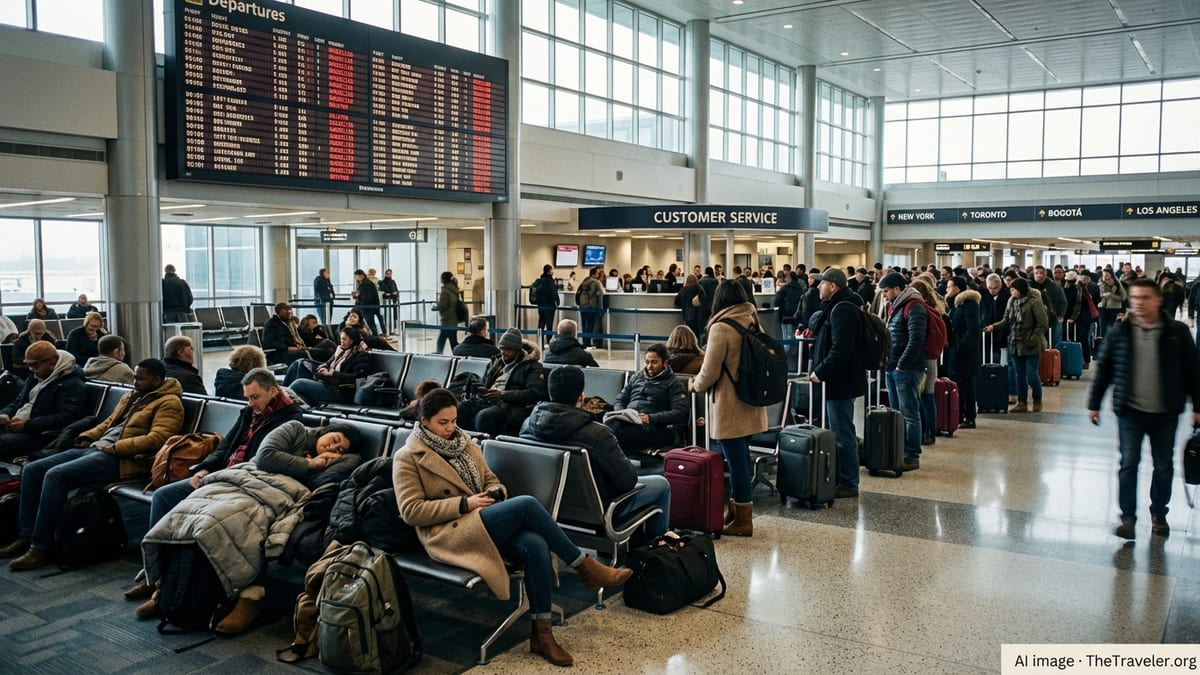
Weather and Traffic Turbulence Hit Key Northeast and Midwest Hubs
Publicly available weather data for early April shows a combination of low cloud ceilings, persistent overcast conditions and brisk northeasterly winds across parts of New England and the Midwest, with Boston Logan and Chicago Midway both reporting cloud cover and cool, unsettled air. These conditions, while not extreme, add complexity to already congested airspace and can trigger spacing requirements that slow arrivals and departures.
Recent storm systems moving through the broader Midwest and Great Lakes region have also stressed Chicago’s aviation network, with localized thunderstorms and heavy rain on April 2 prompting extended delays and a wave of schedule adjustments. While Chicago O’Hare typically absorbs the largest share of weather-related disruptions, Chicago Midway often experiences secondary knock-on effects as aircraft and crews are rerouted around convective weather and ground delay programs.
In the Northeast, residual moisture and onshore flow have complicated operations at Boston Logan, one of the country’s most delay-prone airports during unsettled conditions. Even moderate crosswinds or low visibility can reduce runway capacity, pushing airlines to pad schedules, slow turnarounds and, in some cases, proactively cancel flights on thinner routes in order to protect busier trunk lines later in the day.
As a result, Friday’s tally of 48 delays and 23 cancellations reflects less a single dramatic storm than the cumulative effect of marginal weather layered onto an already tight aviation system, where even modest constraints at a few key hubs ripple outward to smaller airports nationwide.
Ripple Effects Leave Isolated Travelers With Limited Options
The headline numbers for delays and cancellations only hint at the experience for individual passengers, especially those traveling from or to smaller regional airports that depend on connections through Boston and Chicago. When an early leg into Boston Logan or Chicago Midway is scrubbed, travelers can quickly find themselves stranded with few or no same-day alternatives, particularly on routes served by a single daily flight.
Once connecting banks are disrupted, seats on remaining flights tend to evaporate quickly as airlines rebook affected customers. Late in the travel day, this can lead to isolated passengers spending long hours in terminals, or in some cases being routed through multiple hubs in order to reach their destinations. A single cancellation on a regional route can cascade into missed connections for dozens of travelers spread across the country.
Published guidance from consumer advocates notes that passengers whose trips are interrupted often face a patchwork of policies, with coverage varying by airline and by the cause of the disruption. Weather-related delays typically result in fewer complimentary accommodations and reimbursements than disruptions linked to controllable issues such as crew availability or mechanical problems, leaving some travelers to shoulder out-of-pocket costs for meals and hotels when weather is cited as the primary factor.
For those marooned far from major urban centers, ground transportation can also be challenging. If the last flight of the night from a hub like Boston or Chicago to a smaller city is canceled, there may be no realistic bus or rail alternatives, forcing travelers to wait until the following day and adding another layer of logistical and financial strain.
Logan and Midway Among U.S. Airports Most Exposed to Weather Delays
Industry analyses of recent on-time performance highlight that Boston Logan is consistently ranked among the U.S. airports most affected by weather-related delays, particularly during transitional seasons when coastal storms, fog and rapidly shifting wind patterns are common. Boston’s position on the Atlantic, combined with a heavy concentration of short- and medium-haul flights, makes it especially sensitive to minor fluctuations in conditions.
Chicago’s aviation system faces a different but equally disruptive mix of risks. Spring and summer often bring severe thunderstorms and rapidly developing squall lines across northern Illinois, while winter can deliver lake-effect snow and icy runways. Historical data and recent storm coverage show that both Chicago O’Hare and, to a lesser degree, Chicago Midway can see hundreds of delays in a single day when strong convective systems move through, overwhelming even robust de-icing and traffic management plans.
While today’s disruptions at Midway are less dramatic than some previous large-scale events in the Chicago area, they arise against a backdrop of frequent weather-linked interruptions in the region. Aviation analysts have noted that even modest storms can trigger ground delay programs, forcing flights bound for Chicago to wait at their departure airports, extending travel times and increasing the odds of missed connections downline.
In this environment, relatively small pockets of delays and cancellations at Logan and Midway can quickly translate into scattered disruption across the national network, as aircraft operating multi-leg rotations fall behind schedule and crews hit regulated duty-time limits.
Stranded Passengers Navigate Rights, Refunds and Rebooking
Travelers caught up in today’s disruptions are once again confronting the complex landscape of passenger rights in the United States. Public information compiled by consumer organizations shows that, outside of limited protections for oversales, there is no single federal rule guaranteeing compensation for delays or cancellations. Instead, each airline’s contract of carriage and customer-service commitments determine what assistance may be offered in the event of irregular operations.
Many major U.S. carriers publish service guarantees or “customer commitment” pages outlining when they will provide hotel vouchers, meal credits or complimentary rebooking. In practice, the level of support often depends on whether the disruption is categorized as within the airline’s control, such as maintenance or staffing challenges, or outside its control, including weather or air-traffic management constraints. Passengers affected by the current wave of delays linked to weather and traffic flow may therefore receive fewer tangible benefits than those impacted by purely operational problems.
Consumer advocates routinely advise travelers to document all communications with airlines, retain receipts for necessary expenses and explore options such as credit card trip-interruption benefits. During multi-day disruption periods, some passengers find that third-party travel insurance or premium card protections offer reimbursement for hotels and meals that airlines decline to cover, although claim processes can be lengthy.
With today’s relatively modest totals of 48 delays and 23 cancellations, the scale of individual hardship is smaller than during major nationwide meltdowns. Yet for those stranded overnight or forced to abandon plans, the financial and emotional toll remains very real, underscoring how even a moderate disturbance in the system can significantly affect individual journeys.
Strategies for Travelers Facing Continuing Spring Volatility
As spring weather remains volatile across large parts of the country, travel experts and public advisories continue to recommend a few practical steps to reduce the risk of becoming stranded. Morning departures are generally less vulnerable to rolling delays that accumulate through the day, while nonstop flights, where available, minimize the number of potential failure points in an itinerary.
Passengers connecting through weather-sensitive hubs such as Boston and Chicago are encouraged by widely shared guidance to build in longer layovers, particularly when traveling on separate tickets or heading to time-sensitive events. Additional buffer time can make the difference between a stressful sprint across the terminal and a missed connection that results in an unplanned overnight stay.
Travelers are also urged to monitor airline apps and flight-tracking tools closely in the 24 hours before departure. Early indications of mounting delays at Logan, Midway or other key hubs can provide an opportunity to request rerouting, adjust ground transportation or, in some cases, move a trip to another day before flights become fully booked with displaced passengers.
Despite the relatively modest nationwide numbers reported today, the disruptions tied to Boston Logan and Chicago Midway reinforce a familiar reality of U.S. air travel in the spring shoulder season: when weather and congestion converge at a handful of critical airports, even a few dozen delayed and canceled flights can scatter inconvenience across the entire map.