

More news on this day
A high-stakes multinational push to reopen the Strait of Hormuz is unfolding against a backdrop of mounting disruption for global travelers, as aviation analysts warn that every day of closure risks billions of dollars in lost trade and triggers fresh waves of flight delays, cancellations and surging airfares.
Get the latest news straight to your inbox!
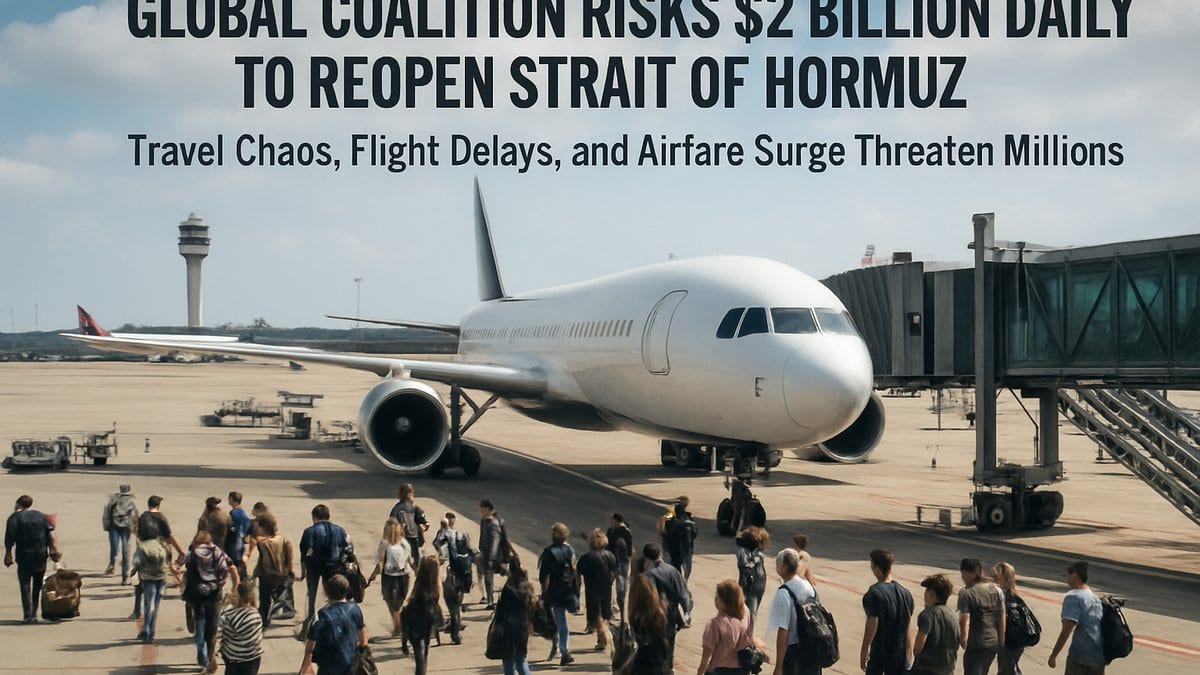
Coalition Campaign Raises the Financial Stakes in Hormuz
Publicly available assessments from market analysts and industry groups indicate that the effective closure of the Strait of Hormuz since early March has become one of the most expensive trade shocks in decades. The narrow waterway typically carries roughly a fifth of the world’s seaborne oil and a significant share of liquefied natural gas exports, and each day of disruption is now being measured in multi-billion-dollar losses across energy, shipping and aviation.
Economic research circulated in recent days suggests that a prolonged blockade and the associated military campaign to reopen the passage could threaten upwards of 2 billion dollars in daily economic activity tied, directly and indirectly, to the corridor. This figure reflects the combined impact of lost or delayed cargoes, emergency rerouting of ships and aircraft, higher war-risk insurance, and the knock-on hit to consumer and business travel.
Reports on the emerging multinational coalition focused on restoring maritime security describe a complex and costly effort that blends naval patrols, air operations and intensive diplomatic coordination. Even if successful in reopening a controlled corridor for shipping, analysts caution that elevated risk premiums and tighter fuel supply could keep travel-related costs high for months after commercial traffic resumes.
Market commentary highlights that once war-risk surcharges and security costs are embedded in freight and insurance contracts, they often persist well beyond the end of active hostilities. For aviation in particular, that means the financial shock of the Hormuz crisis is likely to extend into future travel seasons, reshaping airline schedules, pricing strategies and route planning far from the Gulf.
Jet Fuel Shock Drives Fare Increases and Airline Surcharges
The most immediate pressure point for air travelers is the surge in jet fuel prices, which has tracked the spike in crude benchmarks since the first closures in late February. Industry data compiled by energy and aviation bodies shows jet fuel costs jumping from pre-crisis levels near 85 to 90 dollars per barrel to prices in the 150 to 200 dollar range by late March and early April.
Because fuel typically accounts for 20 to 35 percent of an airline’s operating expenses, this rapid escalation has forced carriers to respond quickly. According to recent coverage from aviation-focused outlets, airlines across Asia, Europe, the Middle East and North America have introduced emergency fuel surcharges, trimmed flight frequencies and shifted capacity away from longer, fuel-intensive routes.
Some carriers have moved beyond surcharges to broader price adjustments. Reporting on fare data and airline announcements points to premium increases on long-haul itineraries that cross or skirt the Middle East, as well as higher prices on transatlantic and transpacific routes affected by aircraft and crew reassignments. In North America, coverage of the domestic market already shows higher ancillary fees, such as checked bag charges, attributed in part to elevated fuel costs.
Aviation economists warn that if fuel prices remain at current levels or climb further, the industry could face a new round of capacity cuts similar to those seen during previous energy shocks. For travelers, that would translate into fewer seats, reduced route choice and sustained upward pressure on fares even if headline crude prices stabilize.
Rerouted Flights, Longer Journeys and Airport Bottlenecks
The closure of the Strait of Hormuz and related airspace restrictions over parts of Iran and Iraq have forced airlines to redraw flight paths across a large swath of the Middle East. According to recent operational updates compiled by aviation tracking services and trade publications, thousands of flights have been cancelled or rerouted since the crisis began, making this one of the most disruptive episodes for global aviation since the height of the pandemic.
Carriers that previously operated direct routes over the Gulf are now deviating via Central Asia, the Caucasus, North Africa or the eastern Mediterranean. These diversions add significant flight time and fuel burn, complicate crew duty schedules and narrow the pool of viable alternates for weather or technical diversions. Passengers experience this as extended journey times, missed connections and a higher risk of last-minute schedule changes.
Regional hubs are also being reshaped. Reporting from the Gulf and wider Middle East indicates that airports in Saudi Arabia and several secondary hubs have emerged as partial safety valves for displaced traffic, picking up rerouted services that can no longer transit traditional corridors. At the same time, long-established hubs in the United Arab Emirates and Qatar have seen portions of their networks curtailed due to proximity to the conflict zone and constraints on nearby airspace.
For travelers outside the region, the impact is most visible in increased congestion at alternative connecting points in Europe and Asia, where airlines are concentrating revised schedules. Airports that were already operating near capacity are now managing additional widebody arrivals and departures, which can mean longer queues at security, immigration and transfer checkpoints, particularly during peak travel periods.
Global Travel Demand Collides With Capacity Constraints
The Hormuz crisis has hit at a time when global passenger demand was still in recovery and in some markets already exceeding 2019 levels. Industry statistics published in late March show strong bookings across leisure and business segments, especially on long-haul corridors linking Europe, Asia and North America. This rebound has collided head-on with the sudden reduction in viable routings and aircraft availability created by the conflict.
Analysts note that even a modest percentage decline in global seat capacity can have an outsized impact when demand is robust. Trade publications tracking schedules estimate that the combined effect of route cancellations, detours and reduced frequencies tied to the Middle East crisis has already removed a noticeable share of long-haul capacity from the market, tightening supply on popular city pairs worldwide.
Airlines are attempting to reassign aircraft and adjust fleets to preserve core routes, but those efforts face practical limits. Long-haul widebody jets are in finite supply, and some carriers had already stretched their fleets to keep up with demand before the crisis. Publicly available fleet data shows that many aircraft remain in heavy maintenance cycles or are being retrofitted with new cabins, reducing the number that can be rapidly redeployed.
For travelers, the result is visible in higher load factors, fewer empty seats and reduced flexibility to change dates or itineraries without incurring substantial costs. Corporate travel managers and tour operators are beginning to warn clients to book further in advance, budget for higher fares and prepare contingency plans in case key routes undergo additional disruption.
Outlook: Prolonged Volatility for Airlines and Passengers
Even if the multinational coalition succeeds in reopening a secure shipping corridor through Hormuz in the coming weeks, aviation specialists expect travel conditions to remain volatile. Insurance markets, route approvals and airspace deconfliction all tend to lag behind frontline military and diplomatic developments, and carriers typically require sustained stability before fully restoring previous schedules.
Economic commentators emphasize that the wider energy shock created by the Hormuz blockade will not unwind overnight. Oil and jet fuel prices often remain elevated for extended periods after supply routes are technically restored, as producers, refiners and traders work through backlogs and rebuild inventories. That dynamic suggests that higher fares and fuel surcharges could persist into the next travel season, particularly on long-haul routes.
There is also a growing debate among policymakers and industry leaders about how to reduce aviation’s exposure to single-point failures in global energy and airspace networks. Recent analysis from think tanks and industry bodies points to the need for more diversified fuel supply chains, investments in alternative routings and closer coordination between civil aviation authorities and security planners.
For now, however, travelers face an environment defined by uncertainty. As the coalition weighs the escalating cost of its push to reopen the Strait of Hormuz against the daily economic toll of continued disruption, millions of passengers worldwide are absorbing the practical consequences in the form of longer trips, busier airports and more expensive tickets.