

More news on this day
A rapidly expanding group of countries, now including the United Arab Emirates alongside the United Kingdom, France, Germany and Japan, is coalescing around plans for a wider 20-nation maritime effort to prevent further escalation in the closed Strait of Hormuz, even as reports indicate that land-based tourism to Dubai, Riyadh and Muscat remains broadly safe and operational.
Get the latest news straight to your inbox!
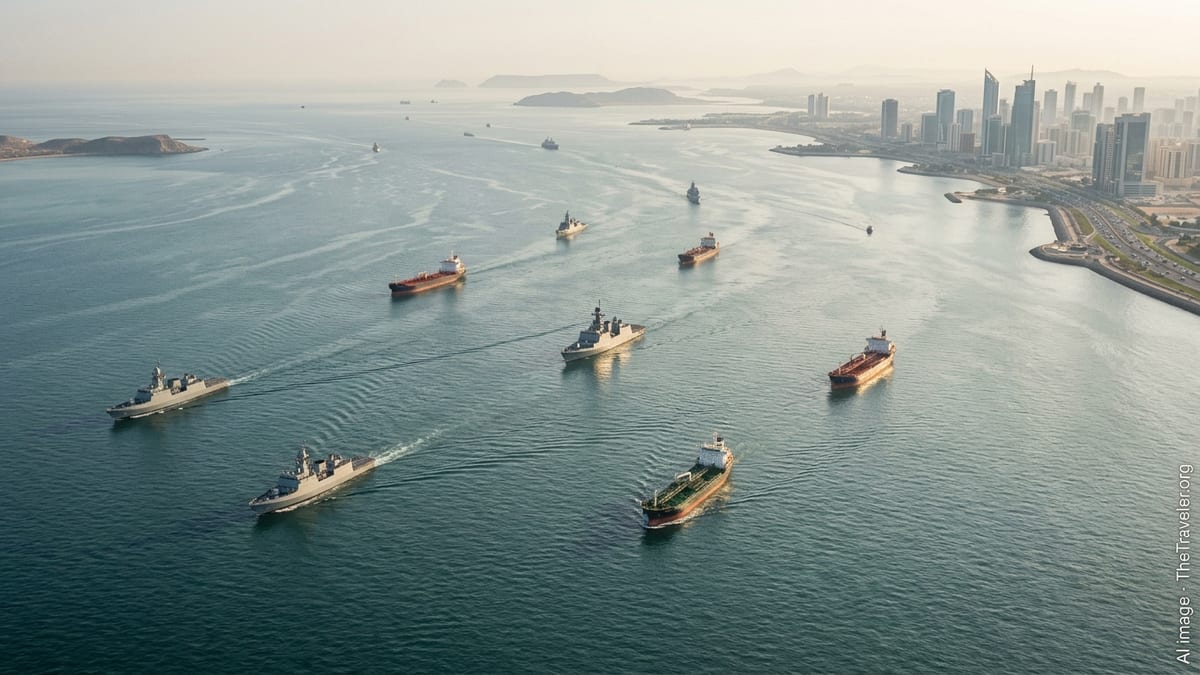
UAE Steps Forward as Regional Partner in Emerging Coalition
Publicly available information from regional outlets and international coverage indicates that the United Arab Emirates has moved into a more visible role in discussions over a prospective multinational effort to stabilize maritime traffic around the Strait of Hormuz. This comes as several European and Asian partners, including the United Kingdom, France, Germany, Italy, the Netherlands, Japan and Canada, have already signaled support for coordinated action to eventually reopen the vital waterway to commercial shipping.
While many of these governments have not committed to full-scale naval deployments, joint statements in recent days describe a shared intention to work on a structured, rules-based framework for maritime security in the Gulf once conditions allow. Observers note that the UAE’s alignment with these positions places a key Gulf tourism and aviation hub inside the core group of states advocating de-escalation and protection of sea lanes.
Commentary in regional business media suggests that Emirati decision-makers are balancing energy-security concerns with the need to protect their image as a predictable travel and logistics gateway. By supporting emerging coalition diplomacy, the UAE is seeking to reassure airlines, tour operators and investors that it is actively engaged in broader efforts to reduce the risk of a prolonged maritime standstill.
Strait of Hormuz Closure Hits Energy Routes but Not Core City Breaks
The closure and heavy militarization of the Strait of Hormuz since late February have disrupted one of the world’s most important energy corridors, forcing tankers and cargo vessels to suspend or severely limit transits. Economic analysis published by major outlets describes the current situation as one of the most serious shocks to global oil and liquefied natural gas flows in decades, with substantial production shut-ins reported across Gulf exporters.
Despite the severity of the maritime crisis, there is a clear distinction between conditions at sea and daily life in major urban centers such as Dubai, Riyadh and Muscat. Travel industry updates, aviation data and hotel market commentary show that airports, city hotels, shopping districts and key visitor attractions in these cities continue to function, with security levels elevated but routine tourism activities largely unaffected on the ground.
Airspace in the region has seen temporary restrictions and rerouting in response to missile and drone activity, including a brief closure over the UAE earlier in the week. However, airline schedules indicate that long-haul connections into Dubai, Riyadh and Muscat have resumed after short suspensions, and booking platforms continue to list regular services, subject to operational adjustments and higher fuel and insurance costs.
Industry analysts stress that the primary risk at present is concentrated on maritime transit and energy infrastructure, rather than on hotels, resorts and cultural sites that draw leisure travelers. As a result, tour operators are adjusting cruise and Gulf-coast sailing itineraries while keeping most city-break and desert-excursion programs in place, pending any change in official travel advisories.
Twenty-Nation Framework Aims to Prevent Wider Escalation
Diplomatic reporting from Europe, North America and Asia points to rapid behind-the-scenes work to knit together a broader grouping of around 20 states prepared to support freedom of navigation in and around the Strait of Hormuz. The core publicly visible group currently includes the United Kingdom, France, Germany, Italy, the Netherlands, Japan, Canada and Gulf partners such as the UAE and Bahrain, with additional NATO and Indo-Pacific states described as potential contributors.
The emerging framework resembles earlier multinational maritime security missions in the region, but with two key differences. First, participating capitals are emphasizing de-escalation and a clear separation from ongoing combat operations, portraying any future naval presence as focused on convoy protection, mine clearance and surveillance rather than offensive strikes. Second, there is more prominent involvement from Asian energy importers, reflecting their heavy reliance on Gulf oil and gas.
Policy documents and expert commentary highlight that this would not be a single, U.S.-commanded expedition but a patchwork of national deployments and politically coordinated mandates, many of which are still under domestic debate. For the travel sector, the main implication is the possibility of more predictable risk management in the shipping lanes that feed Gulf airports, hotels and supply chains, if a durable coalition framework can be agreed.
Analysts caution that the timetable for any such deployment remains uncertain, given the need for legislative approval in several participating countries and the volatile security situation along Iran’s coastline. In the short term, the coalition effort is functioning more as diplomatic signal than operational shield, but it nonetheless offers a roadmap that travel and tourism businesses can factor into medium-term planning.
Dubai, Riyadh and Muscat Tourism: Heightened Vigilance, Continued Operations
From a traveler’s perspective, the most immediate question is whether popular Gulf destinations remain viable for upcoming trips. Based on airline schedules, hotel occupancy reports and statements from major travel brands, the current picture for city and desert tourism in Dubai, Riyadh and Muscat is one of heightened vigilance but continued operations.
Major airports, including Dubai International and Dubai World Central, are operating with reinforced security and occasional schedule changes, but they continue to handle large volumes of passenger traffic. Riyadh’s rapidly expanding tourism offer, from cultural districts to new entertainment zones, is open, while Muscat’s coastal resorts and historic districts are welcoming guests, with some properties introducing additional security briefings and contingency plans.
Travel advisors are encouraging visitors to pay close attention to evolving government advisories from their home countries, as guidance can shift quickly in response to missile attacks, cyber incidents or regional protests. Nevertheless, most current advisories differentiate between the elevated risk to maritime traffic and infrastructure and the more contained risk profile for short-stay leisure and business travel to major Gulf cities.
On the ground, visitors are likely to notice more visible security, occasional road checkpoints near sensitive facilities and a heightened presence of emergency services at transport hubs. For many travelers familiar with the region, these measures are seen as an extension of long-standing security practices rather than a radical departure, helping sustain confidence in the destinations even as geopolitical tensions rise offshore.
Key Considerations for Travelers and the Industry
For airlines, cruise operators and tour companies, the Strait of Hormuz crisis is primarily a question of cost, routing and resilience. Carriers are grappling with higher fuel prices, rerouted cargo legs and war-risk insurance premiums, factors that could eventually feed through to ticket prices or lead to targeted capacity cuts on certain routes into the Gulf. Cruise lines and yacht charter companies, meanwhile, are pausing or redesigning itineraries that depended on smooth transits through the strait.
Travelers planning trips to Dubai, Riyadh or Muscat in the coming weeks are being advised by industry bodies and travel risk consultancies to build in more flexibility than usual. Recommended measures include booking changeable airfares, confirming hotel cancellation policies, registering with consular alert services and monitoring reputable news outlets for updates on both the maritime situation and any sudden airspace restrictions.
For now, publicly available evidence points to a bifurcated landscape: a high-stakes maritime standoff affecting global energy and shipping, and a still-functioning urban tourism ecosystem across key Gulf cities. The UAE’s decision to align itself with an emerging 20-nation coalition, alongside European and Asian partners, is designed in part to keep that second pillar as stable as possible, preserving the region’s role as a global travel crossroads even as the waters off its coast remain among the most contested on earth.