

More news on this day
A sudden escalation of conflict across the Middle East has choked off tanker traffic through the Strait of Hormuz, igniting a sharp spike in jet fuel prices that is rippling through global aviation and exposing critical weak points in airlines’ fuel security strategies.
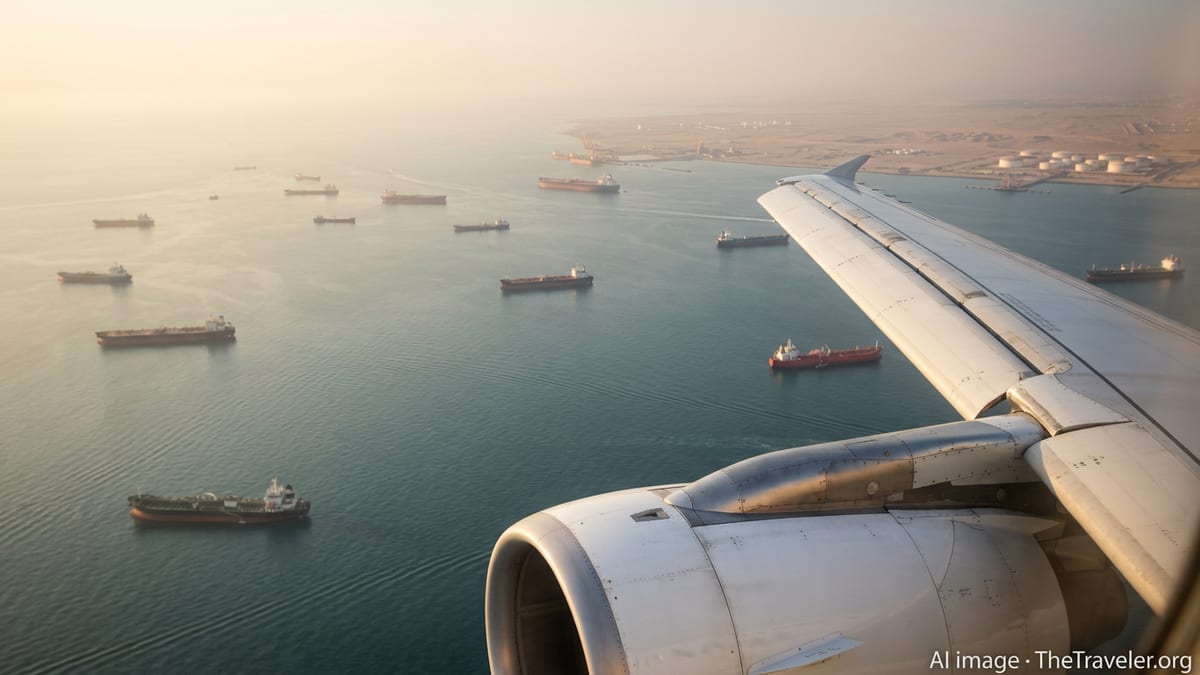
Blockaded Chokepoint Triggers Jet Fuel Price Shock
The de facto closure of the Strait of Hormuz since late February, after joint U.S. and Israeli strikes on Iran, has stalled shipments through one of the world’s most important oil corridors. Roughly a fifth of global crude and large volumes of refined products, including aviation kerosene, normally transit the narrow channel between Iran and Oman. With war now threatening tankers in the Gulf, many shipowners have pulled vessels or rerouted at short notice, throttling supply to key consuming regions.
Oil markets have reacted with alarm. Benchmark crude has jumped sharply in recent days as traders price in the risk of a prolonged outage, while jet fuel prices have risen even faster than crude in some hubs. Analysts note that when refinery capacity is knocked offline and shipping lanes are disrupted, the so‑called crack spread between crude and refined products widens, pushing up aviation fuel costs at a pace that airlines struggle to absorb.
Market data show spot jet fuel prices in northwest Europe climbing by more than 80 percent in less than a fortnight, according to energy price reporting agencies, as buyers scramble to replace lost Middle Eastern cargoes. In Asia, industry researchers report spikes approaching 200 percent in some markets. The surge follows drone and missile attacks on Gulf refineries and export terminals, including facilities in Saudi Arabia and the United Arab Emirates, which have further tightened global supplies of aviation fuel.
European and Asian Hubs Scramble for Alternative Supply
Europe has emerged as one of the most exposed regions to the Strait of Hormuz disruption. Analysts estimate that northwest Europe relies heavily on jet fuel imports from refineries in Kuwait and the wider Gulf, volumes that are now stranded east of the chokepoint. With Kuwaiti barrels unable to move out of the region and a key Saudi refinery temporarily shut after a drone strike, European importers are racing to source replacement cargoes from the United States, India and even as far afield as East Asia.
This reshuffling is costly and slow. Tanker freight rates have surged across major product routes as charterers compete for a smaller pool of willing ships to sail in or around the conflict zone. Longer voyages via the Cape of Good Hope or the Red Sea add weeks to delivery times and consume more fuel, costs that are ultimately baked into wholesale jet prices at airports from London to Frankfurt. Fuel suppliers at some European hubs are now warning airlines of tighter loading windows and advising carriers to tanker extra fuel on inbound flights where weight limits allow.
Asian markets are also feeling the strain. Key aviation hubs such as Singapore, Seoul and Tokyo are heavily dependent on Middle Eastern crude and products. While some refiners hold government‑backed strategic stocks, traders say spot jet prices in the region have jumped by close to triple in recent days, reflecting both the loss of Hormuz flows and heightened war‑risk insurance premiums on any ship still willing to approach the Gulf. Several Asian governments are reportedly considering selective releases from strategic petroleum reserves to ease short‑term pressure on airlines and airport fuel providers.
Airlines Face Rising Costs, Route Disruptions and Capacity Cuts
The fuel shock has arrived at a delicate moment for the airline industry, which had been counting on moderating energy prices to support demand recovery in 2026. Jet fuel typically represents 20 to 30 percent of an airline’s operating costs. With spot prices spiking, carriers that are less hedged now face a sudden and substantial hit to margins, prompting warnings of higher fares, reduced capacity and weaker earnings.
In recent days, airline stocks in the United States and Europe have sold off sharply as investors reassess profit outlooks. Budget carriers and long‑haul operators with thinner cushions are seen as particularly vulnerable. Some Gulf carriers have temporarily grounded aircraft or trimmed schedules amid the closure of key air corridors and uncertainty over fuel availability at regional hubs. Elsewhere, airlines are adjusting routings to skirt conflict zones, adding flight times and burning more fuel precisely when each additional ton of kerosene is getting more expensive.
Executives are signaling that passengers should brace for knock‑on effects. Industry analysts expect carriers to deploy fuel surcharges on international tickets and cargo shipments if elevated prices persist, repeating patterns seen during previous oil shocks. For now, many airlines are prioritizing core long‑haul routes and high‑yield business markets, while reviewing the viability of marginal services, particularly those that require long detours around closed airspace.
Hedging Strategies Expose a Two‑Speed Industry
The crisis is laying bare significant differences in how airlines manage fuel risk. Some European network carriers entered 2026 with the majority of their jet fuel needs hedged through derivatives and forward purchase contracts, locking in prices well below current spot levels. One major group has disclosed hedge cover of close to 90 percent for the year, effectively insulating it from the immediate surge and giving planners time to adjust schedules more gradually.
By contrast, several large U.S. airlines have for years reduced or abandoned traditional hedging programs, arguing that the cost and complexity outweighed the benefits in a benign price environment. Those operators are now fully exposed to the spike at Gulf Coast and other benchmarks, forcing rapid budget revisions and contributing to recent analyst downgrades. The divergence underscores how strategic choices made in calmer markets can become existential in times of geopolitical stress.
Low‑cost carriers present a mixed picture. Some have limited hedging but operate newer, more fuel‑efficient fleets, which helps offset part of the price impact. Others rely heavily on dense short‑haul networks where they can move quickly to cut underperforming flights or raise fares on constrained routes. Across the board, finance chiefs are dusting off playbooks from prior crises, combining selective hedging top‑ups, capacity discipline and ancillary revenue pushes in an attempt to stabilize cash flow.
Exposed Vulnerabilities Renew Focus on Aviation Energy Security
Beyond the immediate price shock, the Hormuz crisis is triggering a broader debate about aviation’s structural dependence on a handful of volatile supply corridors. The Strait has long been recognized as a geopolitical flashpoint, yet the scale of today’s disruption, layered on top of refinery outages and regional conflict, is revealing how little redundancy exists in the global jet fuel system. Many airports rely on a single pipeline or import terminal, and a sizable share of international capacity hinges on uninterrupted Persian Gulf flows.
Policy makers and industry bodies are responding with calls to diversify supply and accelerate the transition to alternative fuels. Some governments are reviewing minimum stockholding requirements for aviation fuel at major hubs and exploring incentives to expand on‑airport storage. Others are pushing faster development of sustainable aviation fuel, which can be produced from a wider range of feedstocks and regions, though volumes remain far too small to cushion a shock of this magnitude in the near term.
For travelers, the implications are likely to be felt in higher fares, fewer marginal routes and more volatile ticket pricing as long as the conflict endures. For airlines and regulators, the crisis is a stark reminder that energy security is no longer an abstract risk but a day‑to‑day operational concern. How quickly the industry can adapt, and whether the Strait of Hormuz reopens to stable traffic, will shape not only balance sheets but the trajectory of global air connectivity in the months ahead.