

More news on this day
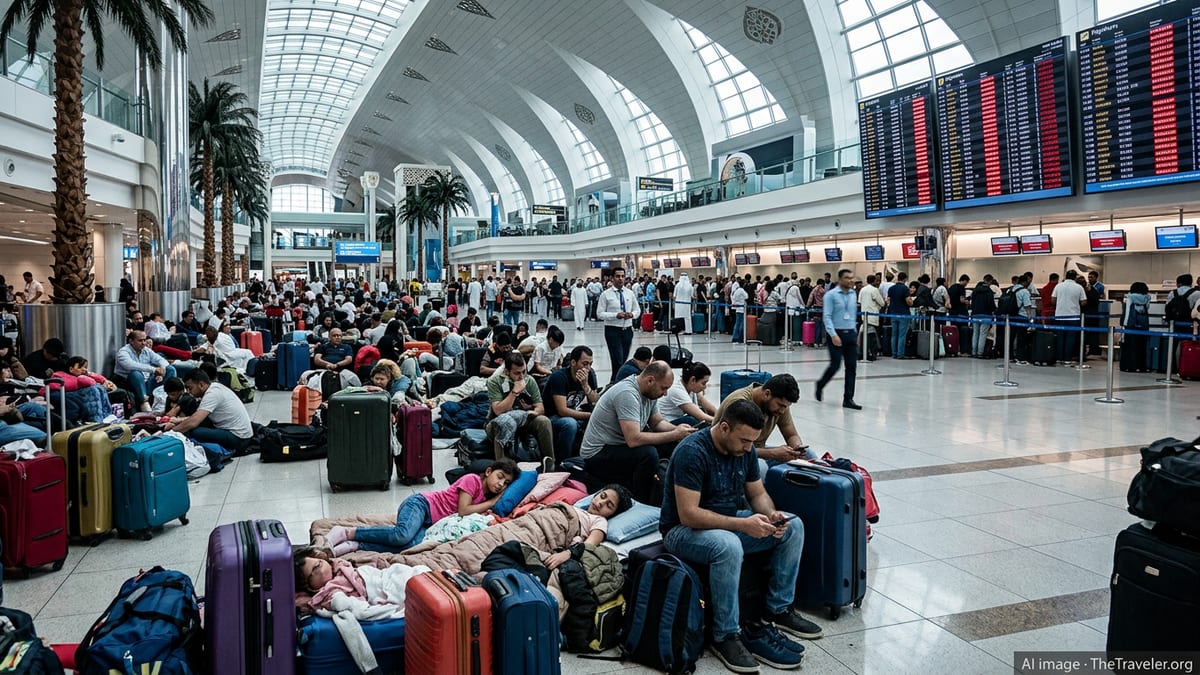
Thousands of travelers remain stranded across the United Arab Emirates this week as sweeping Middle East airspace closures, triggered by the escalating war involving Iran, continue to snarl flight schedules, inflate travel costs and turn once-slick Gulf transfers into days-long odysseys.
Airspace Closures Ripple Through Global Flight Networks
The disruption began on February 28, when joint United States and Israeli strikes on Iran were followed by retaliatory missile and drone attacks, prompting a cascade of airspace closures across the region. Bahrain, Iraq, Israel, Kuwait, Qatar, Syria and the UAE all moved to restrict or halt civilian overflights, forcing airlines to cancel or divert thousands of services that normally funnel through Gulf hubs.
Dubai International, Abu Dhabi’s Zayed International and Sharjah International, among the world’s busiest transfer points linking Europe, Africa and the Americas to Asia, saw normal commercial operations abruptly curtailed. Aviation analytics firms estimate that tens of thousands of passengers a day were affected at Gulf airports alone as more than 20,000 flights across the wider region were grounded or rerouted in less than a week.
While the UAE’s General Civil Aviation Authority has since allowed a gradual resumption of limited operations at major airports, flight schedules remain skeletal and highly volatile. Airlines are prioritizing repatriation services, select long-haul routes and cargo, leaving many travelers with confirmed tickets but no viable departure in sight.
International carriers from Europe and Asia have extended suspensions or sharply reduced frequencies into Gulf gateways, wary of both security risks and the complex air-traffic management required to navigate around still-closed corridors. Passengers bound for destinations from London to Bangkok are now discovering that itineraries involving the UAE can no longer be taken for granted.
Stranded in Transit: Long Layovers Turn Into Open-Ended Stays
For many, the worst impact has been felt not by holidaymakers starting or ending trips in Dubai or Abu Dhabi, but by the huge share of passengers who use the UAE purely as a transfer point. With regional airspace fractured and onward connections canceled, transit passengers have seen carefully timed itineraries disintegrate into open-ended layovers lasting days.
Travelers arriving from Europe, Africa and North America report being escorted off aircraft in the UAE, cleared through immigration and handed hotel vouchers or meal coupons with little clarity about when they might travel onward. Some describe repeatedly returning to airport check-in halls only to be told that their rebooked flights have been pushed back another 24 hours or more.
Even as limited departures resume, routing has become far more circuitous. Instead of a single overnight flight to Asia via Dubai, travelers are being rebooked onto multi-leg journeys that detour through secondary hubs, add unscheduled stops for refueling or safety, and stretch overall travel times to 30 hours or longer. In many cases, previously simple returns now involve transiting a third continent simply to bypass restricted skies.
The uncertainty is compounded by rolling schedule updates. Industry experts caution that flight-status checks done the night before departure may be out of date by the time travelers reach the airport, as airlines continuously adjust to new air-traffic control directives and security assessments.
Rising Costs: Hotels, Private Jets and Overland Escapes
While UAE authorities have instructed hotels in Dubai and Abu Dhabi to extend stays for those unable to depart, and pledged to cover basic accommodation and sustenance for stranded passengers on affected flights, many travelers still face mounting out-of-pocket expenses. Not all visitors qualify for government-backed support or airline vouchers, particularly those on separate tickets, basic-economy fares or itineraries involving multiple carriers.
As standard rooms at airport hotels and mid-range properties across Dubai and Abu Dhabi fill up, nightly rates at remaining options have surged. Some tourists report paying premium prices for last-minute bookings far beyond their original travel budgets, while others have turned to vacation rentals or staying with friends to avoid additional costs.
For wealthier passengers, the crisis has prompted a rush toward private aviation. Charter brokers describe an unprecedented spike in demand from travelers seeking to leave the UAE via less congested airports in neighboring countries. Some have paid six-figure sums for private jet flights from Dubai to European cities, routing through corridors judged safe from potential attacks or further closures.
Those without such means are looking to the roads. Reports from travel agents and embassies describe visitors hiring cars, booking buses or sharing rides to reach airports in Oman or Saudi Arabia, where limited commercial services continue to operate. What would normally be a single direct flight from Dubai has in some cases turned into a four to ten hour overland journey followed by scarce, high-cost air tickets home.
Government Responses and Limited Relief Measures
Facing a mounting humanitarian and logistical challenge, UAE authorities have rolled out a series of emergency measures aimed at easing the burden on stranded visitors. The country has temporarily waived visa overstay fines for passengers whose departures were blocked by the closures, and immigration officials have fast-tracked extensions to ensure tourists and transit passengers remain in the country legally.
The General Civil Aviation Authority has coordinated closely with domestic and foreign airlines to stage what it describes as “exceptional” flights, primarily for repatriation and essential travel. Officials say tens of thousands of passengers have already been processed for departure from Dubai, Abu Dhabi, Sharjah and smaller airports such as Ras Al Khaimah and Fujairah through these limited operations.
Tourism and culture departments in both Dubai and Abu Dhabi have instructed hotels to keep affected guests checked in, rather than forcing them out when their original reservations expire. In practice, the level of support varies: some travelers report seamless extensions and complimentary meals, while others say they have been asked to pay for extra nights after airline vouchers expired.
Foreign governments have also stepped in, organizing evacuation flights from the UAE and advising citizens to leave the wider region while commercial options still exist. Consular staff in Dubai and Abu Dhabi have faced heavy demand as travelers seek documentation, travel letters and assistance rebooking onto scarce outbound services.
What Travelers Should Expect in the Coming Days
Industry analysts say that while the worst of the immediate shutdown may have passed, air travel through the UAE is unlikely to return to normal quickly. Even as some airspace reopens, airlines will need time to reposition aircraft and crews, clear backlogs of stranded passengers and rebuild confidence in the stability of regional routes.
Travelers holding tickets through mid-March are being urged to monitor airline communications closely, refrain from going to the airport without a confirmed departure time and be prepared for last-minute changes. Flexible tickets, travel insurance that covers security-related disruptions and willingness to accept alternative routes or dates may all prove essential.
Should the conflict and associated airspace controls drag on, carriers may opt to shift capacity permanently away from some Gulf hubs, at least in the medium term. That could mean longer routings and fewer nonstop options for passengers from Europe and North America traveling to South and Southeast Asia, as airlines rely more heavily on hubs in Istanbul, Central Asia or farther afield.
For now, thousands in the UAE remain in limbo, watching departure boards flicker and refreshing airline apps in the hope that their flight number finally switches from canceled or delayed to boarding. The crisis has underscored just how central Gulf airports have become to global mobility, and how quickly that connectivity can unravel when the skies above the region close.