

I had been eyeing the Strasbourg Cathedral tower platform for years in guidebooks and friends’ photos, so when I finally made it to the city, climbing those steps felt almost mandatory. The cathedral dominates the skyline, and the idea of seeing Strasbourg, the Vosges and even the Black Forest from 66 meters up sounded like a perfect way to get my bearings.
What I actually found was a mix of memorable views, some poor crowd management, more physical effort than I expected, and a few practical snags that I wish I had anticipated. If you are wondering whether to climb it yourself, here is exactly how it played out for me, warts and all.
Practicalities: Prices, Hours and First Impressions
Before going, I double checked the practical details, because things like hours and prices do change. At the time of my visit, the observation deck cost 8 to 10 euros for a standard adult ticket, with reduced fares for children and students, and free access for small kids and some eligible visitors. Tickets were sold directly at the base of the tower staircase on Place du Château, on the south side of the cathedral. There was no online reservation system for regular visitors, which already told me two things: I could be spontaneous, but I also had to brace for lines and no guaranteed time slot.
The opening hours were split into two blocks: one in the late morning and one in the afternoon and evening. From roughly April to September, the tower kept long hours, typically 9:30 to 13:00 and 13:30 to 20:00, with the last climb about 45 minutes before the evening closing. In the colder months, from October to March, the afternoon closing shifted earlier, around 18:00. The deck closes entirely on January 1, May 1 and December 25. There is also the catch that access can be suspended at any point if the wind picks up, if it rains hard, or if the platform reaches its capacity, which is limited to around 50 to 100 people for safety.
Arriving mid-afternoon on a bright but chilly day, I walked into a courtyard buzzing with tour groups, schoolchildren and people holding pretzels from nearby stands. The platform entrance is easy to miss if you do not know what you are looking for. It is not at the main cathedral door, but slightly around the corner on Place du Château. A small booth and a rope barrier marked the spot. There was a short line that looked manageable, and seeing that, my expectations were still high. It felt like one of those classic European city rituals, a compact challenge with a big panoramic reward at the end.
The Queue and the Crowd: Small Delays, Big Effects
If there is one aspect of this experience that could easily sour your mood, it is the way crowds are handled. When I arrived, the line was maybe fifteen meters long, nothing compared to queues for famous towers in Paris or Rome. Still, it moved in fits and starts. Because the staircase is narrow and the platform has a strict capacity limit, the staff only let small batches in. The result was a wait of around 30 minutes that felt longer than it looked on paper, especially without much shade or shelter. On a cold day, it is uncomfortable; on a hot summer day, I can imagine it being genuinely draining.
There is no advance booking system to spread visitors more evenly across time slots. That might sound liberating, but in reality it turns the whole thing into a bit of a gamble. I watched a couple in front of me turned away because the last ascent of the day had already been called. They had misjudged that 45 minute buffer before closing, a detail that is stricter than it seems. It was a small but painful reminder that you cannot just rock up at sunset and expect to be waved through.
Once I reached the ticket window, the staff were efficient but not especially friendly, which I did not mind personally, but anyone expecting warm, chatty interaction might feel brushed off. The process was simple: pay, get a small paper ticket, wait for the attendant to open the turnstile, and then commit to the climb. There are no lockers, no restrooms and no water at the entrance or along the route, which felt like a missed opportunity. That might be understandable in a fragile medieval structure, but for visitors it means you really need to prepare before you step into the staircase.
The Ascent: 330 Steps of Stone and Mixed Emotions
The climb itself is both the best and the hardest part of the experience. You take a spiral staircase of around 330 to 332 stone steps, tightly wrapped inside a turret. The steps are worn but not dangerously so, and there is a railing to hold onto almost all the way. I am reasonably fit, and I still felt my legs and lungs working hard by the second third. If you are used to elevators and escalators, this can be a small shock to the system.
What surprised me in a good way was how interesting the climb is if you take it slowly. Narrow slit windows open regularly onto the exterior, framing close-up views of flying buttresses, sculpted gargoyles and rooftops. Sometimes the view is straight down to the square, which can be a bit unsettling if you are sensitive to heights, but it also allows you to see details of the cathedral you would never notice from ground level. I found myself stopping more often than strictly necessary, partly to catch my breath and partly to admire a carved figure or the geometric patterns of the stone.
The main downside is the width of the staircase. It is just tight enough that when people are moving both up and down, you are forced into awkward side-step negotiations. If someone stops for a photo, everyone behind them has to stop as well. On my visit, the flow was not controlled very strictly, so clusters formed easily, and I spent several minutes pressed against the wall waiting for a descending group to squeeze past. If you have mobility issues, a bad knee, or any hint of claustrophobia, this is not just uncomfortable, it can be genuinely stressful.
Another small but real frustration is that there is no halfway rest area where you can sit. You can pause on the steps, of course, but in a narrow spiral this makes you feel in the way, even when you technically are not. I saw one older visitor clearly struggling near the top, leaning heavily on the railing while a small group waited patiently behind him. The staff had warned that good physical condition was required, and in that moment I understood why. The climb is not a casual stroll; it is exercise, and it should be treated as such.
The Platform Experience: Views, Weather and Crowding
When you finally emerge onto the platform, the transition from dim stone staircase to open air and light is dramatic. The guard house at the top hosts a small exhibition about the cathedral and the city, including an impressive old hoist wheel and elements linked to the astronomical clock. It is modest as museum displays go, but it helps give the space a sense of history rather than making it just a generic viewpoint.
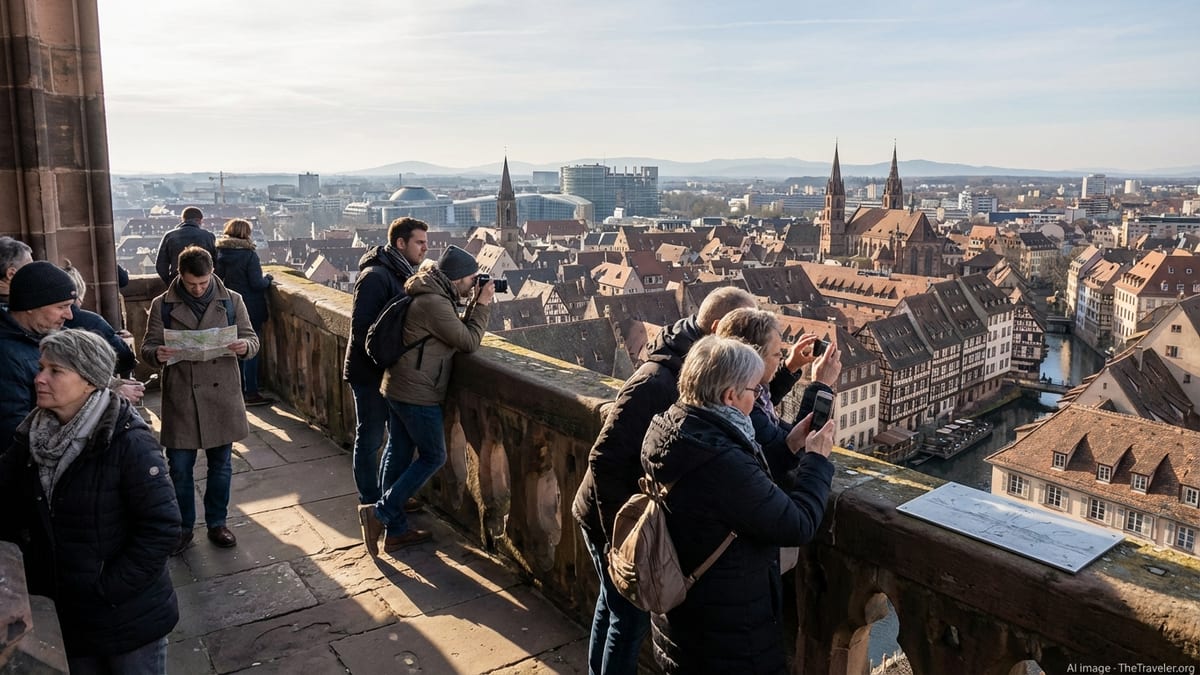
Stepping outside onto the open platform is the real reward. The view is, in a word, superb. Strasbourg’s rooftops stretch out in a patchwork of tiles and gables, intersected by church spires and the soft line of the river. On a clear day you really can see beyond the city to the Vosges mountains to the west and the Black Forest in Germany to the east. In my case, a slight haze blurred the furthest outlines, which was a mild disappointment after all the talk of long-distance visibility, but the immediate urban panorama still felt more than worth the effort.
The vantage point gives you a fresh appreciation for Strasbourg’s mix of medieval, Renaissance and modern architecture. I found it particularly satisfying to spot landmarks I had already walked past at street level: Petite France with its canals, the mass of the European Parliament further away, the dark line of the Vauban dam. Metal plaques and discreet orientation indicators around the platform help you identify districts and significant buildings, which is genuinely useful if you are new to the city and trying to connect the dots.
The experience is not entirely serene, though. The platform can feel quite crowded, especially when a tour group arrives or when everyone is angling for the same corner to capture the cathedral spire or a particular skyline shot. Space is finite, and while the safety barriers are high and solid, it can still feel slightly cramped as people shuffle around with cameras raised. I had to wait several minutes at a couple of spots simply to get a clear line of sight for a photo without random elbows and heads in the frame. It did not ruin it, but it did chip away at the romantic idea of quietly contemplating the city from above.
Safety, Comfort and Accessibility: Not for Everyone
One of the most honest things I can say about the Strasbourg Cathedral tower climb is that it is not universally suitable. If you have heart or respiratory issues, serious vertigo, limited mobility or joint problems, you should think very carefully before attempting it. There is no elevator, no alternative route and no quick way back down if you panic in the middle of the staircase. That is not a flaw in the sense of bad management; it is simply the reality of a medieval structure adapted as best as possible to modern tourism.
From a safety standpoint, I felt secure throughout. The staircase is enclosed and well maintained, the steps are consistent, and the railings are sturdy. On the platform, the barriers are more than high enough to prevent accidents, and everything feels solid underfoot. If anything, the sensation can be a bit too enclosed for anyone who hoped for a more vertiginous, open-air thrill. This is a viewpoint designed to be safe, not to scare you.
Comfort is another story. Wind chill at 66 meters can make even a mild day feel raw, and there is almost no shelter on the platform itself. On my visit, a light breeze turned icy as soon as I stepped out, and I was glad I had a scarf and gloves. In summer, the opposite problem appears: strong sun exposure with few places to hide. There is no shade structure, no seating and no refreshments available at the top. You are essentially standing on a stone balcony, exposed to whatever the weather decides to do.
Accessibility is where the experience is inevitably exclusionary. With hundreds of steps and no lift, the tower is simply off limits for wheelchair users and many older travelers or those with chronic pain. There is something slightly frustrating about that, especially when you consider that the ticket revenue helps fund the cathedral’s restoration. It is understandable given the building’s age and constraints, but it does mean that some visitors are asked to contribute through other experiences downstairs rather than being able to share this particular view.
Expectations vs Reality: Value, Atmosphere and Alternatives
Going in, I expected a fairly standard European tower climb, something comparable to similar platforms in other historic cities. What I got was close to that template, but a bit more intense physically and a bit less polished in terms of visitor flow. The climb is steeper and more sustained than some bell towers I have tackled, and the absence of any resting niches made it feel more like a continuous push than a series of short flights. If you underestimate this, you might arrive at the top panting and too tired to fully enjoy the view at first.
In terms of atmosphere, I had imagined a quieter, almost contemplative space, perhaps because so many photos of the platform show just the view, not the crowd. In reality, it is a tourist attraction that can get noisy. People talk loudly, pose for elaborate selfies, stretch out arms for wide video pans and jockey for position at the railings. None of that is inherently bad, but if your mental image of the place is one of hushed admiration, you might experience a jarring mismatch between expectation and reality.
On the positive side, the educational element on the platform, including the historical displays and the augmented reality tools available via a smartphone app, exceeded my expectations. I appreciated that it was not just a bare balcony. Being able to see the old hoist wheel and learn about the guard house’s past role as a fire lookout added narrative depth to what might otherwise have been just a 360 degree photo opportunity. It helped me connect the architectural feat I was standing on with the working life of the cathedral across centuries.
As for value, I found the price reasonable given the uniqueness of the vantage point and the role of the ticket in funding restoration work. Strasbourg does not have many other elevated viewpoints open to the public, so this is not a commodity product with lots of competition. That said, if you are on a very tight budget or traveling with a large family, the cost does add up, and the free alternative is simply to enjoy the cathedral from the ground and skip the climb. You do not need to go up to appreciate the building’s grandeur.
How I Would Do It Differently Next Time
If I repeated the experience, I would change several things to make it smoother and more rewarding. First, I would go either right at opening time or later in the evening during the longer summer hours. My mid-afternoon climb coincided with peak tour group traffic and a relatively tough light for photography. Arriving earlier or aiming for a time closer to sunset would likely reduce crowding and offer more interesting shadows and colors over the city.
Second, I would better prepare for the physical aspect. That sounds excessive for a tourist activity, but simply doing some steady stair climbing in the days before, or at least wearing more supportive shoes, would have made the ascent more comfortable. I underestimated how much consistent upward motion 330 steps really represent. With better pacing and preparation, I suspect I would have reached the top less winded and more present in the moment.
Third, I would give myself more time on the platform. I ended up budgeting about 45 minutes total, which was just enough for the climb, a brief look at the exhibits and a circuit around the balcony, but not enough to linger. Next time, I would allow at least an hour and a quarter from the moment I joined the queue to the moment I stepped back outside on the square. That extra buffer would make delays, crowds and weather shifts feel less stressful.
Finally, I would pair the tower climb more consciously with other cathedral experiences. For example, visiting the nave and astronomical clock at a quieter time of day, then doing the climb later for the view, would make the day feel more balanced. As it was, I slipped the climb into a busy schedule and it felt a bit like something to “get done” rather than to savor slowly. This is not an attraction you should rush through; it benefits from deliberate pacing.
The Takeaway
After weighing the good and the bad, I do not regret climbing the Strasbourg Cathedral tower, but I also would not universally recommend it to every visitor. The views are undeniably beautiful, and there is something powerful about standing amid centuries-old stonework, looking out over a city that has changed hands and identities so many times. It deepened my sense of place in a way that a simple street-level walk never could. For me, that connection alone justified the effort and the ticket price.
At the same time, the experience asked more of me physically and mentally than I expected. The line was longer than it looked, the stairs felt steeper than they appear in photos, and the crowding on the platform cut into the romantic image I carried in my head. Lack of amenities like seating, water and shelter are not dealbreakers, but they do make the climb less comfortable, especially for anyone not in solid shape.
So, should you climb it? If you are in decent health, have no serious issues with heights or confinement, and enjoy both architecture and urban panoramas, I would say yes, with conditions. Pick your time carefully, avoid the tight window just before closing, and treat the ascent as a small workout rather than a casual stroll. Bring warm layers in cooler months, sun protection in summer, and give yourself more time than you think you need.
If you have mobility concerns, strong vertigo, or simply hate crowds and narrow spaces, you will probably be happier appreciating the cathedral from the ground and perhaps channeling that time and money into another local experience. Strasbourg has enough to offer that skipping the tower will not diminish your trip. For me, though, standing on that stone platform, with the bells above and the roofs spread out in every direction, remains one of my most vivid memories of the city, precisely because it felt earned rather than handed to me on a plate.
FAQ
Q1. How many steps are there to the Strasbourg Cathedral platform, and how hard is the climb?
The climb involves around 330 to 332 stone steps in a narrow spiral staircase. It is not technically difficult, but it is sustained and can be tiring. If you are in average shape and take it slowly, it is manageable, but anyone with mobility or heart issues should think carefully before attempting it.
Q2. How much does it cost to climb the tower?
When I visited, a standard adult ticket cost in the range of 8 to 10 euros, with reduced prices for children, students and some group categories, and free access for very young children and certain eligible visitors. Prices can change, so it is wise to check locally, but it is not an especially expensive attraction compared with similar viewpoints in Europe.
Q3. Do I need to book in advance or reserve a time slot?
For regular visitors, there was no advance booking system. Tickets were sold on-site at the base of the staircase, and access was on a first come, first served basis. That makes the visit flexible but also means you may have to wait in line and cannot guarantee a precise time for your climb.
Q4. What are the opening hours of the observation deck?
During roughly April to September, the deck typically opens from about 9:30 to 13:00 and again from 13:30 to 20:00, with the last ascent around 45 minutes before closing. From October to March, the afternoon closing is earlier, usually around 18:00. The platform is closed on January 1, May 1 and December 25, and access can be temporarily suspended in bad weather or if it is too crowded.
Q5. Is the climb suitable for children?
Physically, many children can handle the steps, and some even enjoy the sense of adventure, but the staircase is narrow and can become crowded. You have to keep a close eye on them, especially near the windows and on the platform. It is not a good idea for very young children who might tire quickly or become frightened in confined spaces.
Q6. What if I am afraid of heights or prone to vertigo?
If your vertigo is mild, you might still manage the climb, as the staircase is enclosed and well protected. However, there are narrow windows where you can see down to the square, and the platform itself is high enough to trigger discomfort if you are very sensitive. With serious fear of heights, I would personally skip it and enjoy the cathedral from the ground.
Q7. Are there facilities like toilets, water or seating on the way up?
No. There are no restrooms, water fountains or proper seating inside the staircase or on the platform. You can pause on the steps to rest, but there is nowhere to sit comfortably. It is important to use the restroom beforehand, bring your own water and be prepared to stand for the duration of the visit.
Q8. What is the best time of day to climb for the view?
Early morning and later in the evening tend to be the most pleasant. Crowds are lighter, the light is softer, and in summer you may catch a beautiful sunset over the rooftops. Mid-afternoon is often the busiest and can be harsh in terms of lighting and heat, so I would avoid that window if possible.
Q9. Can people with reduced mobility or wheelchair users access the platform?
Unfortunately, no. The only way up is via the long spiral staircase, with no elevator or alternative route. That makes the tower inaccessible for wheelchair users and very challenging for anyone with serious mobility issues. The cathedral interior itself is more accessible, so those visitors can still enjoy the building from ground level.
Q10. Is the climb worth it if I am short on time in Strasbourg?
If you enjoy city views and are comfortable with a bit of physical effort, I would say it is worth fitting in, but only if you can spare at least an hour including waiting time. If your schedule is extremely tight, you may find that the queue and the climb eat into time you might prefer to spend exploring the old town or other sights. In that case, admiring the cathedral from outside and inside, without the tower climb, is still a satisfying experience.