

More news on this day
Berlin-Brandenburg Airport is facing severe disruption after strike action brought operations to a near standstill, forcing major European carriers including Lufthansa, Air France, KLM, EasyJet, Ryanair and British Airways to cancel or delay hundreds of flights and leaving thousands of passengers scrambling to rebook at the start of the busy spring travel period.
Get the latest news straight to your inbox!
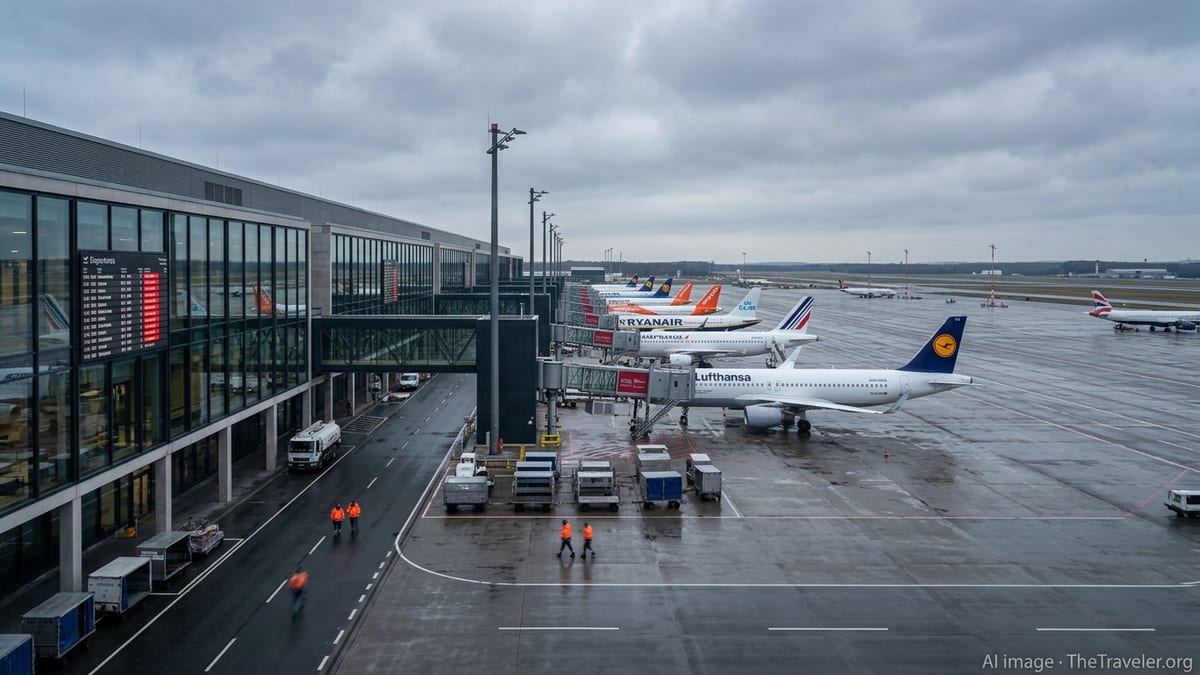
Full-Day Walkout Shuts Down Regular Operations
Publicly available information from Berlin and German media indicates that the latest round of industrial action has effectively shut regular passenger operations at Berlin-Brandenburg Airport for the day, with airport fire and ground services among the staff reportedly participating in the walkout. Without these safety-critical roles, aircraft movements are severely limited, prompting airlines to preemptively cancel most departures and arrivals rather than risk last-minute disruptions at the terminal.
Updates shared through airline channels and passenger tracking platforms show that carriers serving Berlin have thinned schedules to a fraction of normal levels. On a typical day, Berlin-Brandenburg handles hundreds of flights for low cost and network airlines, but the strike has turned departure boards into long lists of cancellations and heavily delayed services, particularly during the morning and evening peaks.
Reports from passenger forums suggest that some limited repositioning and technical flights are still operating, but these exceptions do not provide meaningful capacity for regular travelers. Most commercial passengers booked to fly into or out of the German capital during the strike window are being advised to rebook or reroute.
Airport information channels have warned that even when operations resume, knock-on effects are likely to continue for several days as aircraft and crew are repositioned and airlines work through large backlogs of disrupted itineraries.
Major European Airlines Trim Berlin Schedules
Lufthansa, the largest German carrier, has cut a significant share of its Berlin-Brandenburg schedule, focusing on protecting key domestic and European connections while cancelling many non-essential rotations. Publicly accessible timetables show substantial disruption on routes linking Berlin with Lufthansa’s Frankfurt and Munich hubs, which normally see frequent shuttle-style services throughout the day.
Air France and KLM have also reduced flying between Berlin and their Paris Charles de Gaulle and Amsterdam Schiphol hubs. According to published coverage, both airlines are prioritizing early-morning and late-evening bank connections where possible, while offering customers free rebooking and alternative routings through other European gateways when Berlin flights are unavailable.
Low cost carriers EasyJet and Ryanair, which together account for a large share of Berlin-Brandenburg’s passenger volumes, are cancelling or heavily retiming services across their Berlin networks. Passengers on key leisure and city-break routes to the United Kingdom, Spain, Italy and Eastern Europe are reporting same-day cancellations, with some flights removed from sale as the carriers adjust schedules to the reduced airport capacity.
British Airways has also been affected on its Berlin services from London, with flight status pages showing cancellations and significant delays on certain rotations. Similar adjustments are appearing in the schedules of other European and leisure airlines that normally rely on Berlin-Brandenburg for both point-to-point and connecting traffic.
Passengers Face Rebookings, Rerouting And Long Delays
The disruption at Berlin-Brandenburg is cascading across airline networks, as aircraft and crews scheduled to operate multiple legs throughout the day are knocked out of position. Publicly visible flight tracking data indicates that cancellations on Berlin routes are leading to missed onward connections at major hubs such as Frankfurt, Munich, Amsterdam, Paris and London, extending the impact far beyond Germany.
Travellers posting on social media and aviation forums describe long waits on customer service hotlines and at airport desks as they seek alternative options. Some passengers have been rerouted via other German cities or nearby airports in neighboring countries, while others report being offered travel a day or more later due to a lack of same-day availability.
Accommodation and incidental costs are emerging as a concern, particularly for leisure travelers and families caught mid-journey. With the strike coinciding with the build-up to the Easter and spring school holiday period for parts of Europe, hotel availability in major hubs is reported to be tightening quickly, leading some travelers to seek options well outside traditional airport districts.
Travel agents and online booking platforms are encouraging customers to check the latest status of their flights before leaving for the airport, and to consider alternative rail or coach options where practical, especially for domestic and short cross-border trips within Germany and neighboring countries.
Union Wage Dispute Fuels Ongoing Disruption
The Berlin action is the latest episode in a broader wave of industrial disputes affecting Germany’s transport sector over wage and working conditions. According to published reports on recent negotiations, unions representing airport and aviation workers have been pressing for higher pay and improved staffing levels in response to inflation and increased passenger volumes since the post-pandemic recovery.
Previous strike days in Germany and elsewhere in Europe have already caused widespread cancellations at major hubs, including Hamburg, Frankfurt and Munich, as unions seek to increase pressure during peak travel periods. Analysts cited in open industry commentary suggest that the Berlin stoppage fits a pattern of coordinated or rolling actions designed to maintain leverage over an extended bargaining period rather than through a single prolonged strike.
Airlines operating to and from Germany have repeatedly warned in public statements and investor updates that recurring industrial action is creating operational complexity and adding costs. Each disrupted day requires substantial effort to re-plan aircraft rotations and crew rosters, and in some cases to charter additional capacity or rely more heavily on partner carriers in alliance networks.
Industry observers note that while some progress has been reported in negotiations at the national level, the risk of further localized walkouts at individual airports remains elevated in the short term, particularly if talks fail to deliver agreements acceptable to both union members and airport operators.
What Stranded Travelers Should Know About Their Rights
The Berlin strike is again drawing attention to passenger rights under European air travel regulations, particularly the rules governing cancellations and long delays. Publicly available guidance explains that travelers departing from an airport in the European Union, or flying to the EU on an EU-based carrier, are entitled to certain forms of care and assistance when flights are disrupted.
In practice, this can include food and drink vouchers after a specified waiting period, hotel accommodation when an overnight stay becomes necessary, and transport between the airport and that accommodation. Airlines are generally expected to offer rebooking on the next available flight to the same destination, and in some cases may reroute passengers on alternative carriers or via different airports when direct options are not available within a reasonable time frame.
Compensation rules are more complex in cases involving strikes and other events that may be classified as extraordinary circumstances. Consumer organizations and travel rights specialists often advise passengers to retain all documentation, including boarding passes, booking confirmations and receipts for additional expenses, in case they later pursue claims for reimbursement or compensation.
Travelers currently booked to fly through Berlin-Brandenburg are being urged by publicly available advisories to monitor airline apps and airport information feeds closely, and to avoid traveling to the airport until they have received confirmation that their flight is operating. With schedules still in flux, many airlines are allowing free date or route changes, providing some flexibility to adjust plans until the full extent of the disruption becomes clearer.