

More news on this day
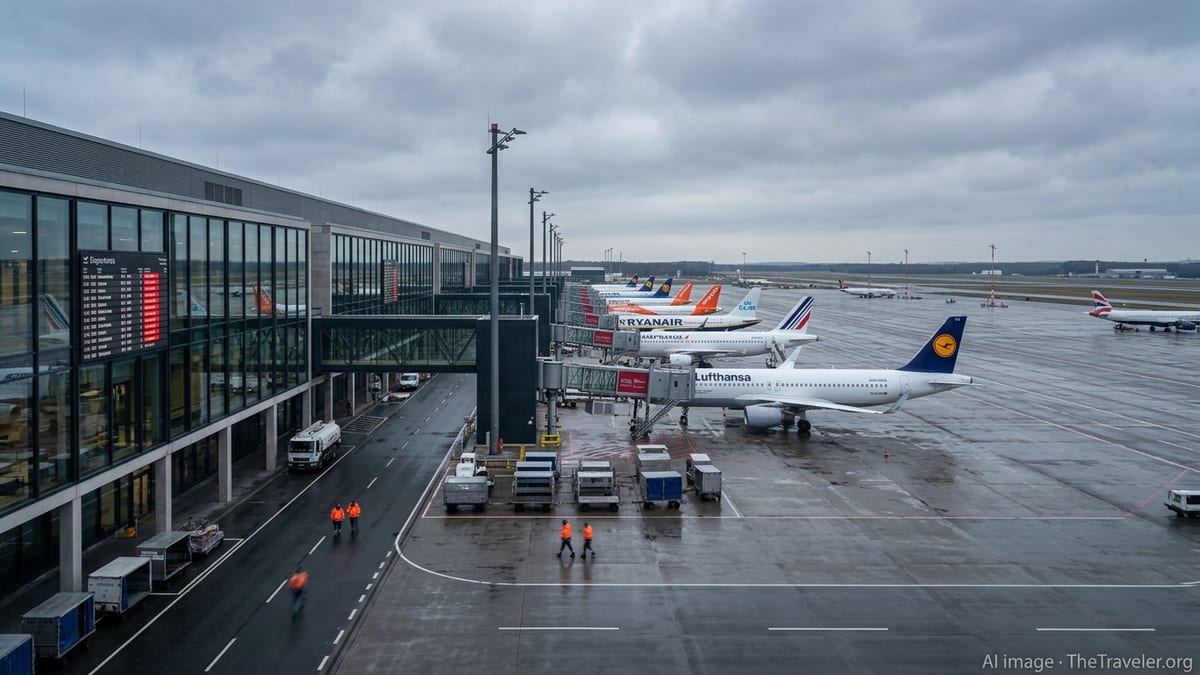
Berlin-Brandenburg Airport has become a focal point of Germany’s latest strike turmoil, with major European airlines including Lufthansa, Air France, KLM, EasyJet, Ryanair and British Airways forced to cancel hundreds of flights and delay departures as a 24-hour walkout by airport workers disrupts operations across the country.
Get the latest news straight to your inbox!
Ground Staff Walkout Paralyzes Key German Hub
The disruption at Berlin-Brandenburg follows a coordinated warning strike by the Verdi union covering public sector employees at airports, including ground handling and security staff. Publicly available information shows that the action, centered on a pay dispute, has brought regular passenger operations at several German airports close to a standstill, with Berlin among the hardest hit.
Berlin-Brandenburg Airport had already warned that normal flight operations could not be guaranteed during the strike period and advised passengers to expect extensive cancellations. Airport notices and media coverage indicate that many scheduled departures and arrivals at Berlin were proactively removed from schedules as airlines sought to avoid aircraft and crew being stranded.
The latest walkout builds on a pattern of industrial unrest at German airports in recent years, where similar strikes have repeatedly shut down or severely limited traffic at Berlin, Frankfurt, Munich and other hubs. Travel analysts note that Berlin-Brandenburg, which only opened in 2020 and is still consolidating its role as the capital’s main gateway, is particularly exposed when ground handling and security resources are withdrawn at short notice.
Major European Airlines Slash Schedules
The strike has rippled through the networks of Europe’s largest carriers. According to published coverage and updated schedules, Lufthansa, Air France, KLM, EasyJet, Ryanair and British Airways have all cancelled multiple rotations to and from Berlin-Brandenburg, with some airlines temporarily suspending almost their entire Monday operations at the airport.
Lufthansa, Germany’s flag carrier and the country’s largest airline by departures, has been forced to cut a significant share of its Berlin services as ground staff and service providers are affected by the strike. Media reports on similar nationwide actions indicate that the group can cancel the vast majority of domestic and European flights in Germany on a single strike day, and the latest disruption at Berlin appears to follow that pattern.
Low cost operators EasyJet and Ryanair, which together account for a substantial share of passenger traffic at Berlin-Brandenburg, have also thinned out their schedules. Flight tracker data referenced in news coverage suggests that most of their planned intra-European departures during the strike window have either been cancelled or retimed, leaving only a reduced number of services operating outside the peak strike hours.
Network carriers Air France and KLM, along with British Airways, have similarly pared back their Berlin frequencies, focusing on safeguarding limited connectivity to their main hubs in Paris, Amsterdam and London where possible. Industry observers note that slot constraints and the need to protect onward long haul connections mean these airlines often prioritize a handful of strategically important rotations while cancelling others.
Thousands of Travelers Face Disruption and Rebooking
Passenger impact has been severe. German airport and airline data cited in recent coverage of nationwide strike actions suggest that when similar walkouts have hit 13 airports simultaneously, more than half a million travelers have faced cancellations or significant delays in a single day. With Berlin-Brandenburg fully or largely closed to regular traffic during the current strike, tens of thousands of passengers passing through the capital’s airport are believed to be affected.
Many travelers have reported being rebooked onto later flights or rerouted via other European hubs, turning short direct journeys into longer multi-leg itineraries. Others have had their trips postponed by a day or more as airlines consolidate passengers onto the few services that can still operate once strike windows close and operations gradually resume.
Publicly available guidance from airlines indicates that affected passengers are being offered rebooking at no extra cost and, where applicable under European air passenger rules, care such as meals and accommodation. However, the high volume of disrupted itineraries, combined with limited spare capacity on alternative routes, means that some travelers are struggling to find seats at short notice, particularly on popular city pairs linking Berlin with major European capitals.
Labor Dispute Adds Pressure To Europe’s Air Travel Network
The Berlin-Brandenburg shutdown is part of a broader labor dispute in Germany that has already disrupted rail, local transport and other public services. Verdi has been pushing for higher wages and improved working conditions for airport staff, arguing that pay has not kept up with inflation and the increased workload associated with the post-pandemic recovery in air travel.
Industry data released in early 2026 shows that European air traffic has largely returned to or exceeded pre-pandemic levels, with carriers such as Ryanair and Lufthansa significantly ramping up capacity. At the same time, airlines and airports have faced reports of staffing shortages and high turnover, which unions say have intensified pressure on remaining workers in key operational roles.
For Germany’s aviation sector, the timing is particularly challenging. Airlines are in the crucial phase of planning and marketing their late spring and summer schedules, and repeated work stoppages can erode traveler confidence in the reliability of certain routes and hubs. Analysts warn that persistent strike-related disruption at Berlin-Brandenburg could push some passengers to choose alternative connection points in neighboring countries.
What Passengers Through Berlin Should Expect Next
With the current walkout limited to 24 hours, published advisories suggest that operations at Berlin-Brandenburg are expected to gradually restart once the strike ends. However, experience from previous nationwide airport strikes in Germany shows that knock-on effects often last into the following day as airlines reposition aircraft and crew and work through backlogs of delayed and rebooked passengers.
Travel experts recommend that passengers due to fly through Berlin-Brandenburg in the aftermath of the strike closely monitor their flight status, allowing additional time at the airport and being prepared for schedule changes even after normal operations formally resume. Crowded terminals, long queues at check in and security, and last minute gate or timing adjustments are all common features in the first hours after a major shutdown.
The latest disruptions underline how sensitive Europe’s tightly timed air networks remain to labor disputes at critical nodes such as Berlin-Brandenburg. As negotiations between unions and employers continue, travelers planning to use the German capital’s main airport in the coming weeks may need to factor in a higher risk of last minute changes and build flexibility into their itineraries.