

More news on this day
Air travel across parts of Europe has been thrown into disarray as widespread delays and cancellations at major carriers, including Lufthansa, Ryanair and Finnair, disrupted at least 720 flights and led to around 80 outright cancellations, affecting passengers in Switzerland, Austria, Spain and several neighboring countries.
Get the latest news straight to your inbox!
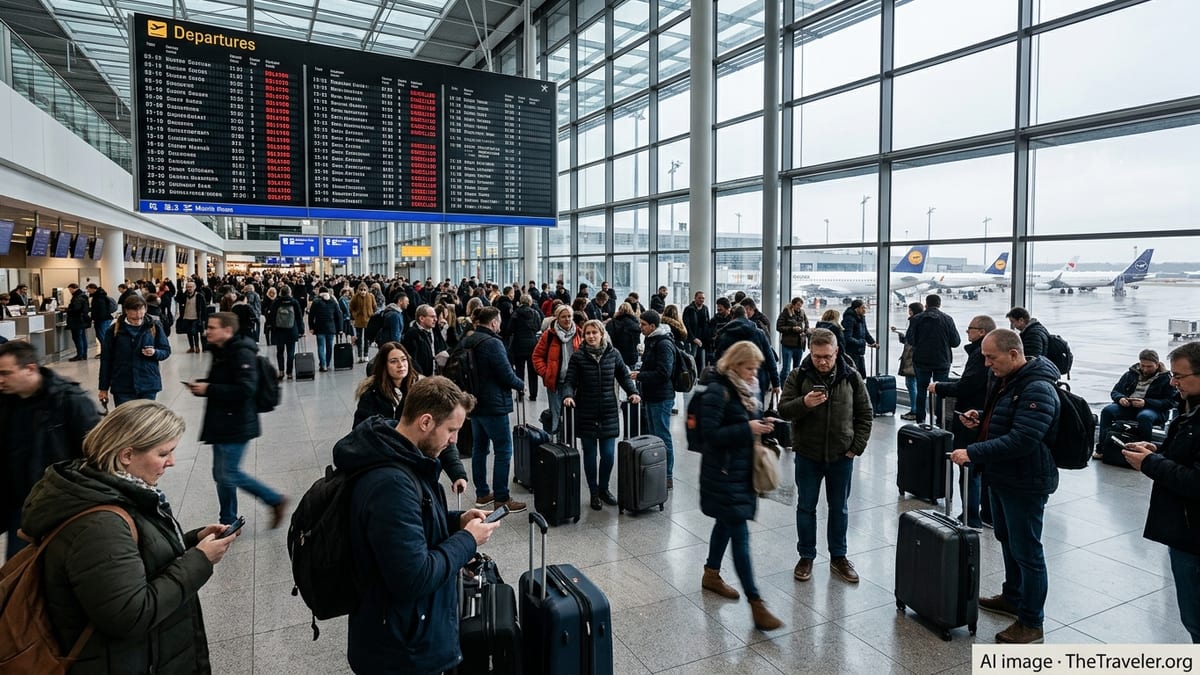
Widespread Disruptions Across Key European Hubs
Reports from airport boards, airline advisories and aviation tracking data point to a cascading wave of schedule disruptions centered on mainland Europe, with Germany, Austria, Switzerland and Spain among the hardest hit. Munich and Vienna, two of the region’s busiest transfer hubs, have seen a significant share of the affected flights, alongside disruptions reported at airports in Zurich, Geneva, Madrid and Barcelona.
Aggregated data from flight-monitoring services on Tuesday and Wednesday indicates that more than 700 flights linked to major European groups were running late, with delays frequently stretching past one hour. Around 80 flights were cancelled outright, forcing thousands of travelers to rebook at short notice or seek alternative rail and road options.
The disruption has largely affected short and medium haul routes within Europe, although some long haul services to and from Asia and North America have also been impacted when crews or aircraft were out of position. Passengers with connections through Munich and Vienna have reported missed onward services and overnight stays after late arrivals made legal crew working-time limits impossible to maintain.
European low cost and network carriers have each experienced knock-on effects as shared ground handling, congested airspace and rerouted aircraft created bottlenecks in tightly planned schedules. This has led to instances where aircraft arrived at a hub airport significantly behind schedule, setting off further delays on later rotations.
Strikes, Staffing Gaps And Winter Weather Combine
Published coverage across European outlets links the current wave of disruption to a combination of labor disputes, chronic staffing shortages and localized bouts of poor weather. At Lufthansa and affiliated carriers, recent and ongoing industrial action by cockpit and ground staff has already led to mass cancellations in March, and residual schedule adjustments appear to be continuing to filter through the network.
Ryanair and Finnair, which operate extensive intra-European networks touching Spain, Austria and Switzerland, have also contended with congestion and staffing challenges at key airports. Publicly available information points to shortages in air traffic control staffing in parts of central Europe and lingering winter conditions at several airports, all of which can rapidly reduce runway capacity and slow turnarounds.
In Spain, local reports describe weather-related restrictions and airspace flow controls on certain days that compounded delays for flights arriving from northern Europe. When aircraft and crews land late, they often trigger a chain reaction of further delays, as tight turnaround windows and mandatory rest times leave operators with little flexibility.
Industry analysts note that airlines entered the spring travel period with schedules close to or above pre‑pandemic levels, but with operating environments that remain fragile. Any industrial action or localized storm system is therefore more likely to translate into broad network disruption, particularly at complex multi‑hub groups.
Passenger Impact In Switzerland, Austria And Spain
Travelers in Switzerland, Austria and Spain have reported long queues at customer service desks, packed rebooking lines and difficulty reaching call centers. Social media posts and forum discussions from affected passengers in Zurich, Geneva, Vienna, Madrid and Barcelona describe a patchwork of experiences, ranging from relatively smooth automatic rebooking to last‑minute cancellations with limited on‑site support.
In Vienna and Munich, where Lufthansa Group and partner airlines funnel a large volume of connecting traffic, passengers arriving from Asia and North America have faced particular challenges when their onward intra‑European legs were cancelled. Some travelers have reported being rebooked via alternative hubs or forced to overnight in transit cities while waiting for available seats.
In Spain, disruptions to flights operated or marketed by European low cost and network carriers have had a noticeable impact at major leisure gateways. Travelers heading to and from Spanish holiday destinations have faced flight swaps, extended delays on the tarmac and the need to adjust hotel and transfer bookings at short notice.
Rail operators in central Europe have also seen rising demand as some passengers opt to abandon disrupted itineraries and complete their journeys by train, especially on routes between Germany, Austria and Switzerland where high speed services offer a practical alternative to short flights.
What Stranded Travelers Can Expect Under EU Rules
Under European air passenger protection rules, particularly Regulation EC 261/2004, many affected travelers may be entitled to assistance and, in some cases, financial compensation. The regulation applies to flights departing from any EU or EEA airport, as well as to flights into the region on EU or EEA carriers, a framework that also covers Switzerland through bilateral arrangements.
When flights are significantly delayed or cancelled, airlines are typically required to offer a choice between rerouting at the earliest opportunity, rerouting at a later date, or a refund of the unused ticket. Depending on the length of delay and flight distance, passengers may also be entitled to meals, refreshments, hotel accommodation where an overnight stay becomes necessary, and transport between the airport and accommodation.
Cash compensation can apply when delays exceed three hours on arrival or when flights are cancelled at short notice, provided that the disruption is not caused by what regulators classify as extraordinary circumstances. Labor disputes internal to an airline, such as strikes by its own staff, are often considered within the carrier’s control for compensation purposes, while severe weather or air traffic control strikes are generally not.
Consumer advocates advise passengers to retain boarding passes, booking confirmations and any written communication from airlines, and to submit claims directly to the operating carrier in writing. Specialized claim firms and national enforcement bodies can offer additional guidance for complex itineraries involving multiple airlines and non‑EU segments.
Outlook For Travelers In The Coming Days
Operational outlooks from airlines and airports suggest that schedules may remain fragile in the short term as carriers work through aircraft repositioning, crew rosters and a backlog of displaced passengers. Even after the most acute phase of cancellations ends, it can take several days for networks built on tight aircraft and crew rotations to fully stabilize.
Travel industry commentators recommend that anyone flying through Munich, Vienna or other busy European hubs in the coming days build extra time into their itineraries. This is particularly important for self‑connecting passengers holding separate tickets, who generally receive fewer protections when a delay on one leg causes a missed onward journey.
Passengers are also encouraged to monitor airline apps and airport departure boards frequently on the day of travel, as same‑day schedule changes have become more common during recent disruption episodes. Where possible, travelers may wish to check in early and travel with carry‑on luggage only to maximize flexibility if they need to switch flights or routes at the airport.
While airlines are gradually restoring regular operations, the latest wave of delays and cancellations underlines the continuing volatility of air travel in Europe. For many passengers caught in the current disruption across Switzerland, Austria, Spain and neighboring countries, the experience is a reminder of the importance of flexible planning and clear awareness of passenger rights.