

More news on this day
European air travel is again buckling under pressure as fresh waves of strikes, winter storms and airspace bottlenecks trigger thousands of new flight cancellations and delays, snarling operations for major carriers such as Lufthansa, Ryanair, EasyJet, Air France and Pegasus at key hubs from Frankfurt and Brussels to Paris, Milan and Istanbul.
Get the latest news straight to your inbox!
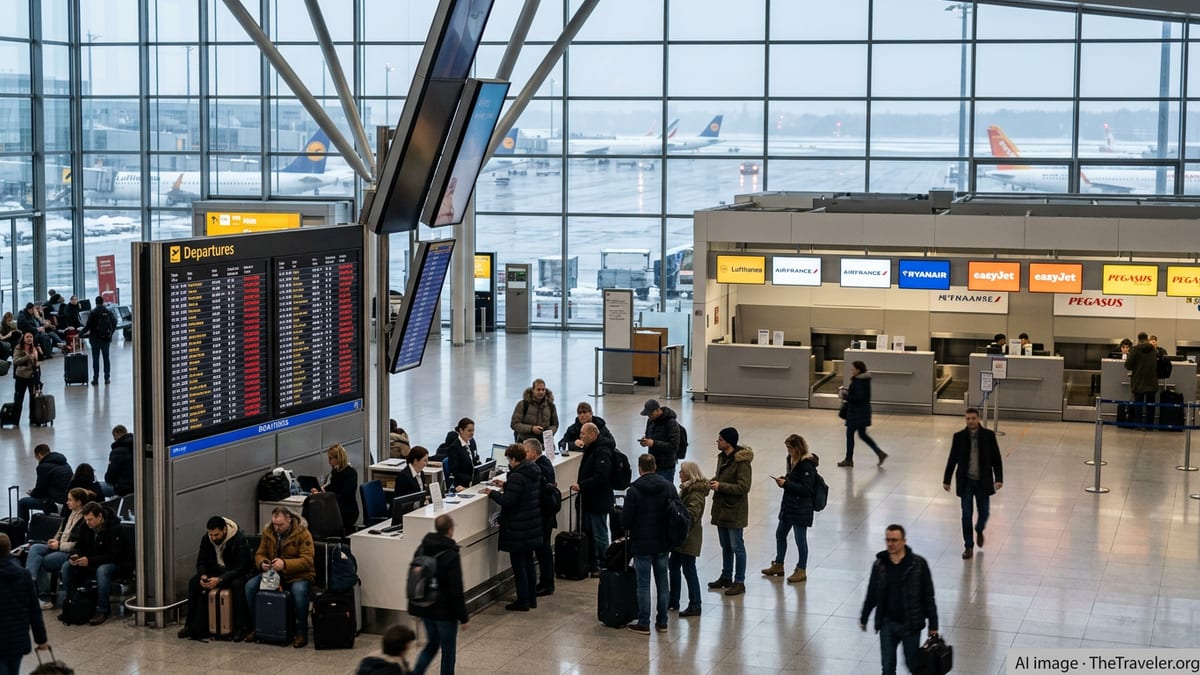
Germany Hit by Renewed Disruption at Frankfurt and Beyond
Germany is at the heart of the latest turmoil, with Frankfurt, Munich and Berlin Brandenburg reporting a sharp spike in cancellations and delays as industrial action and bad weather converge. Lufthansa, which remains the country’s dominant carrier, has been forced to cancel and consolidate hundreds of services over several days, affecting domestic links as well as routes to major European capitals.
The airline has activated a flexible rebooking policy for passengers scheduled to travel on affected dates in March, allowing changes without additional charges on many Germany and near-Europe routes. Travelers connecting through Frankfurt in particular are being urged to monitor their booking status closely and allow extra time, as knock-on effects are rippling into feeder flights serving cities such as Amsterdam, Brussels, Paris, Vienna and Warsaw.
Although other carriers such as Ryanair and EasyJet are not directly involved in the latest Lufthansa labor disputes, they are not immune from the wider operational pressure. Congested airspace, crew and aircraft rotations, and slot restrictions at major German hubs are causing secondary delays and schedule reshuffles for low cost and holiday airlines that rely on tight turnarounds.
The renewed disruption comes on top of a winter already marked by severe storms sweeping across northern and western Europe. Adverse conditions associated with recent named systems have repeatedly forced German airports to reduce runway capacity, compounding the impact of strikes and heightening the risk of rolling cancellations.
Belgium’s 24-Hour Strike Shuts Brussels Departures
In Belgium, a nationwide 24-hour strike on 12 March has brought commercial aviation to a near standstill. Brussels Airport has suspended almost all departing passenger flights for the day, while Brussels South Charleroi has closed to scheduled traffic, instantly wiping hundreds of services from the boards and stranding travelers across the network.
Airlines including Brussels Airlines, Ryanair and several leisure carriers that rely on Charleroi as a low cost hub have been forced to ground their Belgian departures or reposition aircraft elsewhere in Europe. With crews and planes out of place, the disruption is radiating into neighboring countries as operators scramble to salvage rotations for the following days.
The closure of such a central European gateway is sending shockwaves through the continent’s aviation system. Brussels functions as both a key transfer point and a major origin and destination airport for business and institutional travel linked to the European Union, and many passengers are now being rerouted via Frankfurt, Paris, Amsterdam and other hubs already under strain.
Travel experts warn that even after flights resume, irregular operations will persist while airlines work through aircraft imbalances, crew duty limits and passenger backlogs. Those with imminent bookings to or through Brussels are being advised to check for rebooked itineraries and consider rail alternatives for short haul journeys where practical.
France and Italy Battle Strikes, Storms and Saturated Hubs
France and Italy, two of Europe’s busiest aviation markets, are also grappling with a difficult mix of labor action and weather disruption. Air traffic control walkouts in France have forced airlines to cancel or reroute flights not only to and from French cities, but also many overflights that depend on French airspace, intensifying congestion across the region.
Air France has been trimming schedules on selected domestic and European routes, particularly around Paris, as controllers and other aviation workers stage recurrent stoppages. Low cost rivals EasyJet and Ryanair have also been heavily affected, with short haul services into Paris, Nice and other French gateways canceled or delayed, sometimes at short notice.
In Italy, winter storms and cross-border ripple effects have caused disruptions at major airports including Milan and Rome. Flag carrier ITA Airways has faced pressure on its operations, while international players such as Lufthansa, Air France and EasyJet have reported delays on key Italian routes. Travelers heading for popular city-break destinations are encountering longer queues, last-minute gate changes and sudden cancellations as crews and aircraft struggle to stay on schedule.
Analysts say the timing of the latest wave of problems is particularly painful for airlines, which are trying to rebuild capacity ahead of the spring and early summer travel season. Repeated schedule cuts and operational headaches risk denting consumer confidence just as forward bookings begin to ramp up.
Turkey and Pegasus Feel the Strain at Istanbul
Further east, Turkey’s aviation system is feeling the strain as Istanbul, one of Europe’s busiest international gateways, absorbs diversions and schedule changes linked to wider regional disruption. Carriers such as Turkish Airlines and Pegasus are managing a delicate balance between strong demand and weather-related and operational constraints at crowded airports.
Recent data on flight disruptions across Europe highlights Istanbul among the hubs recording significant numbers of delays and cancellations on peak days, with Pegasus listed among the airlines experiencing knock-on effects from storms and congestion. While many flights are still operating, the cumulative impact of small schedule changes is adding up for passengers connecting between Europe, the Middle East and beyond through Istanbul’s vast hub complex.
As in western Europe, winter weather has intermittently reduced runway capacity and led to de-icing delays, forcing airlines to prioritize certain long haul departures and rebook passengers from canceled short haul sectors. With aircraft and crews spread across multiple bases, even a modest number of cancellations can cascade into missed connections and rolling delays for travelers heading to secondary European cities.
Regional observers note that Istanbul’s position as a key east-west connector makes it especially sensitive to disruptions in multiple neighboring markets. Any turbulence in Germany, France or Italy tends to show up quickly in the schedules of Turkish and Pegasus flights linking those countries with Asia and the Middle East.
What Travelers Can Expect and How to Prepare
For travelers planning trips within or via Europe in the coming days, the current situation means a higher-than-normal risk of last-minute changes. Even if your airline is not directly involved in strikes, it may rely on airports, airspace and ground services affected by labor disputes or weather-related capacity cuts in Germany, Belgium, France, Italy or Turkey.
Experts recommend building additional flexibility into itineraries, including longer layovers at major hubs such as Frankfurt, Paris and Istanbul, and avoiding tight same-day connections to cruises, tours or major events. Where feasible, rail or coach alternatives can provide a useful backup on shorter routes, particularly between cities with strong high-speed train links.
Passengers flying on European carriers or departing from EU and EEA airports remain protected by the bloc’s air passenger rights rules, which set out minimum standards for care, rebooking and, in some circumstances, financial compensation when flights are canceled or heavily delayed. However, processing claims and securing alternative travel can still take time during widespread disruption.
With airlines and airports warning that operations may remain fragile through the late winter and early spring period, travelers are being encouraged to keep a close eye on their flight status, ensure contact details are up to date in booking profiles, and arrive at airports early in case of longer security and check-in lines triggered by rolling waves of cancellations.