

More news on this day
US airlines are lining up a wave of new international flights for summer 2026, with Seattle, Boston and Phoenix emerging as key launchpads for transatlantic and transpacific expansion.
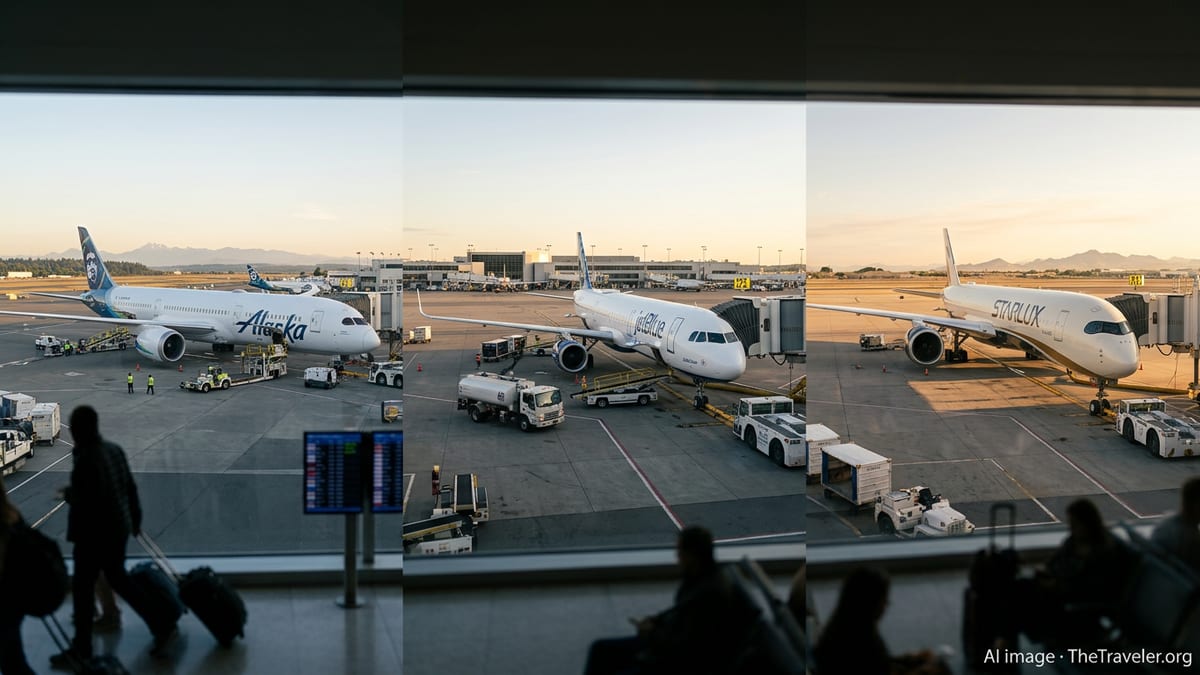
Seattle Emerges as a West Coast Gateway to Europe
Seattle-Tacoma International Airport is set for one of its most globally focused summers yet in 2026, as US carriers add new long-haul links to Europe alongside returning Asian service. Alaska Airlines will make its long-anticipated debut in the European market with a new seasonal nonstop to Rome Fiumicino, slated to begin in late April and operate through the peak summer period. The route, operated by Boeing 787-9 aircraft inherited through Alaska’s merger with Hawaiian Airlines, positions the Seattle-based carrier to compete directly with legacy transatlantic players while giving Pacific Northwest travelers a one-plane ride to Italy’s capital.
Alaska is also preparing a new summer seasonal link between Seattle and Keflavik, opening a nonstop connection to Iceland that is timed to capture peak demand for northern lights shoulder-season trips and summer escapes. The Iceland flight, operated by Boeing 737 MAX aircraft, will give Seattle-based passengers an additional one-stop gateway into continental Europe via onward connections, while reinforcing the airport’s role as a growing hub for mid-sized international markets.
International growth at Seattle in 2026 is not limited to US carriers. Hong Kong-based Cathay Pacific plans to restore its Seattle service from late March, returning a nonstop link to one of Asia’s key financial and aviation hubs. For American travelers, that resumption, coupled with Alaska’s new European routes, will significantly broaden long-haul options from the Pacific Northwest at the start of the summer 2026 travel season.
Boston Adds More Nonstops to Southern Europe
Boston Logan International Airport is also positioned for a busy summer 2026 on the international front, with US airlines extending the city’s reach into southern Europe. JetBlue has outlined plans to expand its transatlantic footprint from Boston with additional seasonal nonstops to Milan and Barcelona, deepening competition on two routes that have rapidly grown in popularity with New England travelers. The new services are designed to operate during the core summer months, when demand for leisure travel to Italy and Spain is strongest.
Those flights build on Boston’s existing role as a secondary transatlantic hub for several US and European carriers. By summer 2026, Logan is expected to have nonstop service from US operators to a mix of major European capitals and leisure destinations, giving Boston-origin passengers more options to bypass New York or other East Coast hubs. Frequency increases on key routes to Dublin and other northern European gateways are also planned, reflecting strong visiting-friends-and-relatives and tourism demand from the region.
The new flights are part of a broader strategy by US airlines to leverage Boston’s affluent catchment area and growing technology and life-sciences sectors. Airlines see an opportunity to serve both premium business demand and strong outbound leisure traffic, using narrowbody and mid-size widebody aircraft that are well suited to medium-haul transatlantic sectors. For travelers, the result in summer 2026 will be more nonstop options, more schedule choice, and increased competition on some of the most sought-after European city pairs.
Phoenix Secures a Long-Sought Nonstop Link to Asia
Phoenix Sky Harbor International Airport is preparing for a historic milestone in 2026, as Asian long-haul service arrives in time for the summer peak. Taiwan-based Starlux Airlines has announced plans to launch nonstop flights between Phoenix and Taipei, using Airbus A350 aircraft and giving the Arizona hub its first direct connection to Asia. Although operated by a foreign carrier, the route represents a major step for US travelers departing from the Southwest and fits into a wider pattern of US airlines and their partners extending long-haul reach beyond traditional coastal gateways.
The Phoenix–Taipei service is expected to begin in 2026, with schedules built around connections to and from other destinations in Asia via Starlux’s Taipei hub. For US passengers, the flight offers a new one-stop pathway to markets across East and Southeast Asia, reducing the need to connect through Los Angeles or San Francisco. It also underscores Phoenix’s growing stature as a Sun Belt mega-hub, where demand for both inbound tourism and outbound international travel continues to rise.
While US carriers have so far focused their Phoenix long-haul strategies on North American and Latin American markets, the arrival of transpacific capacity through a partner airline could incentivize code-sharing and loyalty integration. For summer 2026 travelers, the practical impact will be a new non-stop option to Asia from the desert Southwest, narrowing the gap between inland US hubs and the global connectivity of coastal gateways.
Network Strategies Behind the Summer 2026 Push
The summer 2026 route announcements from Seattle, Boston and Phoenix reflect a broader recalibration by US airlines as they refine their long-haul networks in the post-pandemic era. Rather than concentrating all growth in traditional superhubs, carriers are selectively adding international flights from strong secondary markets where demand, local economies and airport capacity align. Seattle’s combination of tech-driven corporate travel and outdoor-focused leisure demand, Boston’s affluent and internationally connected catchment, and Phoenix’s fast-growing population and tourism base all fit that profile.
At the same time, airlines are deploying new-generation aircraft that make thinner long-haul routes economically viable. Alaska’s 787-9 and 737 MAX fleet, for example, allows the carrier to test summer seasonal links such as Seattle–Rome and Seattle–Keflavik at manageable risk, with the option to adjust capacity as performance becomes clearer. Similarly, transatlantic narrowbodies used from Boston can serve cities like Milan or Barcelona with lower operating costs than older widebodies, supporting seasonal and shoulder-period flying.
For travelers planning summer 2026 vacations, these network shifts translate into more nonstops from home airports and more ways to avoid backtracking through larger, congested hubs. The Seattle–Europe additions open new itineraries for West Coast residents heading to Italy or Iceland, Boston’s European growth makes it easier for New Englanders to reach southern Europe directly, and Phoenix’s new Taipei link offers a fresh gateway to Asia from the American Southwest. With booking windows now open or expected to open in the coming months, the summer 2026 flying season is shaping up to be one of the most globally connected yet for these three US cities.