

More news on this day
In a landmark widebody deal that reshapes Vietnam’s aviation and tourism ambitions, Sun PhuQuoc Airways has ordered up to 40 Boeing 787 Dreamliners, positioning Phu Quoc Island to become one of Asia’s newest intercontinental leisure hubs.
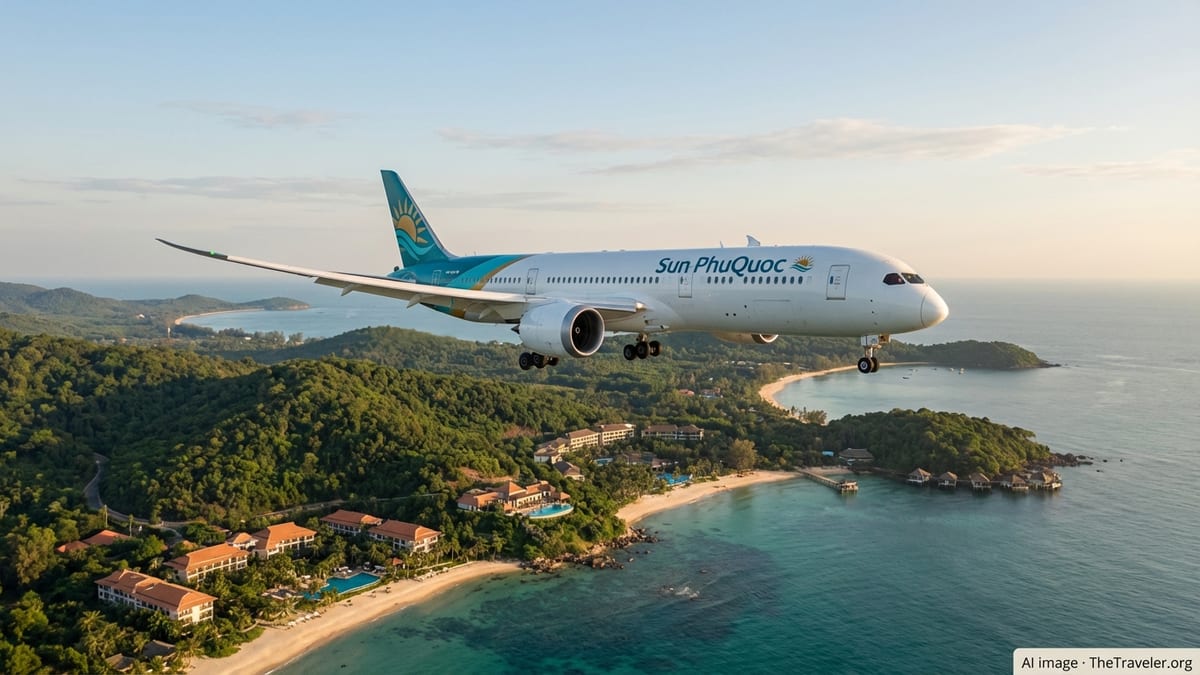
A Record-Breaking Dreamliner Deal for Vietnam
Announced in Washington, D.C. on February 18, 2026, the agreement between Boeing and Sun PhuQuoc Airways covers up to 40 787-9 Dreamliners, in what is being described as the largest Boeing widebody order ever placed by a Vietnamese carrier. Valued at around 22.5 billion dollars at catalogue prices, the move signals an aggressive push by the young airline to leapfrog into the ranks of serious long-haul players and cement Phu Quoc’s role on the global tourism map.
The order will form the backbone of Sun PhuQuoc’s future widebody fleet, complementing its existing narrowbody operations that began in late 2025. For Boeing, the deal deepens its presence in one of Asia’s fastest growing aviation markets and underscores the continued appeal of the 787 family as a long-range, fuel-efficient platform for emerging carriers.
Executives from both companies framed the purchase as more than a traditional fleet expansion. They cast it as a strategic investment in Vietnam’s broader tourism and economic future, where air connectivity, resort development, and destination branding are tightly interlinked. The announcement comes as regional competition intensifies, with nearby hubs in Thailand, Singapore, and Malaysia also vying for long-haul leisure traffic.
Phu Quoc’s Ambition: From Island Escape to Global Gateway
Phu Quoc, once known primarily as a laid-back island of fishermen and pearl farms off Vietnam’s southwest coast, has rapidly transformed over the past decade into a high-end tourism destination. Resorts, theme parks, golf courses, and entertainment complexes led by Sun Group and other developers have recast the island as a flagship for Vietnam’s luxury leisure offering.
Until now, however, much of Phu Quoc’s growth has depended on regional and domestic flights, with international visitors typically connecting via Hanoi, Ho Chi Minh City, or other Asian hubs. The 787 order is designed to change that dynamic by enabling nonstop services from key cities in Europe, North America, and Northeast Asia directly into Phu Quoc, shortening travel times and simplifying itineraries for high-value tourists.
By anchoring its growth strategy in a single island hub, Sun PhuQuoc Airways is pursuing what it calls a “resort aviation” model. The concept tightly integrates air transport with a curated network of hotels, attractions, and experiences on the ground, positioning the airline not only as a carrier but as a gateway to a complete holiday ecosystem. Phu Quoc’s future identity as a global gateway rather than just a regional beach escape rests heavily on whether that model can scale internationally.
Inside the Deal: 787-9s as the Workhorse of a New Network
At the center of the order is the Boeing 787-9, the mid-sized variant of the Dreamliner family. With a range of roughly 14,000 kilometers and typical seating for close to 300 passengers in a two-class configuration, the 787-9 is widely used by airlines to open thinner long-haul routes that would be uneconomical for larger widebodies.
For Sun PhuQuoc Airways, that capability is crucial. The carrier is expected to deploy the aircraft on nonstop links from Phu Quoc to major tourism and economic centers across Asia, as well as select cities in Europe and North America. Industry observers suggest that likely early targets could include key markets in Northeast Asia and major European capitals, followed by North American gateways as brand awareness and demand grow.
The Dreamliner’s combination of fuel efficiency, composite construction, and advanced aerodynamics is also central to the airline’s business case. The 787-9’s economics allow Sun PhuQuoc to experiment with new city pairs and seasonal schedules while keeping operating costs under tighter control. Lower fuel burn per seat and extended range could prove especially important as the airline navigates volatile fuel prices and intensifying competition in long-haul leisure travel.
Transforming Vietnam’s Fast-Growing Aviation Landscape
The Sun PhuQuoc order arrives at a time when Vietnam’s aviation market is expanding at one of the fastest rates in Southeast Asia. Forecasts point to annual passenger growth approaching high single digits over the coming years, supported by rising incomes, a young population, and the country’s growing profile as both a manufacturing base and a tourism hotspot.
Until recently, widebody, long-haul operations from Vietnam were dominated by the national flag carrier on routes to Europe, Australia, and North Asia. The arrival of a second player with a large, modern long-haul fleet centered on a leisure destination marks a notable shift. It suggests a future in which Vietnam will not only connect its main cities to the world, but also export its island and coastal resorts as standalone long-haul destinations.
The deal also strengthens aviation ties between Vietnam and the United States at a politically significant moment. The signing took place during a high-level Vietnamese delegation’s visit to Washington, signaling both economic and diplomatic confidence. For Boeing, landing a major widebody order from a rising private airline in Vietnam provides a showcase example of how its 787 family can underpin new tourism-oriented carriers in emerging markets.
“Resort Aviation” and Sun Group’s Integrated Tourism Play
Sun PhuQuoc Airways is backed by Sun Group, one of Vietnam’s most prominent private conglomerates in real estate, tourism, and entertainment. The airline is effectively the air transport arm of a wider resort and attractions network that spans hotels, theme parks, cable cars, golf courses, and residential developments on Phu Quoc and beyond.
By aligning its fleet strategy with that broader ecosystem, the airline aims to capture value from travelers at multiple stages of their journey, from booking flights and accommodation to experiencing curated tours and attractions. In practice, this means bundled holiday products, coordinated schedules with resort check-in times, and seamless ground transfers that together blur the lines between airline, tour operator, and hospitality provider.
Analysts say that if executed well, this integration could give Sun PhuQuoc a competitive edge over purely point-to-point carriers. The airline can use its control of both the “metal” and the destination infrastructure to manage seasonality, design promotional campaigns, and shape demand flows. However, it also raises the stakes. Any weakness in service quality, schedule reliability, or infrastructure readiness on the island could ripple across the entire tourism value chain.
New Routes, New Markets: Who Will Fly to Phu Quoc?
The scale of the Dreamliner commitment underscores Sun PhuQuoc’s confidence that there is substantial untapped demand for long-haul leisure travel to the island. The airline is expected to target several key segments. These include European and North American holidaymakers seeking an alternative to more established beach destinations such as Phuket, Bali, and the Maldives, as well as affluent travelers from Northeast Asia and India looking for premium resort experiences in Southeast Asia.
Direct long-haul connectivity is particularly important for high-spend visitors who value time savings and seamless itineraries. Nonstop flights mean travelers can step onto a plane in cities such as Seoul, Tokyo, or Paris and arrive directly in Phu Quoc without transiting through traditional hubs. This not only enhances convenience but also bolsters the island’s brand positioning as a destination worth a dedicated trip rather than a side excursion.
At the same time, Sun PhuQuoc’s domestic and regional network will play a vital role in feeding these long-haul services. Connections from Hanoi, Ho Chi Minh City, Da Nang, and other Vietnamese cities, along with regional links across Asia, will help fill Dreamliner seats year-round. The challenge will be balancing inbound tourism flows with outbound demand and ensuring that traffic from multiple markets aligns with the airline’s planned capacity ramp-up.
Economic Ripple Effects for Phu Quoc and Vietnam
Beyond airline economics, the 787 order is poised to have far-reaching implications for Phu Quoc’s local economy and Vietnam’s broader development goals. Increased long-haul access typically drives higher-spend tourism, spurring investments in luxury accommodation, dining, retail, and cultural attractions. The island’s hospitality industry is already preparing for a new wave of visitors with additional rooms, villas, and entertainment offerings aimed at international guests.
Job creation is another key outcome. Expanded flight operations will require more pilots, cabin crew, ground staff, and maintenance technicians, while tourism growth will support employment in hotels, restaurants, transport, and tour services. Training pipelines and partnerships with local educational institutions are expected to become a major focus as Sun PhuQuoc scales toward its stated ambition of operating around 100 aircraft by the end of the decade.
On a national level, successful development of Phu Quoc as a long-haul hub could help diversify Vietnam’s tourism portfolio beyond its established city and heritage destinations. It would also reinforce the country’s narrative as an open, globally connected economy seeking deeper trade and investment ties, particularly with partners in North America and Europe that will be central to the new route map.
Infrastructure, Sustainability, and the Road Ahead
Realizing the full potential of the Dreamliner order will depend heavily on infrastructure readiness. Plans for an expanded or newly configured Phu Quoc International Airport, including upgraded terminals, runways, and support facilities, are seen as critical. Handling a large fleet of long-haul widebodies will require enhancements in ground handling capacity, air traffic management, and passenger processing to avoid congestion and protect the island’s visitor experience.
Sustainability concerns are also in sharp focus as global scrutiny of aviation’s environmental impact intensifies. While the 787-9 offers significant fuel-efficiency gains compared with older widebodies, adding 40 long-haul aircraft will inevitably raise questions about emissions and the long-term environmental footprint of mass tourism on a relatively small island. Sun PhuQuoc and its partners are expected to face pressure to invest in carbon mitigation, sustainable aviation fuel partnerships, and careful management of local ecosystems.
For now, the announcement marks a bold statement of intent. In just a few years, a start-up airline bearing the name of a Vietnamese island has gone from domestic launch to signing one of the country’s most ambitious aircraft orders. If Sun PhuQuoc Airways can convert its Dreamliners into full cabins and loyal repeat visitors, Phu Quoc may soon find itself not only on more world maps, but competing head-on with some of the world’s best known resort destinations.